Top 5 Benefits of Acemannan for Energy Levels
Acemannan is a slow-acting support that may smooth blood sugar, gut and immune factors for steadier daily energy, not a stimulant.


If you want steadier energy without a stimulant, acemannan may help - but the research is still early.
From what I see in the article, the main idea is simple: acemannan does not give a fast jolt like caffeine. Instead, it may help support energy in five indirect ways:
- Blood sugar balance may help cut post-meal crashes
- Mitochondrial support may help cells make energy more smoothly
- Gut health may help the body get more from food
- Immune balance may help ease inflammation-linked tiredness
- Metabolic support may help daily energy feel more even
One human trial lasted 8 weeks and included 75 healthy adults, but much of the rest of the research is still from lab and animal work. So the best way I’d frame this is: acemannan may support steadier day-to-day energy over time, but it is not a proven fix for low energy.
Quick Comparison
| Area | How it may help energy | Research status |
|---|---|---|
| Blood sugar | May slow sugar release after meals | Early / mechanistic |
| Mitochondria | May lower oxidative stress in cells | Preclinical |
| Gut health | May feed gut bacteria and support SCFAs | Early / mechanistic |
| Immune balance | May shift signals toward lower inflammation | Early human + preclinical |
| Metabolism | May support steadier fuel use | Preclinical |
If I had to sum up the whole article in one line, it would be this: acemannan looks more like a slow-burn support tool than a quick energy booster.
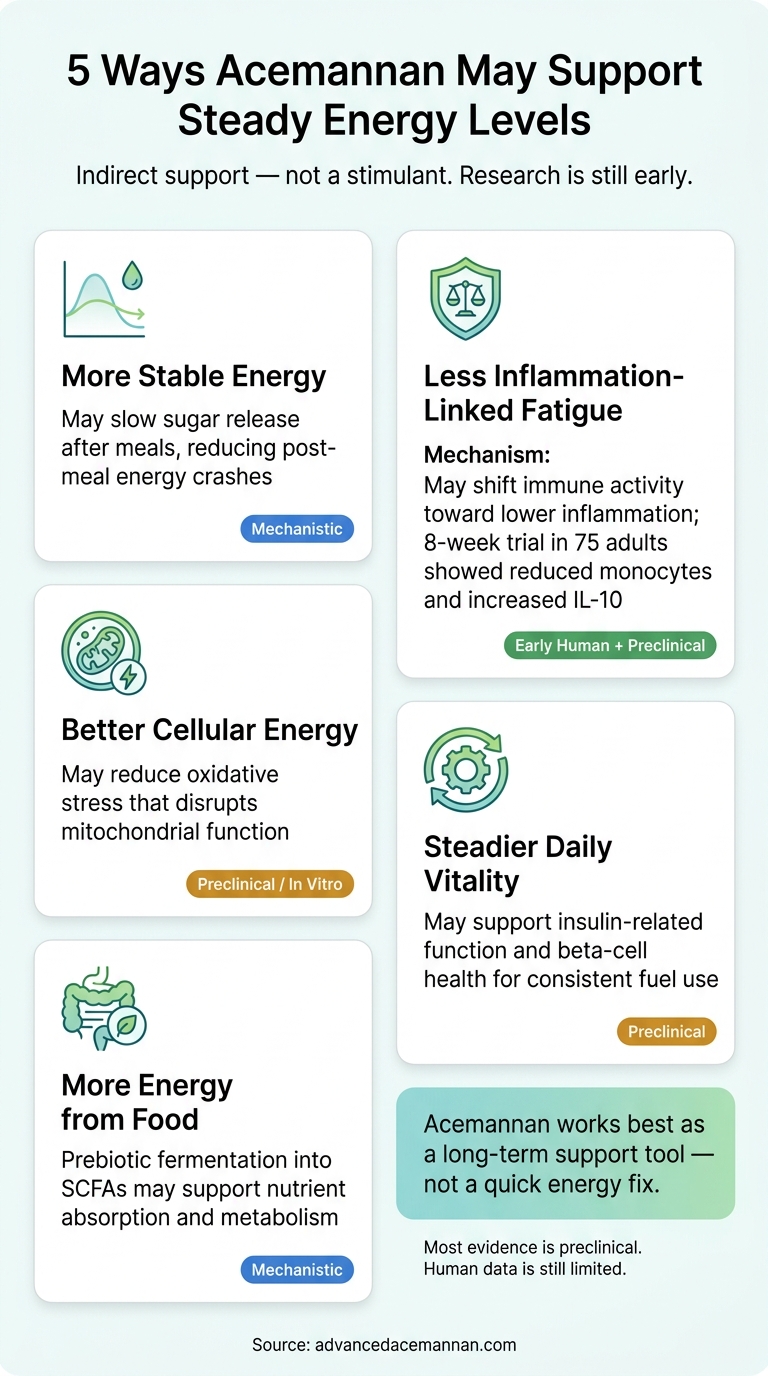
5 Ways Acemannan May Support Steady Energy Levels
How Acemannan May Affect Energy Levels
Acemannan does not work like caffeine. It doesn't give you a direct jolt. Instead, it may support energy in a more indirect way by helping metabolic function across a few linked pathways.
One of the main ideas here is blood sugar stability. When blood sugar jumps and then drops, energy can dip with it. Acemannan may help ease those swings, which could help limit the crashes that leave people feeling drained.
The pathways below show how that support may show up in day-to-day energy:
| Pathway | Mechanism | Potential Energy Benefit |
|---|---|---|
| Glycemic Control | May slow carbohydrate breakdown | Helps prevent energy crashes |
| Cellular Health | Scavenges free radicals; protects against oxidative stress | Supports mitochondrial efficiency |
| Gut Health | Fermented into short-chain fatty acids (SCFAs) | May support energy production |
| Immune Balance | Supports a less inflammatory immune response | May reduce fatigue linked to chronic inflammation |
That said, it's worth keeping expectations in check. Most of the research so far is preclinical, so these should be viewed as possible effects, not proven ones. As researchers Nicholas J. Sadgrove and Monique S. J. Simmonds of the Royal Botanic Gardens, Kew, note:
"Due to contradictory results in the literature, further research is required to provide scientific evidence to confirm or nullify these claims."
So far, these proposed benefits come mostly from in vitro and animal studies.
1. More Stable Energy Through Balanced Blood Sugar
One way acemannan may affect energy is by helping keep blood sugar more even after meals. That matters because when glucose hits the bloodstream too fast, energy can feel a bit like a roller coaster. Acemannan may help smooth that curve by slowing glucose release. It resists digestion in the small intestine, which means it reaches the colon intact.
What happens next in the gut may matter too. In the colon, gut microbes ferment acemannan into short-chain fatty acids. Those compounds may support satiety and a steadier rise in blood sugar after meals. Preclinical studies also suggest acemannan may help protect pancreatic beta cells from stress. If that helps preserve normal insulin-related function, it could support steadier energy over time.
These pathways are still mostly preclinical, but they point in the same direction.
| Mechanism | What It Does | Evidence Level |
|---|---|---|
| Slower sugar release | Slows glucose absorption after meals | Mechanistic |
| SCFA production | Supports satiety and steadier blood sugar | Mechanistic |
| Beta-cell protection | May help protect pancreatic cells from stress | Preclinical |
2. Better Cellular Energy Through Mitochondrial Support
Building on blood sugar balance, acemannan may also help with energy production at the cellular level. Cells produce energy in the mitochondria, and acemannan may support this process by lowering oxidative stress that can disrupt mitochondrial structures.
That kind of protection may help maintain mitochondrial function, which matters because this is where cells make energy. Part of acemannan's activity comes down to acetylation. Higher acetylation appears to help preserve acemannan's protective effect. In plain English, mitochondrial protection looks like the main link between acemannan and more stable day-to-day energy.
Acemannan may do more than act as an antioxidant. It may also affect energy-sensing and cell-survival pathways that help cells use energy and handle stress.
| Factor | Impact on Mitochondrial Support |
|---|---|
| Antioxidant activity | Reduces oxidative damage to mitochondrial structures |
| Metabolic signaling | Energy-sensing pathways support cellular energy use |
3. More Energy Available Through Gut Health and Nutrient Absorption
Acemannan may help with energy by helping the gut work better and by helping the body get more out of food. That matters because your gut plays a big part in how much usable energy you can pull from what you eat.
As a prebiotic, acemannan may help feed beneficial gut bacteria. Those microbes ferment it into short-chain fatty acids, which the body can use and which may help support energy metabolism.
Acemannan may also help the gut barrier itself. It may support the gut lining, and that can help the body absorb nutrients more efficiently.
There’s another angle here too. Acemannan slows sugar release from starches during digestion, which may help cut down on those after-meal energy dips.
Because this gut-related effect is prebiotic, steady intake matters more than using it once in a while. At the same time, most of the evidence is still preclinical, and human data are still limited.
4. Less Fatigue Through Immune Modulation and Inflammatory Balance
Chronic low-grade inflammation can wear you down. When the immune system stays slightly switched on, it uses up energy the body would rather spend on focus, movement, and recovery. Over time, that can leave you feeling more drained than you should. Acemannan may help tilt immune activity toward a less inflammatory state, which could leave more of the body's resources available for daily function instead of constant immune upkeep.
There’s some early human data behind that idea. In an 8-week randomized trial of 75 healthy adults, the higher acemannan-rich dose lowered monocytes, which can climb during chronic inflammation, and increased IL-10, a cytokine that helps limit inflammation-related damage.
That said, most of the mechanism data still comes from preclinical work. So while the theory makes sense, the connection to lower day-to-day fatigue in healthy adults hasn’t been proven yet. The same shift in immune balance may also help support more efficient daily metabolism.
sbb-itb-b88dd21
5. Better Metabolic Efficiency and Daily Vitality
Beyond blood sugar, gut, and immune support, acemannan may also help the body use energy more efficiently. It doesn't work like caffeine. There’s no stimulant effect here. Instead, its role appears to be at the metabolic level - helping support the systems that keep metabolism moving through the day, rather than pushing a short burst of energy.
Its prebiotic activity may play a part here. By feeding gut microbes, acemannan may support metabolic efficiency, which could lead to steadier energy and less of that mid-afternoon slump instead of a spike-and-crash effect.
There’s also an antioxidant side to this. Acemannan's sustained radical clearance activity may help protect cells from oxidative stress, which can get in the way of efficient energy use.
At the same time, this part of the research is still taking shape. A lot of the current evidence comes from in vitro work and animal models, and some reviews point out mixed findings in the literature.
The table below sums up the main metabolic pathways.
| Mechanism | Potential Benefit | Evidence Level |
|---|---|---|
| Prebiotic fermentation | Supports metabolic efficiency and steadier energy | Mechanistic |
| Antioxidant activity | Protects cells from oxidative stress | Preclinical / In vitro |
Comparison Tables for Key Sections
The tables below lay out five ways acemannan may help support steadier energy. Think of this as the quick-scan version before getting into the research details below.
| Mechanism | Main Energy Benefit | Evidence Level |
|---|---|---|
| Blood Sugar Balance | Slows starch-to-sugar conversion; less post-meal energy drift | Mechanistic |
| Mitochondrial Support | Stronger antioxidant support; better cellular energy | Preclinical / In vitro |
| Gut Health | Prebiotic fermentation into SCFAs; better gut lining support and nutrient uptake | Mechanistic |
| Immune Modulation | Shift toward less inflammatory immune activity; lower inflammation signals | Preclinical / Early human |
| Metabolic Efficiency | May support insulin-related function and beta-cell health for steadier daily energy | Preclinical |
The research highlights below make it easier to see where the evidence is strongest and where the science is still early.
Research Highlights and Practical Context
Most of the evidence behind acemannan's energy-related effects falls into four main areas: glycemic control, cellular energy support, gut fermentation, and inflammatory signaling.
The clearest signal comes from blood sugar regulation. In preclinical models, including diabetic mice, acemannan has been linked to lower fasting glucose and better glucose control.
Gut fermentation adds another piece to the puzzle. In the colon, acemannan is fermented by microbes into short-chain fatty acids (SCFAs). The body then absorbs these compounds, and they help with energy metabolism and satiety. Mechanistic studies also suggest that acemannan affects the AKT/mTOR and PI3K/Akt/GSK-3β signaling pathways, which play a central role in cellular growth, metabolism, and energy regulation.
Inflammation may matter just as much for day-to-day energy. On that side, acemannan has been shown to inhibit NF-κB activation and the JAK2/STAT3 signaling pathway. In plain English, that points to support for immune balance rather than immune overactivation.
That said, most of these findings are still preclinical. So while the current evidence points to acemannan as a supportive nutraceutical, the human data is still limited.
Conclusion
Put all five benefits together, and one idea stands out: steadier energy, not a jolt of stimulation.
Acemannan may help support energy in indirect ways. It may help keep blood sugar more stable, support gut function, lower inflammatory load, and help the body use fuel more efficiently.
That matters because low energy often doesn't come from just one issue. More often, it's a mix of small imbalances happening at the same time. In day-to-day terms, acemannan's main energy upside seems to be steadier digestion and slower sugar release.
Any deeper effect is more likely to show up with steady use over time, not overnight. So it's best to think of acemannan as a long-term support option for steadier energy, not a quick fix.
For more research-focused context, visit Advanced Acemannan.
FAQs
How long does acemannan take to affect energy?
When you take acemannan by mouth, gut microbes break it down first. From there, it can show up in the bloodstream in as little as 90 minutes.
Once it’s in circulation, it travels to organs like the liver, spleen, and brain. There, it helps support cellular metabolism and energy production by improving nutrient uptake and the removal of toxins.
Can acemannan help with afternoon energy crashes?
Yes, acemannan may help reduce afternoon energy crashes by supporting steadier metabolic responses.
Research suggests it can lower post-meal glucose levels and slow the release of sugars from starches. In plain English, that may help keep energy more even after you eat instead of giving you a sharp spike followed by a slump.
It may also slow digestion and increase satiety. That can help manage hunger and may reduce fatigue tied to post-meal blood sugar swings.
Who may benefit most from acemannan for energy?
Acemannan may help people who want to support metabolic health and keep a healthy energy balance. It may do this by helping regulate blood sugar and lipid levels.
It may also help with digestive health, satiety, immune function, and overall vitality. That includes day-to-day mental sharpness, such as concentration and memory.