From Harvest to Finished Product: How Cold Processing Helps Preserve Acemannan in Aloe Vera
Verify acemannan preservation in aloe by checking batch CoAs, temperature/exposure logs, and finished-product test results.

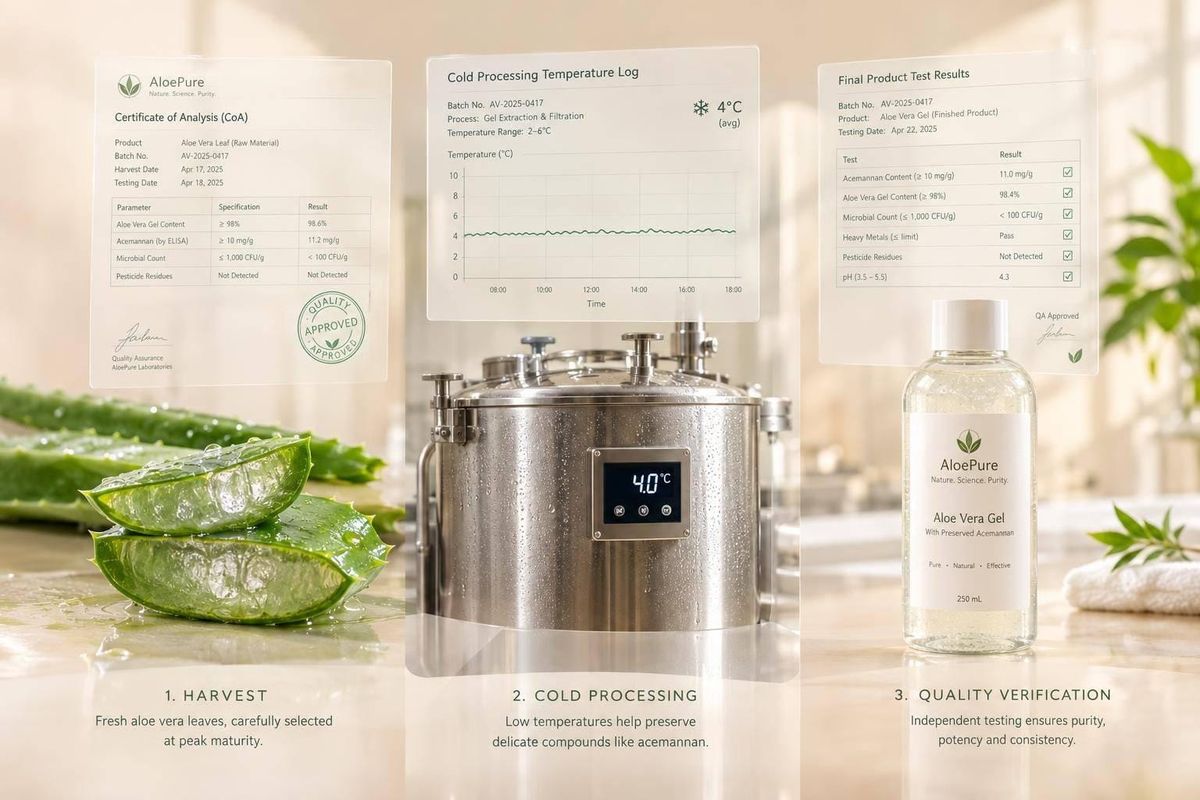
Cold processing can help protect acemannan - but I’d check the batch results, not just the label. Ask for temperature and handling-time records plus a Certificate of Analysis (CoA) that matches your product’s lot number.
Here’s what I look for:
- Heat control from harvest to packaging: Check extraction, stabilization, concentration, drying, and cooling. A limit such as 104°F (40°C) needs process validation; it isn’t a universal cutoff.
- Finished-product testing: Confirm acemannan identity, amount, acetylation, and molecular-weight distribution - not just an aloe percentage.
- Safety and storage checks: Review microbial results, impurities, any solvent residues, and shelf-life testing in the intended packaging.
My rule: <u>match each label claim to measured results</u>. “Cold processed” alone doesn’t prove preservation, and preserved acemannan isn’t proof that a product works as a treatment.
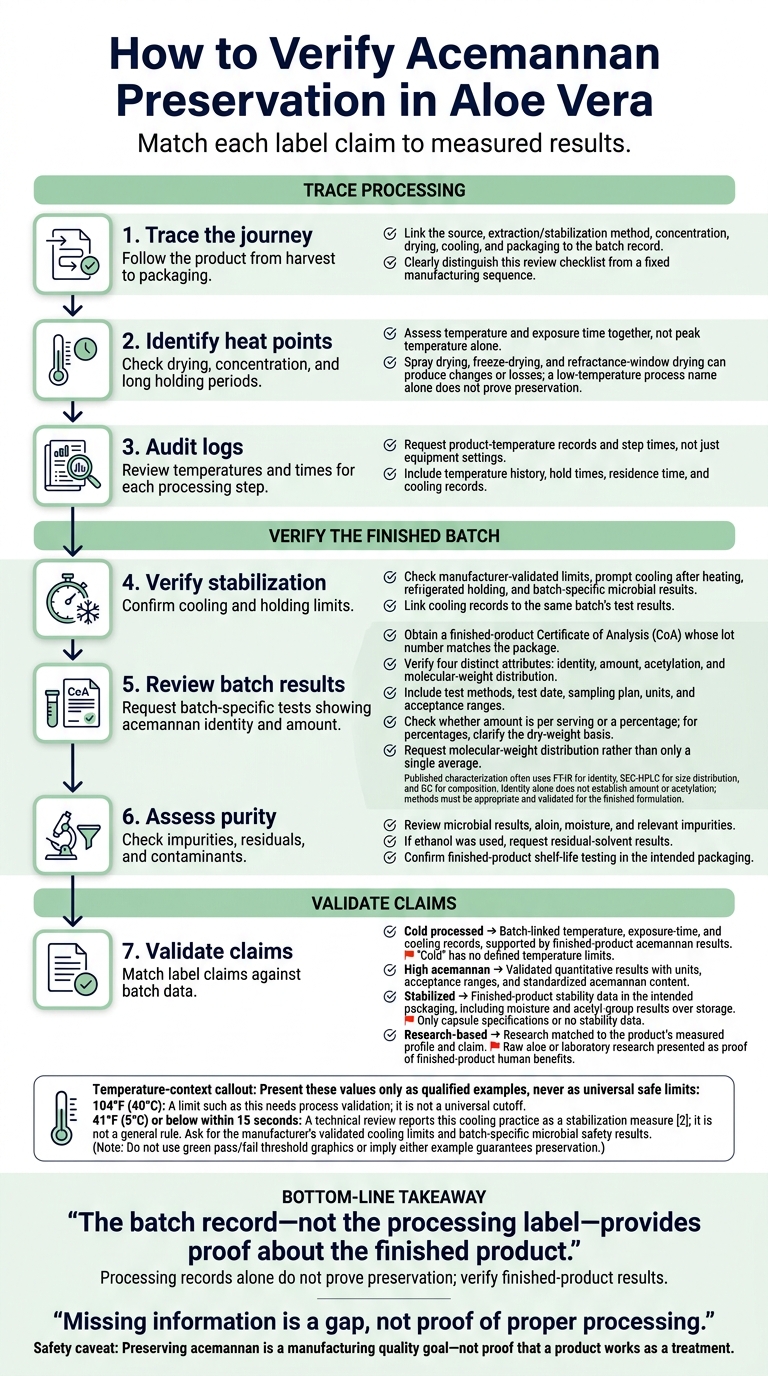
How to Verify Acemannan Preservation in Aloe Vera
Extract and Stabilize Gel With Controlled Heat
Use Chilled Handling and Validated Stabilization
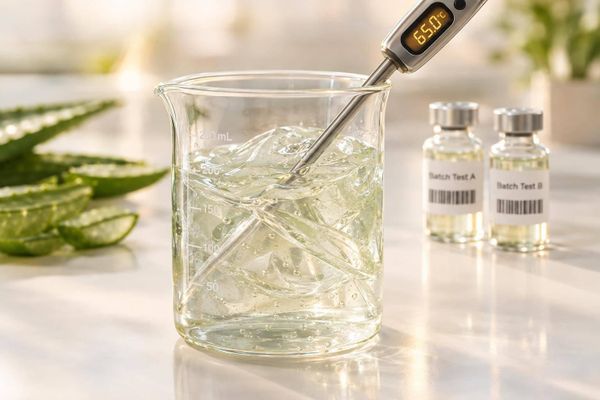
After extraction, chilled filtration helps control heat exposure. Keep temperatures within validated limits, record them for each batch, and maintain those controls through stabilization.
Use the lowest validated heat during stabilization to protect acemannan’s acetyl groups. Stabilize and package promptly to limit moisture loss. Record acemannan results after filtration for each batch, backed by third-party testing for every batch.
Assess Temperature and Exposure Time Together
Keep temperature controls in place through concentration and drying. Acemannan is sensitive to heat damage. Processing can remove acetyl groups or break down the molecule, so assess temperature and exposure time together, rather than peak temperature alone.
High-heat drying and aggressive concentration can alter acemannan. Request testing after concentration and drying, then confirm the final batch result. Include these processing records and test results in the finished-product review to support preservation claims.
sbb-itb-b88dd21
Limit Heat During Concentration and Drying
Once the gel is stabilized, concentration and drying are the next steps where heat needs close control.
Control Holding Time and Cooling
Treat extended holding, concentration, drying, and cooling after heating as separate checkpoints. Request product-temperature records and step times, not just equipment settings.
Keep product temperature and residence time tightly controlled during concentration and drying. Use refrigerated holding and low-heat concentration, with documented time limits. Cool promptly after heating.
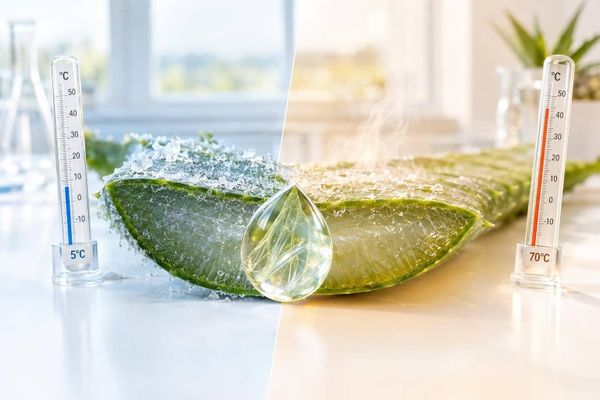
A technical review reports cooling aloe juice to 41°F (5°C) or below within 15 seconds as a stabilization measure.
That’s a reported practice, not a general rule. Ask for the manufacturer’s validated cooling limits and batch-specific microbial safety results. Link the cooling record to that batch’s test results.
Compare Processing Methods and Testing Needs
A processing name doesn’t tell you how much heat the product experienced - or for how long. Use the table below to check what each processing disclosure should include.
| Process step | Heat exposure | Risk | Manufacturer evidence to request |
|---|---|---|---|
| Chilled handling | Refrigerated holding; duration still matters | Delays or temperature drift | Temperature logs, hold times, microbial results |
| Short thermal treatment | Brief heating followed by cooling | Excess heat exposure affecting acetylated chains | Product temperature, treatment time, cooling records |
| Concentration | Varies with conditions and residence time | Long-chain damage | Temperature history, residence time, acemannan results |
| Spray drying | Heat during drying | Structural damage or acetyl-group loss | Drying records, finished polysaccharide testing |
| Freeze-drying | Low-temperature drying | Structural changes or losses | Cycle records, finished acemannan testing |
Studies report changes or losses with spray drying, freeze-drying, and refractance-window drying. Request finished-product results for acemannan content and polysaccharide profile. A low-temperature process name alone doesn’t prove preservation.
Verify Acemannan in the Finished Product
The batch record - not the processing label - provides proof about the finished product.
Request Processing Records and Batch Results
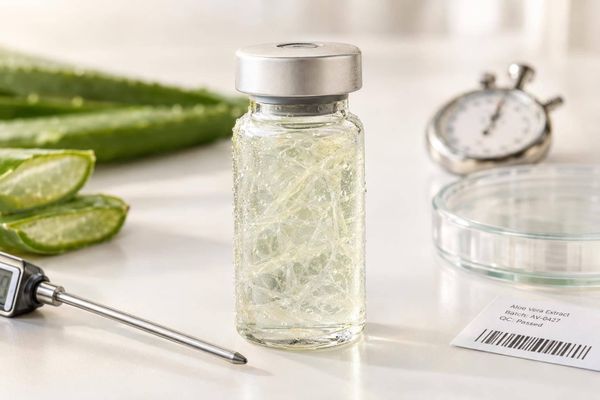
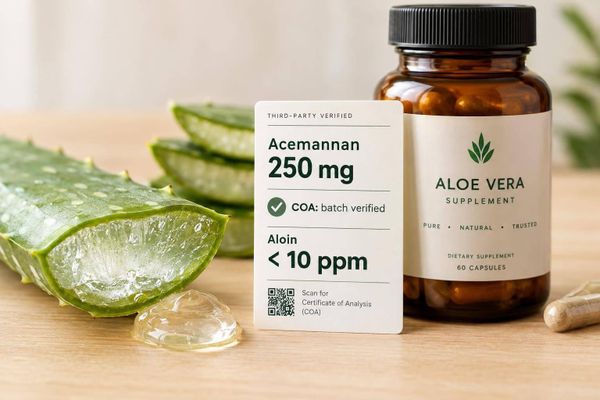
Ask for a batch-specific Certificate of Analysis (CoA) for the finished product, not a generic spec sheet. Check that its lot number matches the package. The CoA should report acemannan identity, amount, acetylation, and molecular-weight distribution. It should also include test methods, the test date, sampling plan, and acceptance ranges.
Match the CoA to the batch record, including the source, extraction/stabilization method, temperature history, exposure time, cooling, and drying. If the process used ethanol, request residual-solvent results. Ask for relevant aloin, moisture, and impurity results, too. Processing records alone don’t prove preservation.
Check Test Methods and Acceptance Ranges
With the CoA in hand, ask what each test measures. Published characterization often uses FT-IR for identity, SEC-HPLC for size distribution, and GC for composition. An identity result alone doesn’t establish amount or acetylation.
If the report includes RP-HPLC, loss-on-drying, or impurity testing, ask which attribute each test measures and whether the method is validated for the finished formulation. Request a separate acetylation result. Don’t accept “native structure” in place of a measured result.
Every result needs units and an acceptance range. Ask whether the amount is reported per serving or as a percentage. If it’s a percentage, check whether it’s based on dry weight. Request the molecular-weight distribution and its acceptable range - not just a single average. Generic aloe percentages don’t establish acemannan preservation.
Match Label Claims to Supporting Data
For “stabilized,” request finished-product shelf-life data in the intended packaging. Capsule specifications alone don’t prove acemannan preservation.
Check label claims against the CoA and stability data, rather than relying on the process name. Each claim needs the supporting evidence below.
| Claim | Evidence that supports it | Red flag |
|---|---|---|
| Cold processed | Batch-linked temperature, exposure-time, and cooling records, supported by finished-product acemannan results | “Cold” has no defined temperature limits |
| High acemannan | Validated quantitative results with units, acceptance ranges, and standardized acemannan content | Generic aloe percentages or missing batch results |
| Stabilized | Finished-product stability data in the intended packaging, including moisture and acetyl-group results over storage | Only capsule specifications or no stability data |
| Research-based | Research matched to the product’s measured profile and claim | Raw aloe or laboratory research presented as proof of finished-product human benefits |
Conclusion: Confirm Preservation With Records and Testing
Cold processing matters only when records document validated temperature limits, exposure times, and batch-specific acemannan results. Preserving acemannan is a manufacturing quality goal - not proof that a product works as a treatment.
Review a Product in 7 Steps
Use this checklist to review any finished aloe product.
- Trace the journey: Follow the product from harvest to packaging.
- Identify heat points: Check drying, concentration, and long holding periods.
- Audit logs: Review temperatures and times for each processing step.
- Verify stabilization: Confirm cooling and holding limits.
- Review batch results: Request batch-specific tests showing acemannan identity and amount.
- Assess purity: Check impurities, residuals, and contaminants.
- Validate claims: Match label claims against batch data.
If the records, test results, and label don't match, the claim is unverified. Missing information is a gap, not proof of proper processing.
FAQs
How much acemannan should I look for per serving?
Look for acemannan content listed in milligrams (mg) per serving or as a percentage of dry weight - not total aloe weight or extract ratios such as 200:1. For raw materials, 5% acemannan by dry weight is a common benchmark, while 10% is often considered satisfactory.
Check whether the results use an as-is or dry basis. Also, confirm that a batch-specific Certificate of Analysis from an ISO/IEC 17025 accredited laboratory supports those results.
Can acemannan degrade after I open the product?
Yes. Acemannan can degrade after opening if exposed to heat, moisture, or poor storage conditions. These conditions can affect its structure, including its acetyl groups.
Keep the product tightly sealed in a cool, dry place away from sunlight. Avoid storing it on countertops or in humid bathrooms. Follow the label’s storage instructions and “use after opening” timeframe.
What if the manufacturer won’t share batch results?
A “cold-processed” label isn’t enough if the manufacturer won’t share batch results. Ask for a lot-specific certificate of analysis (COA) that matches the lot number on your bottle. It should include:
- Numerical acemannan results with units
- The lab’s name and ISO/IEC 17025 accreditation
- The test method, such as NMR, HPLC, or AOAC Official Method 2018.14
- Sample-collection and test dates
- Testing of the finished product - not just the raw input
If the manufacturer can’t provide this documentation, put the purchase on hold.