Preserving What Matters: Why Processing Temperature Is Critical to Acemannan Integrity
How processing temperature affects acemannan acetylation, molecular size, and safety—why batch testing beats labels.

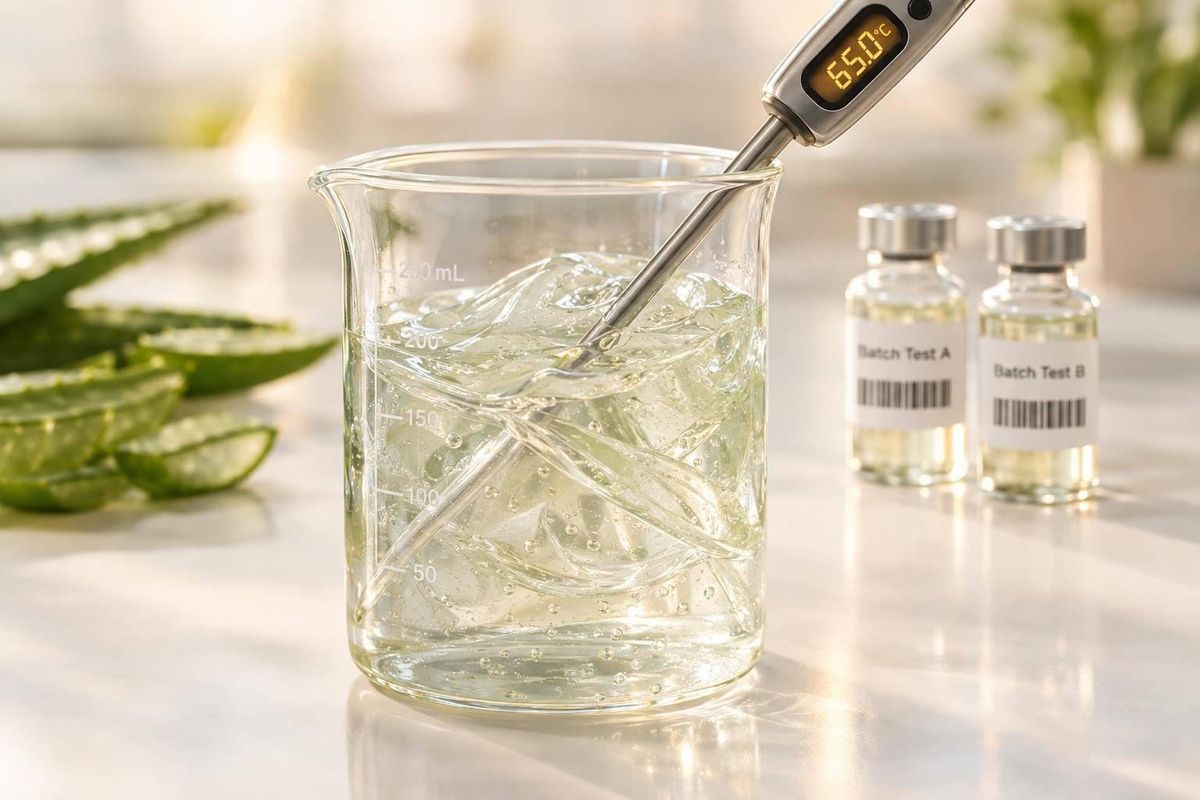
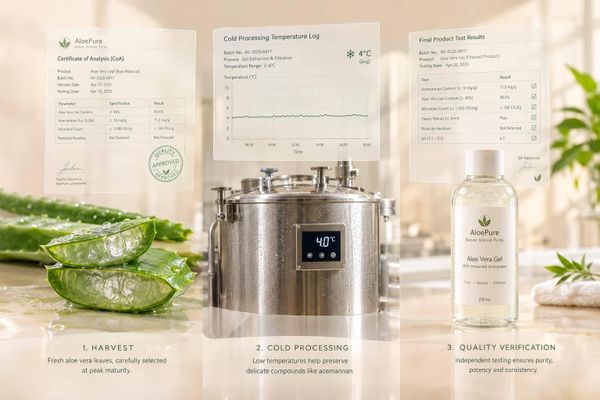
I look for batch test results - not a “cold-processed” label - to judge acemannan preservation. Ask for product temperatures, exposure times, and finished-batch tests for acemannan content, acetylation, molecular size, and microbial safety.
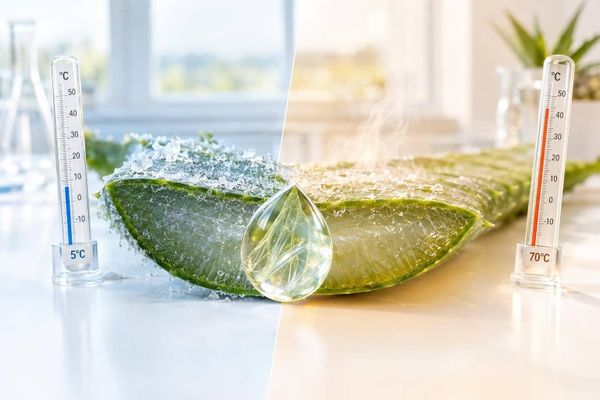
Why? Reported deacetylation was about 14% at 140°F (60°C) versus more than 46% at 176°F (80°C) or higher under the conditions studied - not universal limits.
Here’s how I compare the options:
- Lower-temperature processing: May limit structural damage, but still needs validated microbial controls.
- Heat-intensive processing: Can support microbial control and drying, but may change acemannan’s structure.
- Freeze-drying: Avoids sustained high heat, but does not guarantee preserved acetylation or safety.
Across all three, I check time, product temperature, drying conditions, and finished-batch results. <u>Content alone does not prove intact structure</u> - and intact structure does not prove a health effect.
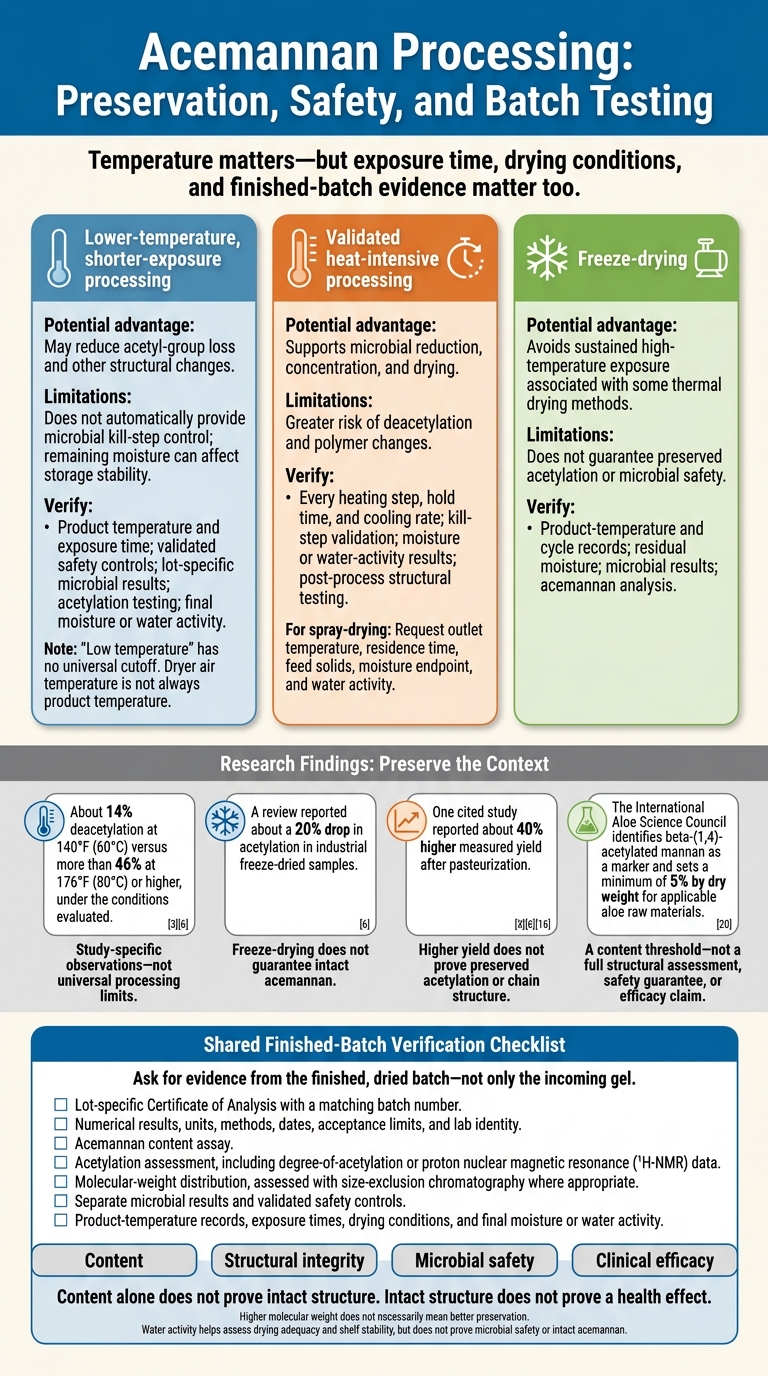
Acemannan Processing: Preservation, Safety, and Batch Testing
1. Lower-Temperature Processing
Temperature and Exposure Time
“Low temperature” has no universal cutoff. What matters is the processing step, temperature, and exposure time. Research suggests that drying around 140°F (60°C) may preserve acemannan structure better than higher-temperature drying under the conditions studied. Ask which step that temperature refers to and how long the gel stayed at that temperature.
The key question: Does the finished material still contain intact acemannan?
Moisture and Drying Conditions
Dryer air temperature isn't always the same as product temperature. Request product-temperature records, drying duration, and final moisture or water activity, which affects microbial growth. Lower-temperature drying still needs validated microbial control and shelf-life data. The drying method and final product testing matter just as much as the temperature setting.
Acemannan Structural Integrity
Freeze-drying does not guarantee intact acemannan; one review reported about a 20% drop in acetylation in industrial freeze-dried samples.
Processing Disclosure and Testing
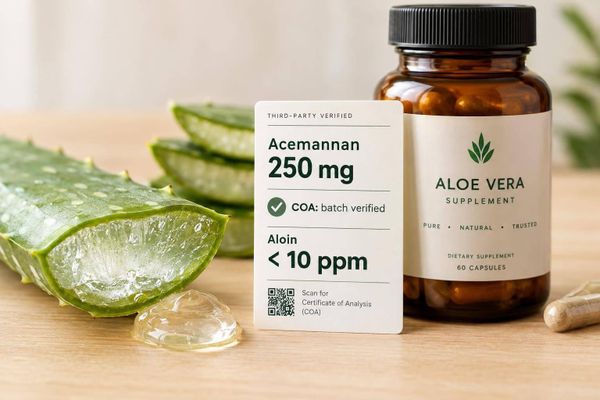
Check the lot-specific Certificate of Analysis for numerical results, units, methods, acceptance limits, lab identity, and a matching batch number. Size-exclusion chromatography can assess molecular-weight distribution, while proton nuclear magnetic resonance (¹H-NMR) can assess acetylation. Confirm that the results apply to the finished, dried batch, not just the incoming gel.
sbb-itb-b88dd21
2. Heat-Intensive Processing
Heat-intensive methods improve microbial control compared with lower-temperature processing, but they also increase the risk of acemannan damage.
Temperature and Exposure Time
A cited review reports about 14% deacetylation at 140°F (60°C) versus more than 46% at 176°F (80°C) or higher under the conditions evaluated. These figures are not universal thresholds.
Ask about every heating step, hold time, and cooling rate. Peak temperature matters, but so does total heat exposure.
Moisture and Drying Conditions
The headline temperature alone doesn’t tell you enough about spray-drying exposure. Request the outlet temperature, residence time, feed solids, moisture endpoint, and water activity.
Acemannan Structural Integrity
Heat deacetylates acemannan and can change how its chains interact. Molecular weight may decrease or increase, so a higher molecular-weight result does not prove better preservation.
Processing Disclosure and Testing
One cited study reported about 40% higher measured yield after pasteurization, but higher yield does not prove preserved acetylation or chain structure.
Processing disclosures and test results need to address both microbial safety and preservation of acemannan’s structure.
Processing Tradeoffs: Preservation, Safety, and Drying
Preservation, microbial safety, and shelf stability each need separate evidence. Lower temperatures may protect structure, but they don’t prove microbial safety. Validated heat-intensive processing improves microbial control and drying, but it can also change acemannan.
A process can support one goal while working against another. Compare methods by what they preserve, what they put at risk, and what testing confirms.
| Approach | Potential advantages | Limitations | Required verification |
|---|---|---|---|
| Lower-temperature, shorter-exposure processing | May reduce acetyl-group loss and other structural changes | Does not automatically provide microbial kill-step control; remaining moisture can affect storage stability | Validated safety controls, lot-specific microbial results, and acetylation testing |
| Validated heat-intensive processing | Supports microbial reduction, concentration, and drying | Greater risk of deacetylation and polymer changes | Kill-step validation, moisture or water-activity results, and post-process structural testing |
| Freeze-drying | Avoids the sustained high-temperature exposure of some thermal drying methods | Does not guarantee preserved acetylation or microbial safety | Product-temperature and cycle records, residual moisture, microbial results, and acemannan analysis |
The label alone isn’t enough - the batch record matters. Water activity helps assess drying adequacy and shelf stability, but it doesn’t prove microbial safety or intact acemannan. Likewise, a freeze-dried label doesn’t confirm preserved acetylation. Reported studies found large changes in acetylation under some drying conditions.
The International Aloe Science Council (IASC) lists beta-(1,4)-acetylated mannan as a marker and sets a minimum of 5% by dry weight for applicable aloe raw materials. That threshold is not a full structural check for ingredient specifications. Request a lot-specific certificate of analysis that identifies the test method, along with degree-of-acetylation or NMR data and separate microbiology results.
Conclusion: Choose Test Results Over Processing Labels
When comparing low- and high-heat methods, batch data matters more than processing labels. Check what happened throughout the process - not just during the “cold-processed” step. Ask for recorded product temperatures and hold times.
Measured content does not prove that structure was preserved. Start with assay results, then review acetylation and molecular-size data to assess preservation. Request batch-level results that include values, methods, dates, and acceptance limits.
Even intact acemannan does not prove clinical benefit. Processing records and test data establish quality, not efficacy.
FAQs
Can acemannan lose integrity during storage?
Yes. Heat, moisture, oxygen, and light can change acemannan’s molecular structure, including its chain length and acetyl groups. Humidity or temperatures above 104°F–140°F (40°C–60°C) can cause major degradation.
Store products tightly sealed in a cool, dry place out of direct sunlight. Follow the manufacturer’s storage instructions, including how long to use the product after opening.
What acetylation results should I look for?
A cold-processed label isn’t enough. Ask for a lot-specific Certificate of Analysis that includes validated, quantitative acetylation data measured by nuclear magnetic resonance (NMR) spectroscopy, along with acemannan content and molecular-weight distribution.
Check that it lists the test method, laboratory name, testing date, and defined acceptance ranges. Acetylation results confirm whether acetyl groups remain attached after processing. Heat can remove these groups, weakening the structure.
What if a manufacturer won’t share batch tests?
A cold-processed label isn’t proof of a manufacturer’s quality or processing claims. You need batch-specific test results to verify those claims.
Ask for a Certificate of Analysis (CoA) that matches your product’s lot number. It should include acemannan results with units, the testing method, the laboratory’s name, and proof of ISO/IEC 17025 accreditation. If the manufacturer can’t provide this data, put your purchase on hold.