Heat vs. Cold Processing: Understanding the Impact on Acemannan Stability and Aloe Vera Quality
Compare heat vs cold aloe processing—how each affects acemannan structure and microbial safety; request lot-specific COAs and stability data.

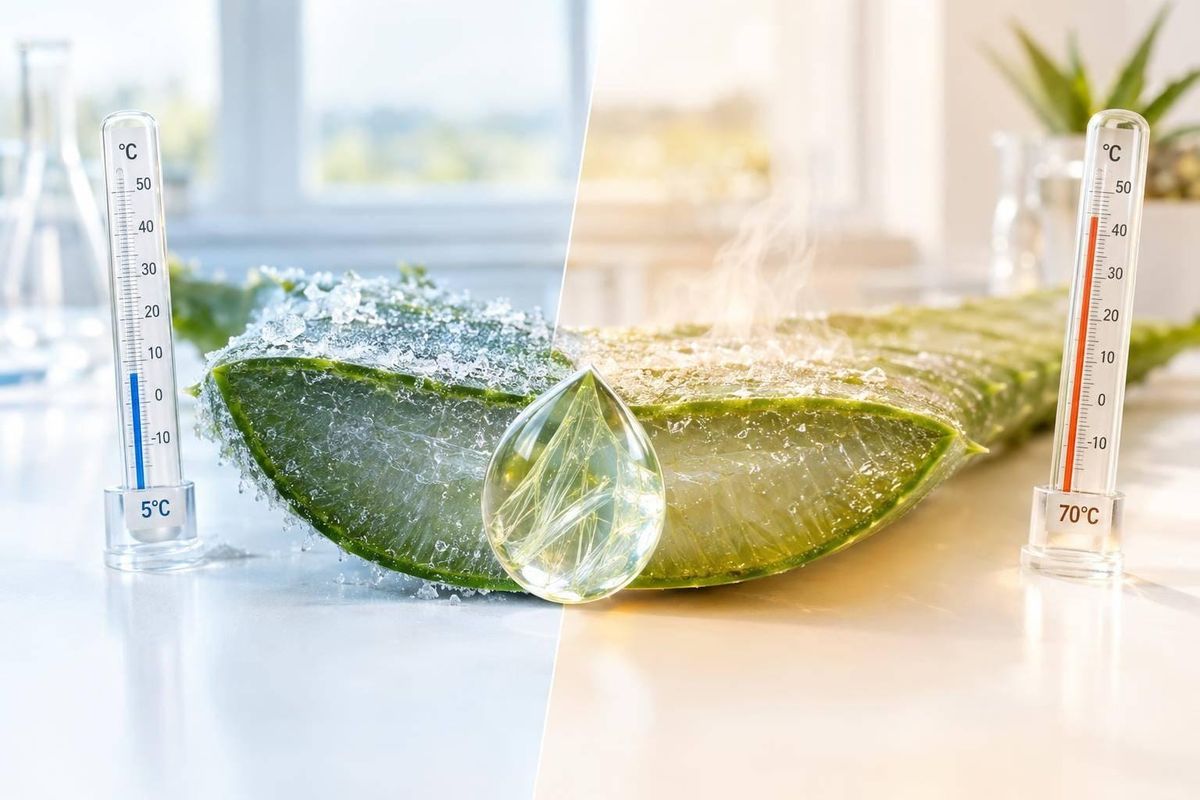
Neither heat nor cold processing alone proves aloe vera quality. I’d check the finished batch’s acemannan tests, microbial results, and temperature-time records before choosing either.
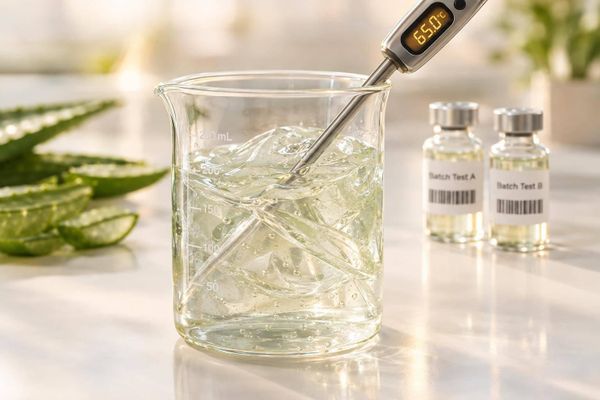
Brief heating around 149°F (65°C) preserved some acemannan properties in certain studies - but that is not a universal safety or quality limit. Cold extraction reduces heat exposure at one stage; later heating, slow handling, and poor storage can still affect the product.
Here’s what I’d compare:
Quick Comparison
| What I’d check | Heat processing | Cold processing |
|---|---|---|
| Temperature and time | Hold time and cooling affect total heat exposure | Low extraction temperatures don’t rule out later heating |
| Acemannan structure | Heat may alter acetyl groups and chain size | Less heat does not guarantee intact structure |
| Microbial control | Needs a validated heat treatment | Needs validated controls, such as filtration or preservatives |
| Shelf life | Depends on packaging, formula, and storage | May also depend on refrigeration |
| Color, odor, flavor, and texture | Heat can change these traits | Oxidation and contamination can still cause changes |
| Testing | Batch results and packaged-product stability data | The same checks - not just a “cold-processed” label |
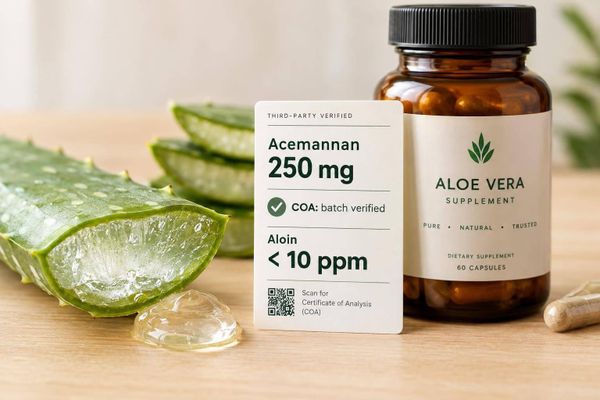
My bottom line: <u>check acemannan preservation and microbial safety separately</u>. Ask for a lot-matched certificate of analysis, acetylation and molecular-weight data when structural claims are made, and shelf-life results covering both unopened and opened storage. For oral products, also check aloin results against the IASC limit of no more than 10 ppm.
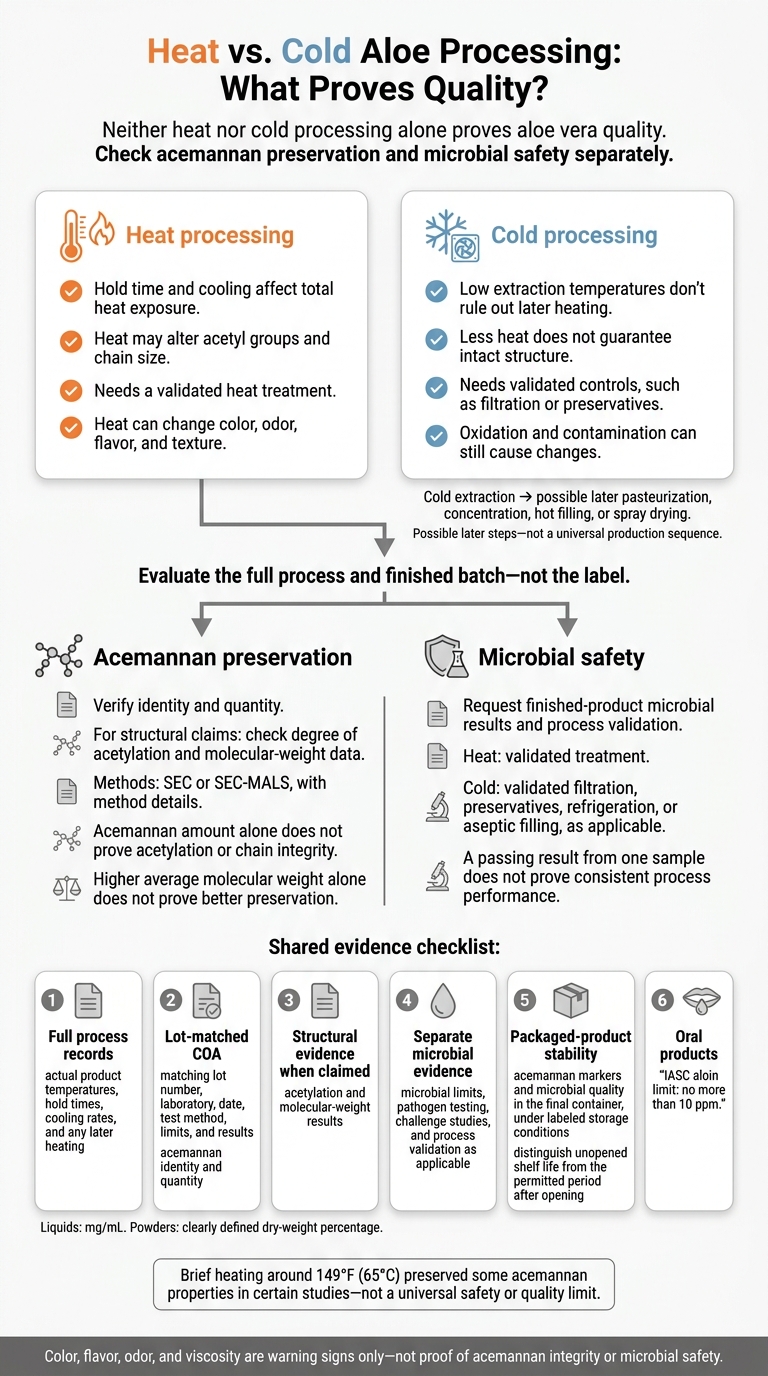
Heat vs. Cold Aloe Processing: What Proves Quality?
Heat Processing: Microbial Control and Acemannan Stability
Heat helps stabilize aloe by reducing enzyme activity and microbes, but it can also change acemannan. Acemannan retention depends on the full time-temperature profile and cooling rate. Limiting heat exposure makes this balance harder to strike, which is where cold processing enters.
How Temperature and Time Affect Acemannan Structure
In some studies, brief heating around 149°F (65°C) caused relatively little change. Higher temperatures or longer exposure have been linked to deacetylation, loss of branching, and lower molecular weight. These findings apply to the conditions studied - not universal temperature limits.
Drying can cause more change than pasteurization. Industrial drying studies reported molecular-weight decreases from about 49 to 23–26 kilodaltons and 40% to 70% reductions in acetylation level. Don’t apply these results directly to liquid pasteurization.
Short Pasteurization vs. Prolonged Heating
The ranges below are studied examples, not processing instructions. Each process needs validation for the product’s pH, viscosity, formulation, and target microorganisms. Liquid heating and drying work differently, so compare them only as examples of heat exposure.
Heat exposure Processing objective Reported temperature and duration Potential acemannan effects Microbial-control benefit Main quality risks Moderate moist-heat pasteurization Stabilize liquid aloe About 149°F (65°C); under 15 minutes studied, with 15 minutes also reported as a conventional example Brief treatment preserved biological activity relatively well in some studies; acetylation and molecular structure still need testing Reduces microbes when validated Too little treatment if unvalidated; possible structural changes High-temperature short-time treatment Shorten holding time while controlling microbes About 185–203°F (85–95°C) for 1–2 minutes Shorter exposure may limit losses, but retention is not guaranteed Reduces microbes in a short time when validated Possible acemannan loss and quality changes if the process is not validated Prolonged or repeated heating Extend treatment or concentrate the product Variable; record the actual exposure Allows more time for deacetylation and molecular-weight shifts May reduce microbes, but overprocessing increases acemannan-loss risk Overprocessing and inconsistent quality Thermal drying Remove water to make powder; drying is a separate heat process, not a pasteurization example Conditions vary; changes reported above about 140°F (60°C), including 158–176°F (70–80°C) in drying studies; no single duration applies Can greatly change acetylation and molecular weight Lowers water activity after drying but does not, by itself, prove pathogen control Heat, dehydration, and oxidation damage
Cooling counts as part of total heat exposure.
One processing review describes flash-cooling treated juice to 41°F (5°C) or below within 15 seconds to limit continued heat exposure.
Track the actual product temperature, hold time, and cooling rate - not just the machine setting. Lower heat can help protect acemannan’s structure, but safety still depends on the full process.
sbb-itb-b88dd21
Cold Processing: Less Heat, Remaining Risks
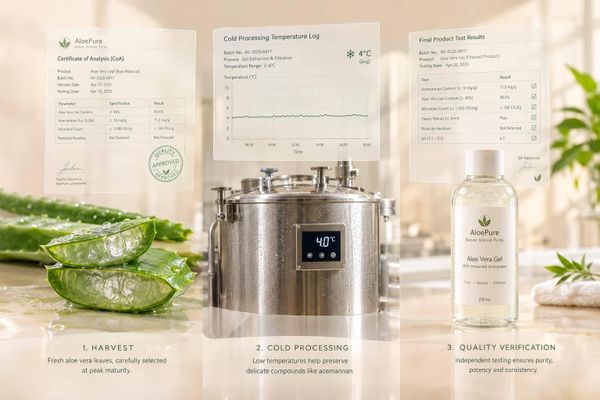
Cold processing uses less heat during extraction and early handling. This can help limit acemannan deacetylation - the loss of acetyl groups - and damage to its chains. But lower temperatures alone do not prove that acemannan’s original structure remains intact in the finished product.
Cold Extraction Is Only One Processing Step
Cold extraction refers only to the separation step. Later steps, including pasteurization, evaporation, concentration, hot filling, or spray drying, can still add heat. A “cold-processed” claim does not mean the product stayed unheated throughout production.
Ask which stages the claim covers, and request the full process flow, not just the extraction temperature. What happens after extraction matters, too.
Factors Beyond Heat That Affect Preservation and Safety
Slow processing can leave enzymes active. Oxygen and pH also affect polysaccharide stability and how well preservatives work. Ask how the manufacturer controls holding time, oxygen, and enzyme activity - and whether preservatives remain effective in the finished formulation.
Cold processing alone does not guarantee microbial safety. Filtration needs a validated pore size and verified filter integrity. UV treatment needs a verified dose and enough penetration. Sanitation and post-treatment handling matter as well. Shelf-life claims should be backed by preservative-effectiveness testing, finished-product microbial testing, and stability testing of the packaged product.
Heat vs. Cold: Comparing Quality and Safety
Compare finished-product test results, not the label. Plant variety, maturity, extraction, and drying also affect acemannan. To make a useful comparison, compare like with like.
There are two separate questions here: how much acemannan remains, and whether the product is microbiologically safe. The table compares heat and cold processing using the same quality criteria.
| Evaluation criterion | Heat processing | Cold processing | Evidence needed |
|---|---|---|---|
| Temperature | Higher temperatures can add processing stress | Lower extraction temperatures do not rule out heating later | Actual product-temperature records throughout processing |
| Duration | Short exposure may limit changes; prolonged heating may increase them | Lower heat does not prevent degradation over time or microbial growth | Batch records and hold-time data |
| Acemannan integrity | May change acetylation and chain structure | May reduce thermal stress but does not guarantee preservation | Degree-of-acetylation testing plus SEC or SEC-MALS with method details |
| Microbial control | Heat can achieve a validated reduction in microbes | Cold processing needs validated filtration, preservatives, refrigeration, or aseptic filling | Challenge studies, microbial limits, pathogen testing, and process validation |
| Shelf life | May improve initial microbial stability | May need added packaging, preservative, or refrigeration controls | Real-time and accelerated stability studies in final packaging |
| Sensory and chemical quality | May affect color, flavor, odor, viscosity, or oxidation markers | May better retain sensory traits, but oxidation and contamination can still occur | Sensory specifications plus chemical stability testing |
| Testing needs | Requires process validation and acemannan characterization | Requires microbial-control validation and acemannan characterization | Batch-specific certificate of analysis and stability data |
The full process, formulation, and test methods matter - not just temperature. Preserving acemannan structure and checking safety require different tests.
Acemannan Preservation and Microbial Safety Need Separate Tests
Acemannan amount alone does not prove acetylation or chain integrity. Read molecular-weight results alongside verified identity, mannose-rich composition, and acetylation results. A higher average molecular weight does not, by itself, mean better preservation.
Likewise, a passing microbial result from one sample does not show that the production process works consistently.
What Determines Shelf Life Beyond Processing
Shelf life also depends on packaging barriers, closure integrity, headspace oxygen, pH, preservatives, light, and storage temperature. Opening the package adds exposure and contamination risks.
Testing should cover the finished package under its labeled storage conditions. It should also distinguish unopened shelf life from the permitted period after opening.
Color, flavor, odor, and viscosity are warning signs only. They cannot confirm acemannan integrity or microbial safety.
How to Assess Aloe Vera Processing Claims
Check Processing Records and Batch Test Results
Start with the processing record. A cold-processed claim should be backed by records showing limited heat exposure. Ask for the temperature range, maximum exposure time, product form, and details of any later heating step.
Next, check what’s in the finished batch and whether it met release limits. Request a certificate of analysis (COA) that matches the lot number and includes the lab, date, test method, limits, and results. It should also report acemannan identity and quantity. If the claim includes structural preservation, ask for molecular weight and acetylation data. These help assess how processing affected acemannan’s structure - not just how much remains.
Liquid quantities should be reported in mg/mL. For powders, look for a clearly defined dry-weight percentage.
Request finished-product microbial test reports and microbial-control validation records separately from the acemannan results. For oral products, ask for aloin testing, too. IASC materials identify a limit of no more than 10 ppm aloin for oral products.
Verify Storage Directions and Shelf-Life Testing
Check whether stability testing supports the labeled storage period. Review the expiration date, seal integrity, storage instructions, and stated after-opening period.
Ask for stability data from testing in the final container. The data should cover acemannan markers and microbial quality throughout both the unopened shelf life and the stated after-opening period. If those records aren’t available, treat the claim as unverified.
FAQs
How can I compare acemannan levels in liquids and powders?
Don’t rely on generic labels or total polysaccharide counts. Ask for a Certificate of Analysis (CoA) that matches the product’s lot number and reports acemannan in milligrams per serving or as a percentage of dry weight.
Check whether results are reported as “as-is” or “dry basis” so you’re comparing values on the same basis. Heat and processing can damage acemannan’s structure even when its content remains measurable. Ask for acetylation and molecular-weight distribution testing to check whether that structure remains intact.
Does preserved acemannan structure guarantee health benefits?
No. Preserved acemannan structure is a marker of manufacturing quality - not clinical proof of specific health benefits. Research links structural markers to possible immune and gut-health effects, but preservation alone doesn’t prove that acemannan delivers those effects.
High carbohydrate or polysaccharide counts can still occur when the structure has degraded. Confirming structural integrity takes batch-specific testing, such as NMR or SEC/GPC. Labels and concentration claims can’t establish it.
What if a manufacturer won’t share batch test results?
Quality and processing claims need batch-specific test results. Without them, you can’t verify those claims. “Cold-processed” alone doesn’t guarantee acemannan stability or product integrity.
Ask for a Certificate of Analysis (CoA) that matches your product’s batch number. It should include numerical acemannan results, the laboratory’s name and ISO/IEC 17025 accreditation, the test method, and confirmation that the finished product was tested. Hold off on buying if this documentation isn’t available.