The Smart Shopper’s Guide to Acemannan Aloe Supplements
Demand numeric acemannan mg, COAs, and aloin data before buying any aloe supplement.
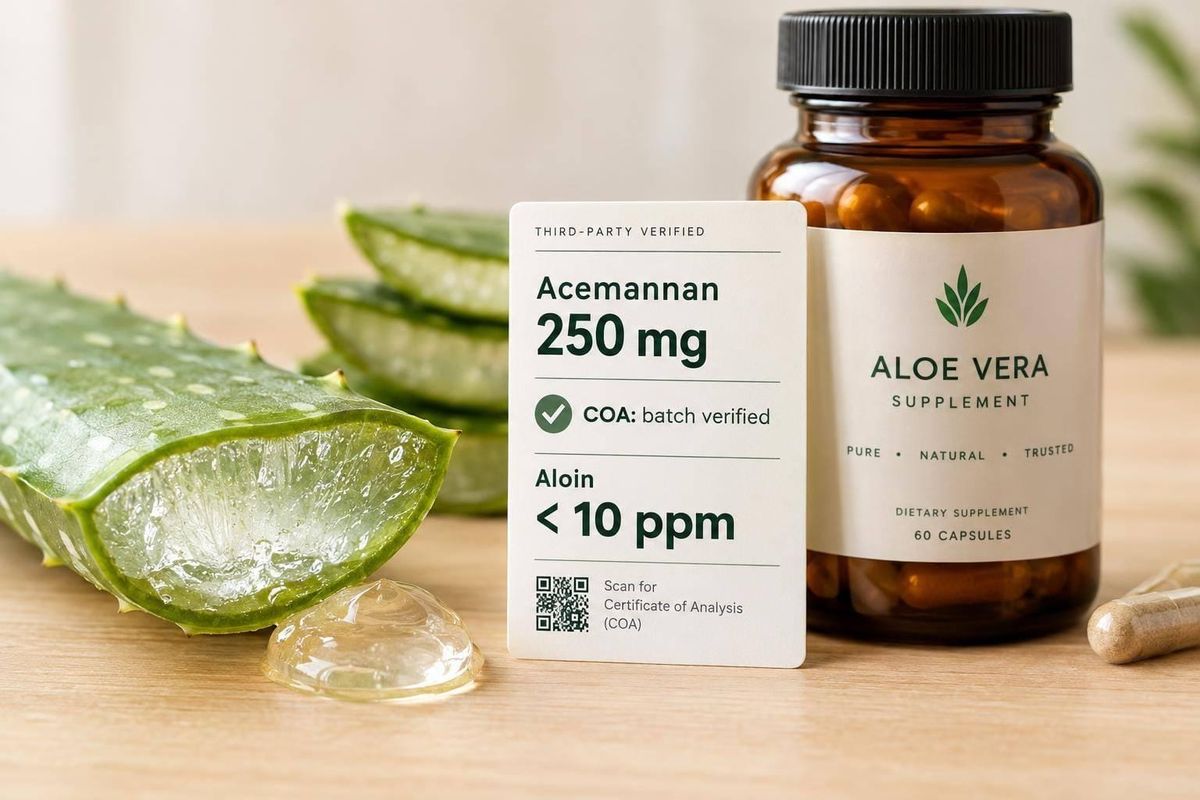
I start with acemannan milligrams per serving - not total aloe weight. Then I compare cost per 100 mg and check whether batch tests support the label. For example, a $30.00 bottle containing 3,000 mg of labeled acemannan costs $1.00 per 100 mg.
Before buying capsules, powders, or liquids, I check:
- Contents: Acemannan amount, inner-leaf aloe source, processing method, and a matching finished-batch report.
- Testing: Numeric aloin results, the test method, lab credentials, and contaminant checks.
- Shelf life: Storage instructions and support for the labeled amount through expiration.
- Personal safety: Health conditions, medications, pregnancy, breastfeeding, or planned surgery that warrant a healthcare professional’s review.
My rule: <u>Missing details mean pause</u>. Documentation helps verify what’s in the bottle - not whether it works or is safe for you. While shoppers focus on purity, understanding the science-backed health benefits of acemannan provides context for why these metrics matter. Supplements should not replace medical care.
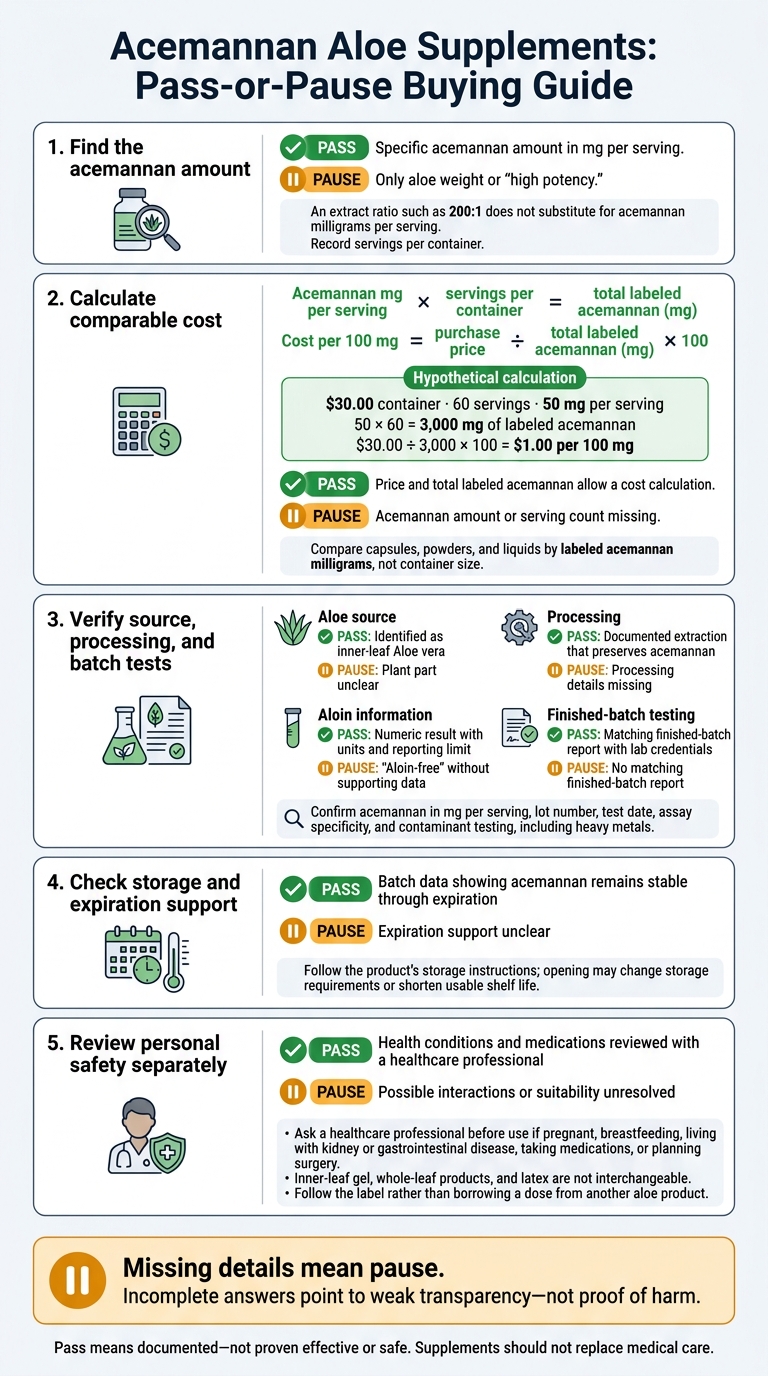
Acemannan Aloe Supplements: Pass-or-Pause Buying Guide
Check Acemannan Amounts and Compare Costs
Find Acemannan Milligrams per Serving
Start with the Supplement Facts panel. Find the acemannan milligrams per serving and the servings per container, then use those numbers to calculate cost per 100 mg.
If the label lists only total aloe weight or an extract ratio such as 200:1, ask for a lab result that reports acemannan in milligrams per serving.
Compare Capsules, Powders, and Liquids
The format affects convenience, but the comparison standard stays the same.
| Format | Label details | Practical trade-offs |
|---|---|---|
| Capsules | Milligrams per capsule, capsule count, and excipients. | Handy for travel; may contain fillers. |
| Powders | Concentration, scoop weight, and total servings. | Compact; may clump without moisture control. |
| Liquids | Content per milliliter and serving volume. | Easy to swallow; often need preservatives and refrigeration after opening. |
Compare products by labeled acemannan milligrams, not container size.
Calculate Cost per 100 mg of Labeled Acemannan
First, calculate the total labeled acemannan in the container:
Acemannan mg per serving × servings per container = total labeled acemannan (mg).
Then calculate the cost:
Cost per 100 mg = purchase price ÷ total labeled acemannan (mg) × 100.
Hypothetical calculation: A $30.00 container with 60 servings of 50 mg each contains 3,000 mg of labeled acemannan. The cost is $30.00 ÷ 3,000 × 100 = $1.00 per 100 mg.
If a product doesn't disclose acemannan milligrams per serving, don't substitute total aloe weight or an extract ratio. A higher number doesn't guarantee value if processing damaged the acemannan.
With the price calculated, check whether the aloe source, processing, and batch tests support the amount on the label.
sbb-itb-b88dd21
Check Aloe Source, Processing, and Test Results
Identify the Plant Part and Processing Steps
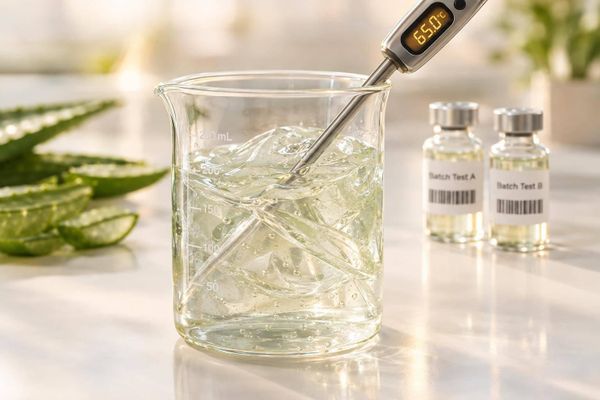
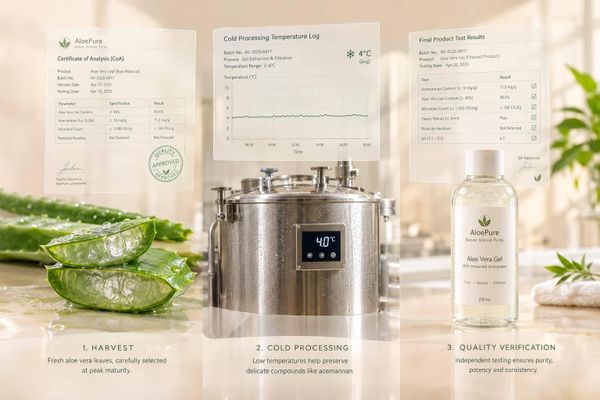
Check the batch report to see which part of the aloe plant was used and how it was processed. Make sure it also lists acemannan per serving and a numeric aloin result.
Review Test Results
If the source and processing look reasonable, check the finished-batch certificate of analysis. Confirm the acemannan amount in mg per serving, lot number, test date, and numeric aloin result.
If the batch report matches the label, check safety and whether the product fits with your medications next. If those batch details are missing, review safety before buying.
Check Personal Safety and Missing Information
After reviewing the price and batch details, check whether the product fits your health profile. Natural origin and lab results don’t make a supplement right for everyone. Assess personal safety separately from acemannan content and price.
Review Health Conditions and Medications
Safety depends on the plant part used. Inner-leaf gel, whole-leaf products, and latex are not interchangeable. Compounds associated with latex, including aloin, can cause laxative effects and gastrointestinal distress.
Ask a healthcare professional before use if you’re pregnant, breastfeeding, have kidney or gastrointestinal disease, take medications, or have surgery planned. Bladder pain syndrome and interstitial cystitis are chronic conditions that need medical supervision. Follow the label rather than borrowing a dose from another aloe product.
If the product still seems suitable, choose a quality acemannan supplement by asking the manufacturer for any missing technical details.
Ask Manufacturers for Specific Details
Ask the manufacturer to provide:
- The exact acemannan amount in mg per serving, the assay used, and whether that assay measures acemannan specifically
- The plant part and processing method, numeric aloin results, lab credentials, and contaminant testing, including heavy metals
These details help you understand what a potency or purity claim actually covers.
Incomplete answers point to weak transparency - not proof of harm. Put the purchase on hold if you can’t get enough information to assess whether the product suits you.
Check Storage and Acemannan Content Through Expiration
Before buying, ask about shelf life and whether the labeled acemannan amount is supported through expiration. Follow the product’s storage instructions. Storage needs vary by format, and opening the product may change those requirements or shorten its usable shelf life.
Conclusion: Use a Pass-or-Pause Buying Checklist
Once you’ve checked the label facts, use this worksheet before checkout. Mark pass only when documentation supports the claim. Keep anything unresolved on pause.
| Check | Pass | Pause |
|---|---|---|
| Acemannan disclosure | Specific acemannan amount in mg per serving | Only aloe weight or “high potency” |
| Aloe source | Identified as inner-leaf Aloe vera | Plant part unclear |
| Processing | Documented extraction method that preserves acemannan | Processing details missing |
| Aloin information | Numeric result with units and reporting limit | “Aloin-free” without supporting data |
| Finished-batch testing | Matching finished-batch report with lab credentials | No matching finished-batch report |
| Comparable cost | Price and total labeled acemannan allow a cost calculation | Acemannan amount or serving count missing |
| Potency through expiration | Batch data showing acemannan remains stable through expiration | Expiration support unclear |
| Personal safety | Health conditions and medications reviewed with a healthcare professional | Possible interactions or suitability unresolved |
Pass means documented - not proven effective or safe. Don’t use supplements in place of medical care.
FAQs
Is there an evidence-based acemannan dose?
There’s no single evidence-based dose for acemannan. Human studies use different aloe products, delivery routes, and concentrations, so their doses can’t be compared directly.
The findings apply to the specific products studied. Instead of looking for a general dose, match your supplement to the exact preparation and concentration used in the research. Choose products whose labels clearly list the numerical amount of acemannan.
What aloin level is acceptable?
For oral aloe supplements, aloin levels should be below 10 parts per million (ppm). This is the oral safety benchmark set by the International Aloe Science Council.
Don’t rely on vague claims like “aloin-free” or “pass.” Ask for a batch Certificate of Analysis that lists specific numerical results for aloin A and B to confirm proper purification.
How can I verify a lab report’s authenticity?
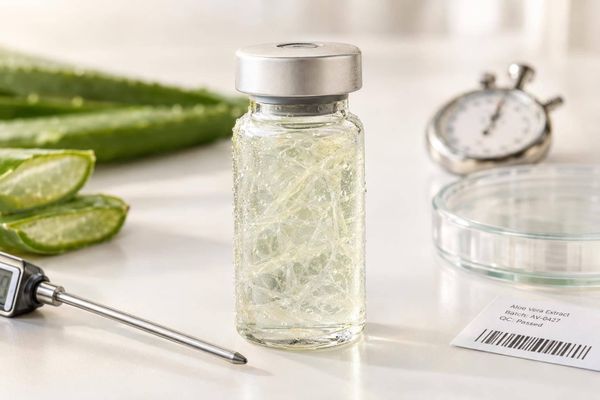
Ask for a lot-specific Certificate of Analysis (COA) that matches the batch number on your bottle. Look for the laboratory’s name, ISO/IEC 17025 accreditation, and numerical results - not just “pass” or “conforms.”
The COA should list testing methods, such as NMR, HPLC, or AOAC Official Method 2018.14, along with clear sample-collection and testing dates. Check that the report covers the finished product, not just its raw ingredients.