Protecting Acemannan: The Role of Cold Processing in Aloe Vera Quality
Cold-processed labels don't guarantee preservation — demand temperature/time logs, microbial controls, and lot-specific acemannan tests for amount, chain length, and acetylation.

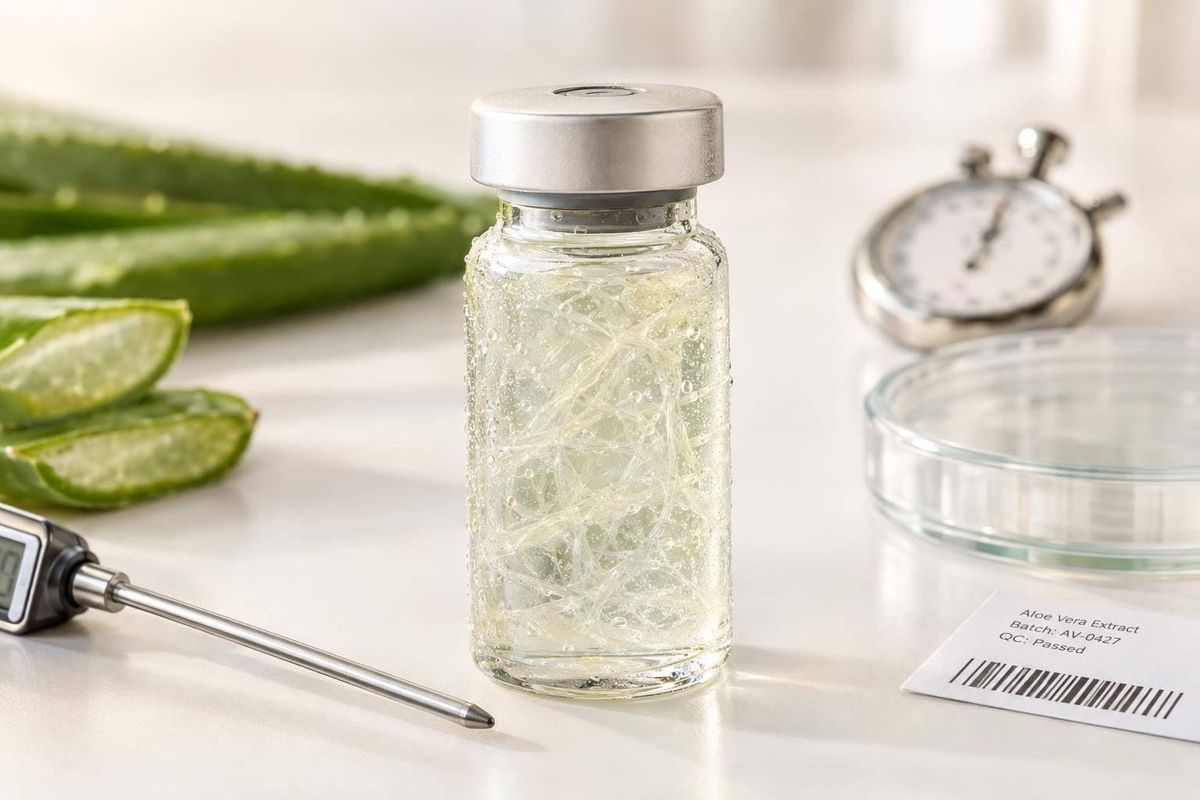
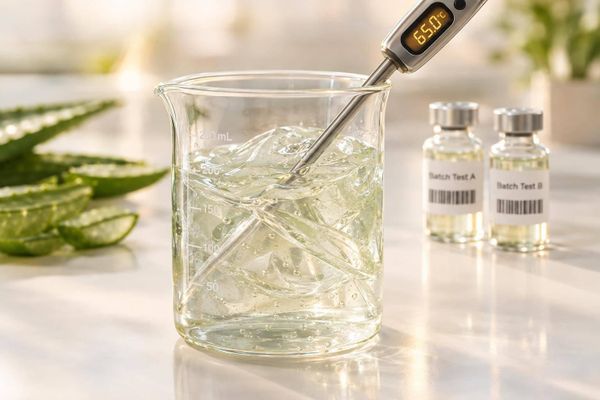
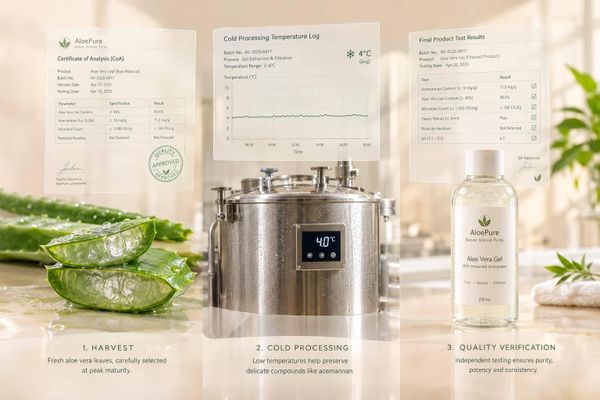
I wouldn’t judge aloe vera quality by a “cold-processed” label alone. I’d ask for temperature and time records, plus lot-specific tests for 3 things: acemannan amount, chain length, and acetylation - whether its attached acetyl groups remain.
Here’s how I’d compare the four methods:
- Cold processing: Check every step for later heating, and ask how microbes are controlled.
- Pasteurization: Check the product’s temperature and holding time, then review tests after heating.
- Heat-based dehydration: Review the whole drying cycle and final moisture. Removing water can increase the reported concentration without preserving more acemannan.
- Spray drying: Check product temperature, time in the dryer, before-and-after tests, and any added fillers.
Quick Comparison
| Method | Records I’d check | Main caution |
|---|---|---|
| Cold processing | Temperatures, holding times, microbial controls | “Cold” does not prove preservation or safety |
| Pasteurization | Heating and cooling records | Heat can change chains and acetyl groups |
| Heat-based dehydration | Drying time, temperature, final moisture | Water loss can distort comparisons |
| Spray drying | Product temperature, dryer time, fillers | Air temperatures alone don’t show product exposure |
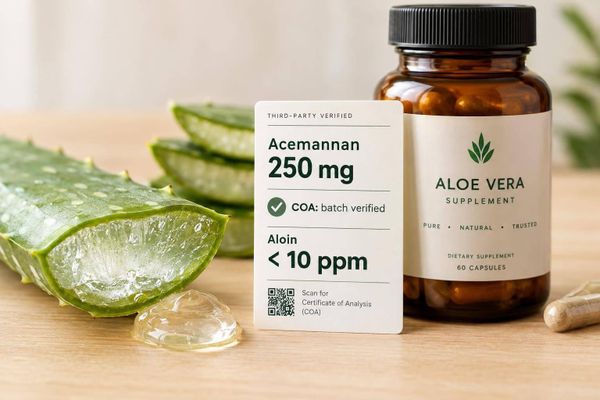
For any method, I’d match the Certificate of Analysis to your package’s lot number, check acemannan in mg per serving, and review safety and storage records. Ask for temperatures in °F and °C - not just a process label.
My bottom line: <u>test results matter more than processing claims</u>. They can show preservation, not prove immune or gut-health effects.
1. Cold Processing
Temperature and Exposure Time
Cold processing is the baseline method, but judge it by records - not labels. Request exact temperatures in °F/°C and time logs for every production step, not just extraction.
Acemannan Content and Structure
Request batch-specific acemannan content backed by a Certificate of Analysis (CoA). Also ask for third-party results covering acemannan content, molecular-weight range, and acetylation.
Content alone doesn’t tell the whole story. Together, these results show how much acemannan is present, whether its chains stayed intact, and whether acetyl groups remain attached.
Safety and Documentation
Cold processing does not prove microbial safety. Request batch microbial test results to help verify control across the entire process.
Review GMP records and NSF certification alongside the test results. For ethanolic extraction, request records for extraction and every step that follows, including handling and packaging. These records provide the baseline for comparing cold processing with heat-based methods.
sbb-itb-b88dd21
2. Pasteurization and Controlled Heating
Temperature and Exposure Time
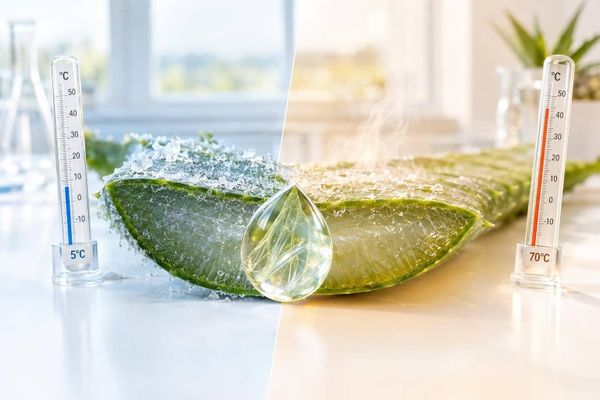
When heating begins, temperature and exposure time become the main threats to acemannan. Higher temperatures and longer holding times add heat stress, which can shorten acemannan chains and remove acetyl groups. There’s no single temperature–time limit that preserves acemannan across all products.
Acemannan Content and Structure
Detecting acemannan isn’t enough. The question is whether its structure stayed intact. Heat can leave measurable acemannan behind while changing its molecular weight and acetylation. Testing should check acemannan content, molecular-weight range, and acetylation.
Safety and Documentation
Batch records must document the actual heating conditions and the acemannan structure test results. Process validation confirms that the heating step met specifications. Finished-product testing checks whether acemannan survived intact. A validated heating step alone does not prove molecular preservation.
3. Heat-Based Dehydration
Temperature and Exposure Time
Unlike a single pasteurization step, dehydration exposes aloe to heat throughout the drying process. Check the full drying cycle: temperature, duration, and final moisture - not just peak temperature. High heat and long drying times can damage acemannan and remove acetyl groups. A lower drying temperature alone doesn’t prove that acemannan has been preserved.
Acemannan Content and Structure
A higher acemannan reading in dried aloe may come from water loss, not better preservation. Ask for final moisture results and third-party polysaccharide profiling to help assess the difference.
Safety and Documentation
Drying records need batch results to back them up. Request drying logs, final moisture results, and batch polysaccharide tests. Excess moisture during drying or storage can alter acemannan, so keeping the ingredient dry and sealed helps protect it. These records and results also give you a basis for assessing the next method: spray drying.
4. Spray Drying
Temperature and Exposure Time
Focus on the aloe’s actual product temperature and time in the dryer. Request inlet and outlet air temperatures in °F (°C), actual product temperature, and residence time. Air readings alone don’t tell you what the aloe experienced.
Spray drying can damage acemannan’s molecular structure. That’s why testing before and after drying matters.
Acemannan Content and Structure
Request paired before-and-after results for acemannan content, molecular profile, and acetylation. These results help show whether spray drying reduced acemannan content, shortened its chains, or removed acetyl groups.
Also ask whether the reported powder weight includes carriers or fillers. Otherwise, dilution could be mistaken for degradation.
Safety and Documentation
Powder claims can hide processing losses, so records and test results must agree. Request records showing whether spray drying was used at any stage, plus third-party testing of the finished powder to support any cold-processed claim.
The claim must identify every heated step - including later spray drying - and the processing records must match the test results.
Acemannan Testing: Quantity and Molecular Structure
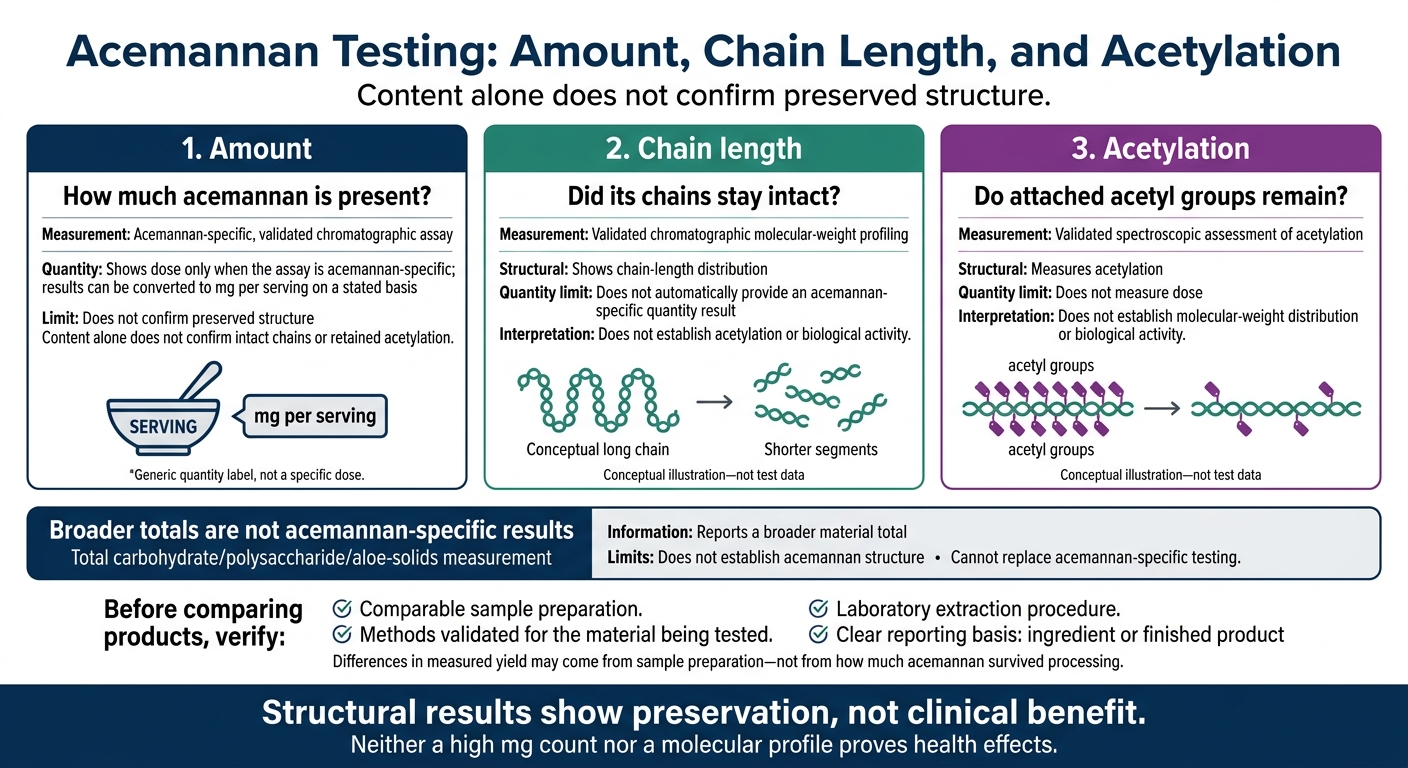
Acemannan Testing: Amount, Chain Length, and Acetylation
After processing, testing is the only way to verify how much acemannan survived. Ask for results in mg per serving, with a clear reporting basis: the ingredient or the finished product. Total carbohydrate, total polysaccharide, and aloe-solids measurements report broader totals. They don’t replace acemannan-specific results.
Heat can shorten acemannan chains and remove acetyl groups, changing molecular weight and structure. That’s why testing must check both chain length and acetylation.
| Measurement and method | Quantity information | Structural information | Interpretation limits |
|---|---|---|---|
| Acemannan-specific, validated chromatographic assay | Shows dose only when the assay is acemannan-specific; results can be converted to mg per serving on a stated basis | Does not confirm preserved structure | Content alone does not confirm intact chains or retained acetylation. |
| Validated spectroscopic assessment of acetylation | Does not measure dose | Measures acetylation | Does not establish molecular-weight distribution or biological activity. |
| Validated chromatographic molecular-weight profiling | Does not automatically provide an acemannan-specific quantity result | Shows chain-length distribution | Does not establish acetylation or biological activity. |
| Total carbohydrate/polysaccharide/aloe-solids measurement | Reports a broader material total | Does not establish acemannan structure | Cannot replace acemannan-specific testing. |
To compare products, request comparable sample preparation and methods validated for the material being tested. Ask the laboratory to specify its extraction procedure, reporting basis, and whether the results apply to the ingredient or finished product. Without those details, differences in measured yield may come from sample preparation - not from how much acemannan survived processing.
Use the results to compare preservation rather than marketing claims. Structural results show preservation, not clinical benefit. Neither a high mg count nor a molecular profile proves health effects.
Safety and Process Records: A Buyer's Checklist
Check lot records to verify that processing preserved acemannan and controlled safety. Ask for microbial-control records and lot-specific safety data. Batch testing checks a sample; it doesn’t prove that the process stayed under control.
Request acemannan quantity and structure results along with the safety records and process details below.
| Method | Safety records | Process disclosures | Finished-product evidence |
|---|---|---|---|
| Cold processing | Microbial controls; third-party batch testing | Extraction method; maximum product temperatures; holding times; later heating | Lot safety results |
| Pasteurization and controlled heating | Thermal-treatment validation; batch safety testing | Product temperature; exposure time; cooling records | Post-treatment safety results |
| Heat-based dehydration | Microbial-control records | Product temperatures; drying duration; later heating | Dried-product safety results |
| Spray drying | Microbial-control records | Maximum product temperatures; residence time | Finished-powder safety results |
Process Checklist
- Maximum product temperatures in °F and °C, plus holding times.
- Time from harvest to processing, in hours.
- Stabilization method and preservatives used.
- Records for each stage: extraction, concentration, drying, and later heating.
Preparation and Storage Checklist
Check whether the product uses inner-leaf or whole-leaf material, and review its fillers and other ingredients. Request details on packaging, capsule material, storage instructions, and stability documentation.
Once you have the process steps, match the records to the lot number on the package.
Batch-Document Checklist
- Certificate of analysis (CoA) that matches the package lot number.
- Sample type and processing stage: finished product or an earlier ingredient.
- Laboratory, test method, and test date.
- Results, units, specifications, and acceptance criteria.
- Acemannan quantity and structure results tied to that same lot number.
Treat “Cold-extracted,” “standardized,” and “third-party tested” as claims until the lot record shows the method and results.
Conclusion: Choose Testing Over Processing Claims
Across processing methods, the pattern is consistent: lower heat better preserves acemannan’s long chains and acetyl groups. Heat can improve safety and shelf life, but how much acemannan survives depends on both temperature and exposure time.
When evaluating aloe vera products, look for temperature and time records, microbial controls, and batch-specific tests for acemannan quantity, molecular weight, and acetylation. Without that documentation, preservation remains unverified. A “cold-processed” label alone cannot fill the gap.
Verified acemannan preservation is a quality finding - not proof of immune or gut-health benefits. Use test results to check preservation, rather than labels that offer no supporting evidence.
FAQs
Is there a standard temperature for “cold-processed” aloe?
No. “Cold-processed” is a marketing claim, not a regulated temperature standard. Low-temperature extraction alone doesn’t guarantee that acemannan stays intact.
Ask for temperature-and-time records for extraction, concentration, and drying. For cold-processed claims, request confirmation that temperatures stayed below 104°F (40°C). Check acemannan preservation through finished-product testing, such as NMR, SEC/GPC, and HPLC - not the label alone.
How can I tell if acemannan test results are reliable?
Look for a lot-specific Certificate of Analysis (COA) that matches your product’s batch number. It should show numerical results - not just “pass” or “conforms”.
Check the laboratory’s name, ISO/IEC 17025 accreditation, testing dates, and test methods, such as NMR, HPLC, or AOAC Official Method 2018.14. Make sure the results apply to the finished product, not just its raw ingredients.
Can acemannan degrade after I open the product?
Yes. Acemannan’s molecular structure - especially its acetyl groups - is sensitive to heat, moisture, and other storage conditions.
Keep the container tightly sealed in a cool, dry place away from direct sunlight. Avoid humid bathrooms and countertops exposed to heat or moisture. Follow the label’s storage instructions, and use the product within the recommended time frame after opening.