Acemannan Dosage: What the Science Says
No single acemannan dose fits all—effects depend on product form, delivery route, concentration, and study length.


Here’s the short answer: science does not give one standard acemannan dose. Human studies use different aloe products, different routes, and short study periods, so the numbers do not line up cleanly.
If I boil the article down, this is what matters most:
- Most human studies tested aloe-based products, not pure acemannan
- Form changes the meaning of the dose: syrup, gel, cream, sponge, extract, and purified powder are not the same thing
- Route changes the meaning too: oral, topical, and injection-based use should not be compared side by side
- Most oral studies lasted about 4 weeks, so long-term safety is still unclear
- Topical studies often report concentration, not milligrams, such as 0.5% gel
- Lab and animal doses are not human serving sizes
- Some oral aloe products appear safe short term up to about 42 days, but rare liver injury cases have been reported after 3 to 24 weeks
- Labels often do not show actual acemannan content, which makes product-to-study matching hard
A few study examples make the problem clear:
- GERD trial: aloe syrup 10 mL once daily for 4 weeks
- Ulcerative colitis trial: aloe gel 100 mL twice daily for 4 weeks
- IBS trial: decolorized leaf extract 50 mL 4 times daily for 1 month
- Topical oral use: 0.5% acemannan gel
- Animal injection study: 2 mg/kg weekly in cats and dogs
Quick comparison
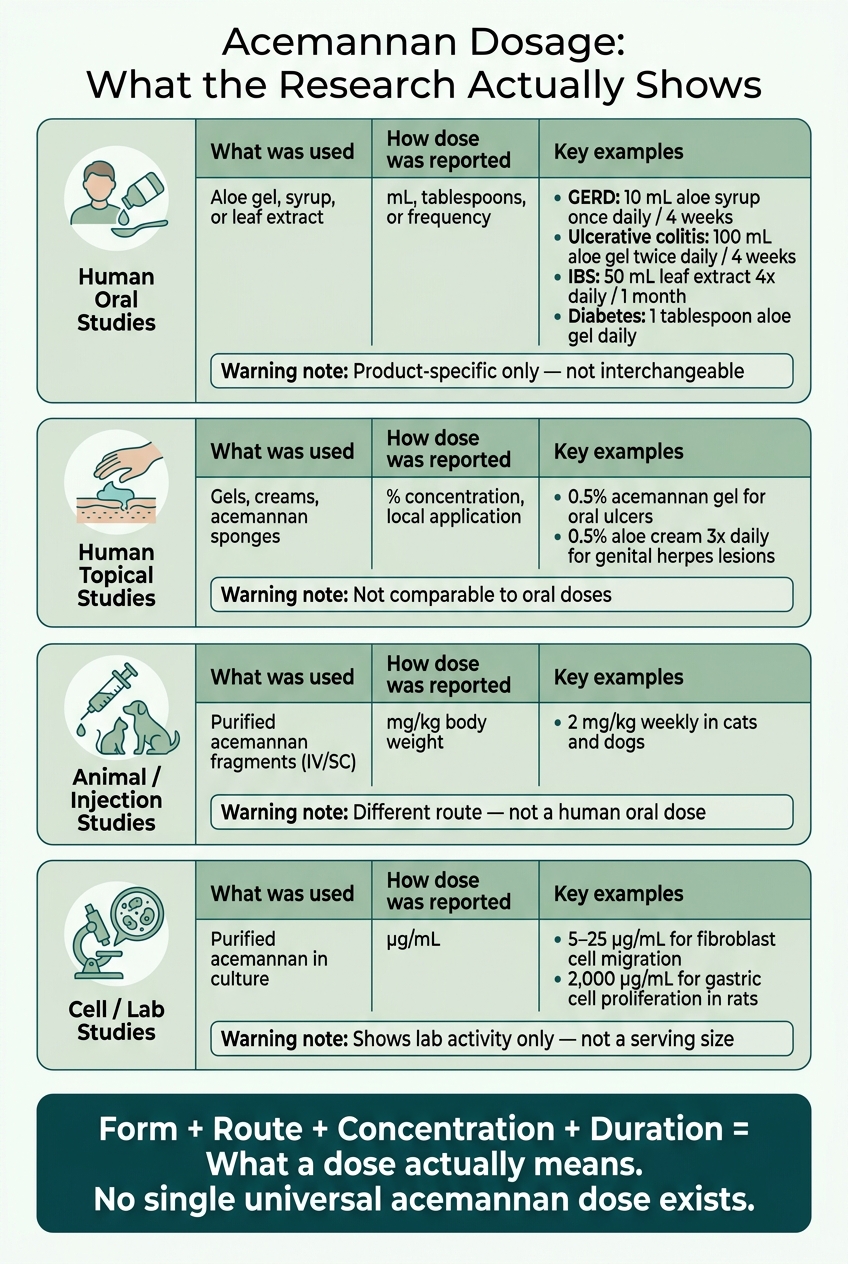
Acemannan Dosage by Study Type: What the Research Actually Shows
| Study type | What was used | How dose was reported | What you should know |
|---|---|---|---|
| Human oral | Aloe gel, syrup, leaf extract | mL, tablespoons, frequency | Product-specific only |
| Human topical | Gels, creams, sponges | % concentration, local application | Not comparable to oral use |
| Animal/injection | Purified fragments | mg/kg | Different route, not a human oral dose |
| Cell studies | Purified acemannan | µg/mL | Shows activity in a dish, not a serving size |
So if you’re looking for a single “best acemannan dosage,” the research does not support that. The safer way to read the evidence is to match the exact product, route, concentration, and study length instead of treating all aloe or acemannan products as if they were the same.
sbb-itb-b88dd21
What acemannan is and which forms have been studied
Acemannan is a polysaccharide found mainly in the inner leaf gel of aloe vera. Researchers study it for effects tied to the immune system, wound healing, and inflammation. One thing matters a lot here: the form used in a study changes what the dose numbers mean.
Purified acemannan vs. aloe-based preparations
Some papers look at purified acemannan. Others use aloe-based preparations that include acemannan along with other compounds. Those forms are not interchangeable.
Processing can change the final makeup of the material. That helps explain why dose claims are hard to line up from one product to another.
"The bioactive components of A. vera considerably differ based on their extraction method." - BMC Complementary Medicine and Therapies
Oral, topical, and injection-based delivery routes
The delivery route also changes how acemannan is used and how study results should be read. Oral forms are studied for digestive and metabolic effects. Topical forms are studied for skin and oral tissue repair. Injection-based forms are studied for immune-related effects.
| Delivery Route | Studied Form | Primary Research Focus |
|---|---|---|
| Oral | Oral acemannan or aloe preparations | Satiety, glucose release slowing, and digestive effects |
| Topical | Acemannan/chitosan nanohydrogels; 0.5% gels | Wound healing, oral ulcers, and tissue repair |
| Injection | Purified acemannan fragments | Immune and cancer-related responses |
With those forms in mind, the next section looks at the human dose ranges reported in studies.
Human dose ranges reported in studies
Most human studies look at aloe-based products, not pure acemannan. So if you're trying to compare doses across studies, it gets messy fast. It also means product labels don't give you a clean apples-to-apples match.
The clearest human data come from short oral trials.
Oral dose ranges and study duration
Most oral studies run for about 4 weeks. That's long enough to spot short-term effects, but not enough to say much about long-term safety or how well these products keep working over time.
| Form | Dose | Duration | Study Population | Reported Outcome |
|---|---|---|---|---|
| Aloe gel syrup (5 mg/mL polysaccharide) | 10 mL once daily | 4 weeks | GERD patients (n=79) | Reduced heartburn, regurgitation, and nausea |
| Aloe vera gel | 100 mL twice daily | 4 weeks | Ulcerative colitis (n=44) | Improved clinical remission and histological scores |
| Decolorized leaf extract | 50 mL four times daily | 1 month | Diarrhea-predominant IBS | Improved IBS symptoms |
| Aloe vera gel | 1 tablespoon daily | Not consistently reported | People with type 2 diabetes | Modest reduction in fasting blood glucose and HbA1c |
One detail stands out in the GERD trial: 10 mL of aloe syrup performed about as well as omeprazole and ranitidine for regurgitation, but it did less for heartburn. That's worth noting, but only for that specific syrup. It doesn't tell us how pure acemannan would act on its own.
Topical and procedure-based human uses
Topical and procedure-based studies are harder to compare because they report doses in a different way. Instead of listing milligrams, they usually describe the concentration or the product format.
For example, a 0.5% acemannan gel has been studied for local use on the oral mucosa to treat ulcers. A 0.5% aloe cream applied three times daily until healed was also tested in a genital herpes trial, where it was linked with faster lesion healing.
Dental use follows the same idea. Acemannan sponges or gels are placed right at the treatment site to help support dentin, pulp, bone, and soft tissue repair. In these cases, the format itself is part of the dose. So comparing them in milligrams to oral supplements doesn't make much sense.
Animal and laboratory dose ranges and reported outcomes
Human studies give product-specific dose ranges. Animal and lab studies do something different: they help show how acemannan might work. Once human research stops giving clear dosing ranges, these non-human data become useful for understanding mechanism. Most of what we know on that front comes from animal and cell studies.
Immune, wound, and bone-related findings
In immune research, purified acemannan promoted dendritic-cell maturation and reduced inflammatory signaling in human macrophages. Injected fragments have also been studied for immune stimulation.
For wound healing, the lab data point to activity across a range of concentrations. In fibroblast cultures, 5–25 µg/mL promoted cell migration. In rat gastric mucosa models, 2,000 µg/mL was the best level for cell proliferation. In rats given oral aloe preparations, acemannan was linked to increased TGF-β and FGF production. In bone-related work, acemannan supported cell proliferation, differentiation, and mineralization in stromal cell models.
| Model | Form / Route | Dose or Concentration | Duration | Main Finding |
|---|---|---|---|---|
| Rat gastric mucosa cells | Purified acemannan | 2,000 µg/mL | 24 hours | Cell proliferation |
| 3T3-L1 fibroblasts | Acemannan | 5–25 µg/mL | 3–9 hours | Cell migration / wound closure |
| Cats/dogs | Injectable (IV/SC) | 2 mg/kg | Weekly | Immune/tumor response |
Those figures show biological activity in test systems. They are not a human dosing guide.
How to read non-human dosing data
Cell-culture concentrations show what it takes to get a response in a controlled dish. That setup leaves out a lot. It doesn't tell you what happens during digestion, how much gets absorbed, or how the body changes acemannan after intake.
Animal doses given by injection are also a different case. IV or SC delivery skips the digestive tract, which makes it very different from swallowing a capsule or drinking aloe juice. So these dose ranges are best used as a map of activity, not as proof of a safe or effective human dose.
Put simply, cell-culture activity does not equal a human serving size. That shifts the focus to tolerability, not just whether the compound does something in a lab.
Safety, uncertainty, and the bottom line
What published studies say about tolerability
Animal and lab data may show activity, but human safety data sets the limit for day-to-day use.
Right now, human safety research is limited. Most published studies look at topical use or oral mucosal use for only about 7 days.
One trial included 100 healthy subjects who completed a skin patch test. Another included 50 healthy participants who applied 0.5% acemannan gel to the oral mucosa three times a day for 7 days.
Oral aloe gel, which contains acemannan, is generally viewed as safe for short-term use up to about 42 days. After that, the picture gets murkier. Long-term human safety data is thin, and rare cases of liver toxicity have been reported 3 to 24 weeks after people started taking oral aloe. So if someone is thinking about daily use over months, the research just isn't there yet.
Key points for reading product labels
For most people, the label is where this gets practical.
Start by checking what the product actually contains. A label that names purified acemannan is not the same as one that says "aloe vera" or "whole leaf extract." Those terms sound similar, but they do not mean the same thing.
A few label details matter more than they may seem:
- Be careful with products labeled "whole leaf" or "non-decolorized whole leaf." IARC classifies non-decolorized whole-leaf aloe extract as possibly carcinogenic to humans (Group 2B).
- Match the product to the research. A topical wound-healing study does not confirm the dose for an oral supplement, and the reverse is also true.
- Look for IASC certification when the product is meant for internal use. The International Aloe Science Council (IASC) requires these products to contain less than 10 parts per million (ppm) of aloin. That's one plain sign the product was processed to cut down compounds linked with more risk.
Form, route, concentration, and duration all change what a dose may do. So when a product points to research to justify its serving size, look a little closer. Did the study use the same preparation, the same delivery method, and the same type of people? If not, the comparison may not hold up.
FAQs
How can I compare acemannan labels to study doses?
Check the label for the amount of acemannan or polysaccharides in each serving. A lot of aloe products don't list acemannan at all, which makes side-by-side comparison tricky. Third-party testing or certification can also help confirm product quality.
Then compare that amount with doses used in research, such as 50–200 mg of dried aloe extract or about 15 mL of aloe vera gel per day. If the product doesn't list acemannan content, making a direct comparison gets a lot harder.
Is pure acemannan different from aloe vera gel or extract?
Yes. Pure acemannan is a specific polysaccharide taken from aloe vera gel.
Aloe vera gel or aloe vera extract is different. It usually contains a mix of compounds, such as acemannan, other polysaccharides, vitamins, and minerals.
The exact makeup can change based on the aloe source and how the material is processed.
What does short-term aloe safety mean for daily use?
Short-term oral aloe use is generally seen as safe for daily use for up to 42 days.
The risk goes up with long-term use or higher doses, especially with aloe latex, which can lead to serious side effects.