Top 5 Research Studies on Acemannan Explained
Acemannan shows immune, wound‑healing, metabolic and radioprotective effects in studies, though human trials remain limited.


Acemannan, a key compound in aloe vera gel, has been extensively studied for its effects on immune function, tissue repair, and metabolic health. Found in the inner leaf gel of Aloe vera, this β-(1,4)-linked acetylated mannan interacts with immune cells, promotes wound healing, and supports gut health. Here's a quick overview of five notable studies:
- Immune Modulation: Acemannan enhances the maturation of dendritic cells and boosts lymphocyte activity, improving the immune system's response to threats.
- Radioprotective Effects: Animal studies show increased survival rates and reduced oxidative stress after radiation exposure.
- Wound Healing: Topical application accelerates tissue repair, promotes growth factor production, and reduces inflammation.
- Macrophage Polarization: It shifts macrophages to a tissue-repair state, aiding in inflammation control and healing.
- Comprehensive Review: Data confirms its roles in antiviral activity, blood cell production, and metabolic regulation.
Key takeaway: Acemannan's benefits vary by application method - oral, topical, or intravenous - making it a versatile tool for health interventions. However, more human studies are needed to confirm its full potential.
What Science Says About Acemannan
Structure and How It Works
Acemannan's molecular structure is at the heart of its wide-ranging effects on health. It is a polydispersed β-(1,4)-linked acetylated mannan, and its unique design allows it to bind to mannose receptors on immune cells. Interestingly, breaking down its long molecular chains into smaller fragments enhances its effectiveness. These smaller fragments act as mannose receptor agonists, specifically targeting macrophages and dendritic cells, and triggering a series of immune responses. According to researchers Nicholas J. Sadgrove and Monique S. J. Simmonds:
"These fragments can intravenously boost vaccine efficacy or entrain the immune system to attack cancer cells by mannose receptor agonism of macrophage or dendritic cells."
Acemannan's effects also vary depending on how it is administered. When applied topically, it promotes wound healing by encouraging macrophages to shift into an M2 polarization state. This shift reduces inflammation and speeds up tissue repair. Orally, acemannan interacts with gut microbes, which ferment it into short-chain fatty acids (SCFAs). These SCFAs play a role in regulating blood sugar levels and increasing feelings of fullness.
Here’s a breakdown of how acemannan works through different methods of application:
| Application Route | Biological Interaction | Primary Benefit |
|---|---|---|
| Intravenous | Mannose receptor agonism on dendritic cells | Enhanced vaccine efficacy and anti-tumor activity |
| Topical | M2 macrophage polarization | Faster wound healing and tissue repair |
| Oral | Microbial fermentation into SCFAs | Better blood sugar regulation and increased satiety |
| Cellular | Downregulation of the NLRP3 inflammasome | Lowered systemic and localized inflammation |
Safety Profile and Toxicology
Studies on animals, such as Swiss albino mice and chickens, have shown that acemannan has immunomodulatory and radioprotective properties without causing acute toxicity . Additionally, research on similar glucomannans has demonstrated their safety for dietary use, even in moderately obese adults. This evidence underlines acemannan's potential as a safe and effective supplement.
sbb-itb-b88dd21
Top 5 Research Studies on Acemannan
Over the years, scientists have conducted numerous studies to understand acemannan, focusing on its interactions with cells and its effects on living organisms under stress. Below are five key studies that delve into its health-related applications.
Study 1: Acemannan as an Immunomodulator in Human Cells
A team from Chungbuk National University, led by Sun-A Im and Chong-Kil Lee, explored how acemannan influences the immune system. They concentrated on professional antigen-presenting cells, such as human dendritic cells and macrophages, discovering that acemannan promotes both the phenotypic and functional maturation of immature dendritic cells. This maturation enhances the cells' ability to identify and respond to potential threats. Additionally, the study revealed that acemannan improves lymphocyte responsiveness, boosting the immune system's capacity to combat foreign antigens.
"Acemannan purified from Aloe vera induces phenotypic and functional maturation of immature dendritic cells." - Lee, Chong-Kil et al.
Interestingly, the study noted that the biological activity of acemannan was influenced by its molecular size. Smaller fragments of acemannan demonstrated stronger immunomodulatory effects in cell cultures.
Study 2: Radioprotective and Antioxidant Effects in Mice
This preclinical study focused on Swiss albino mice exposed to radiation, highlighting acemannan's potential benefits. Findings included increased survival rates and reduced oxidative stress in the mice.
Moreover, acemannan helped restore blood cells like white blood cells and platelets, which are often damaged by radiation. It also sped up the healing of radiation-delayed wounds.
"Studies that used purified acemannan demonstrate that acemannan exerts immune-stimulating, anti-cancer, anti-viral, and hematopoiesis-increasing activities." - Im, Sun-A, College of Pharmacy, Chungbuk National University
While these results are promising, further research involving human trials is necessary to confirm its radioprotective effects.
Study 3: Acemannan in Wound Healing and Tissue Regeneration
Researchers have investigated how acemannan aids in wound healing and tissue repair across various models, such as skin, bone, and intestinal tissue. When applied topically - often paired with chitosan - acemannan encouraged the formation of granular tissue, which is crucial for effective healing.
It also stimulated the proliferation and differentiation of epidermal keratinocytes, the cells responsible for regenerating the skin's outer layer. Additionally, acemannan enhanced the production of growth factors like Transforming Growth Factor-β (TGF-β) and Fibroblast Growth Factor (FGF). In bone models, it supported bone marrow stromal cells by promoting extracellular matrix synthesis and mineralization. When administered orally, it facilitated epithelialization in the small intestine and colon.
"In topical applications, an acemannan/chitosan combination accelerates the closure of wounds by promoting granular tissue formation... This causes M2 polarisation, reversal of inflammation, and acceleration of the re-epithelialisation process." - Nicholas J. Sadgrove and Monique S. J. Simmonds, Royal Botanic Gardens, Kew
These findings underscore acemannan's potential in tissue repair across multiple systems.
Study 4: Macrophage Polarization and Metabolism
Acemannan has been shown to shift macrophages into the M2 state, which is associated with tissue repair and reduced inflammation. This transition occurs through mannose receptor activation and supports antitumor responses. These findings highlight acemannan's role in balancing the immune system and promoting healing.
Study 5: A Broad Review of Acemannan's Medicinal Properties
A comprehensive review pulled together data from various studies, confirming acemannan's roles in immune modulation, antiviral activity, and tissue repair. This broad analysis provides a clearer picture of how acemannan works across different biological systems, reinforcing its therapeutic potential.
What These Studies Mean for Your Health
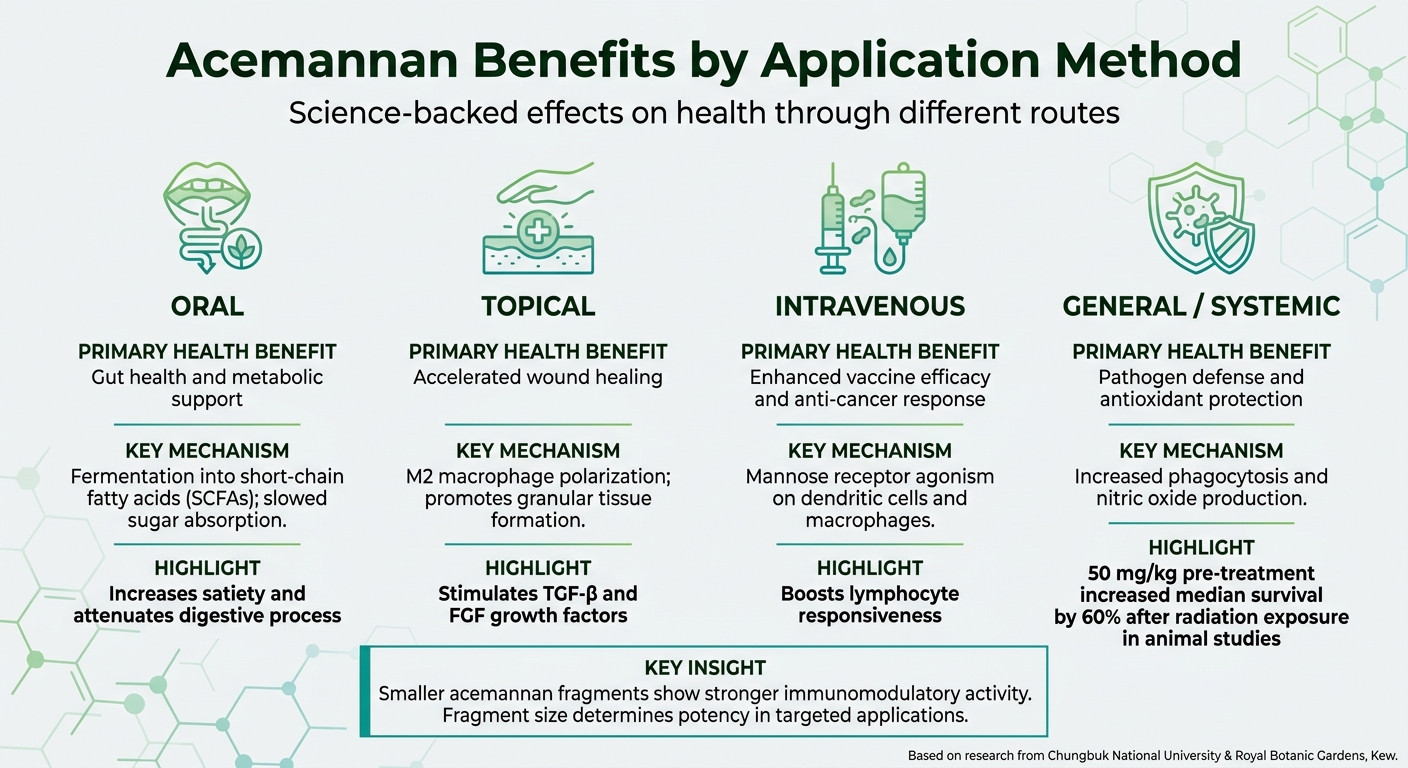
Acemannan Benefits by Application Method: What the Research Shows
The findings from these five studies highlight acemannan's measurable effects on immune function, tissue repair, and metabolic processes. What's clear is that the benefits of acemannan depend on how it’s delivered to the body.
A major takeaway is immune support. Acemannan activates macrophages and dendritic cells, boosting phagocytosis - the process where harmful particles are engulfed and neutralized. It also increases nitric oxide production, which helps the body fight off pathogens.
Beyond its immune-boosting properties, acemannan shows antioxidant and radioprotective capabilities. For instance, in animal studies, a seven-day pre-treatment with 50 mg/kg of acemannan increased median survival rates by 60% after radiation exposure, while post-treatment resulted in a 20% survival increase. Researchers Sumit Kumar and Ashu Bhan Tiku observed:
"Acemannan has the ability to protect mice against radiation-induced mortality by immunomodulation and can be developed as a radiation damage mitigation agent."
Although human trials are still necessary, the mechanisms observed - including stimulating new blood cell production and maintaining spleen function - are critical for recovery from physical stress.
When it comes to wound healing, acemannan plays another vital role. It promotes the M2 state in macrophages, which speeds up the transition from inflammation to tissue repair. Orally consumed acemannan also benefits the gut lining by aiding epithelialization. Nicholas J. Sadgrove of the Royal Botanic Gardens, Kew, explained:
"The main advantage of dietary acemannan is the attenuation of the digestive process, increasing satiety, and slowing the release of sugars from starches."
The method of application determines the specific benefits of acemannan, as shown below:
| Application Method | Primary Health Benefit | Key Mechanism |
|---|---|---|
| Oral | Gut health and metabolic support | Fermentation into SCFAs; slowed sugar absorption |
| Topical | Accelerated wound healing | M2 macrophage polarization; granular tissue formation |
| Intravenous | Enhanced vaccine/cancer response | Mannose receptor agonism on dendritic cells |
| General | Pathogen defense | Increased phagocytosis and nitric oxide production |
The effectiveness of acemannan also depends on fragment size. Smaller fragments have shown stronger immunomodulatory activity, particularly in targeted applications. Understanding this structure-function relationship is essential for incorporating acemannan into wellness strategies tailored to specific needs.
Conclusion
The five studies highlight that Acemannan offers measurable benefits across various body systems. It supports tissue repair by modulating immune responses and growth factors, presenting scientifically grounded advantages rather than vague wellness promises.
The compound’s structure plays a key role in its effectiveness. Breaking Acemannan into smaller fragments boosts its immunomodulatory properties, while the O-acetyl groups in its molecular makeup are essential for its antioxidant and radioprotective effects. This structural specificity is the foundation of the benefits observed in the research.
Researchers at Chungbuk National University summarized the findings:
"Studies that used purified acemannan demonstrate that acemannan exerts immune‑stimulating, anti‑cancer, anti‑viral, and hematopoiesis‑increasing activities."
However, the research is not yet conclusive. As noted by Nicholas J. Sadgrove and Monique S. J. Simmonds from the Royal Botanic Gardens, Kew, "Due to contradictory results in the literature, further research is required to provide scientific evidence to confirm or nullify these claims". Understanding the current evidence - and recognizing areas where more research is needed - allows you to make informed decisions about incorporating Acemannan into your health regimen. This knowledge helps you adopt strategies grounded in science for your wellness journey.
FAQs
What is acemannan, exactly?
Acemannan is a naturally occurring polysaccharide extracted from the gel of Aloe vera (scientifically known as Aloe barbadensis Miller). It plays a central role in delivering many of the plant's health benefits, such as boosting the immune system, aiding wound healing, and reducing inflammation. Acemannan works by activating immune cells like macrophages, promoting tissue repair, and supporting digestive health. In the colon, it encourages the production of beneficial short-chain fatty acids, further highlighting its importance in the therapeutic effects of Aloe vera.
Which form works best: oral, topical, or IV?
The ideal form of acemannan depends on what you're aiming to achieve health-wise:
- Oral: This is great for boosting the immune system and supporting gut health. It works by stimulating immune cells and helping repair the gut lining.
- Topical: Perfect for wound care, as it encourages healing and helps regenerate tissue.
- IV: Intravenous delivery may offer targeted immune support, but research on this method is still in its early stages.
For now, oral and topical applications stand out as the most effective options for general health and wound care, according to current studies.
What do human studies show so far?
Acemannan has shown potential immune-boosting properties in human studies. It appears to activate key immune cells like macrophages and dendritic cells, while also promoting the production of nitric oxide and cytokines such as IL-6 and IL-8. Additionally, it supports processes like hematopoiesis, which is crucial for maintaining a healthy immune system. Animal studies back these findings, highlighting its role in activating macrophages and aiding the development of immune cells. Although these results are promising, further clinical trials are necessary to validate its effects and determine the best dosages for human use.