Acemannan Supplements
No established oral dose — check acemannan mg per serving, request lot-specific COAs for aloin and contaminants, and review safety.

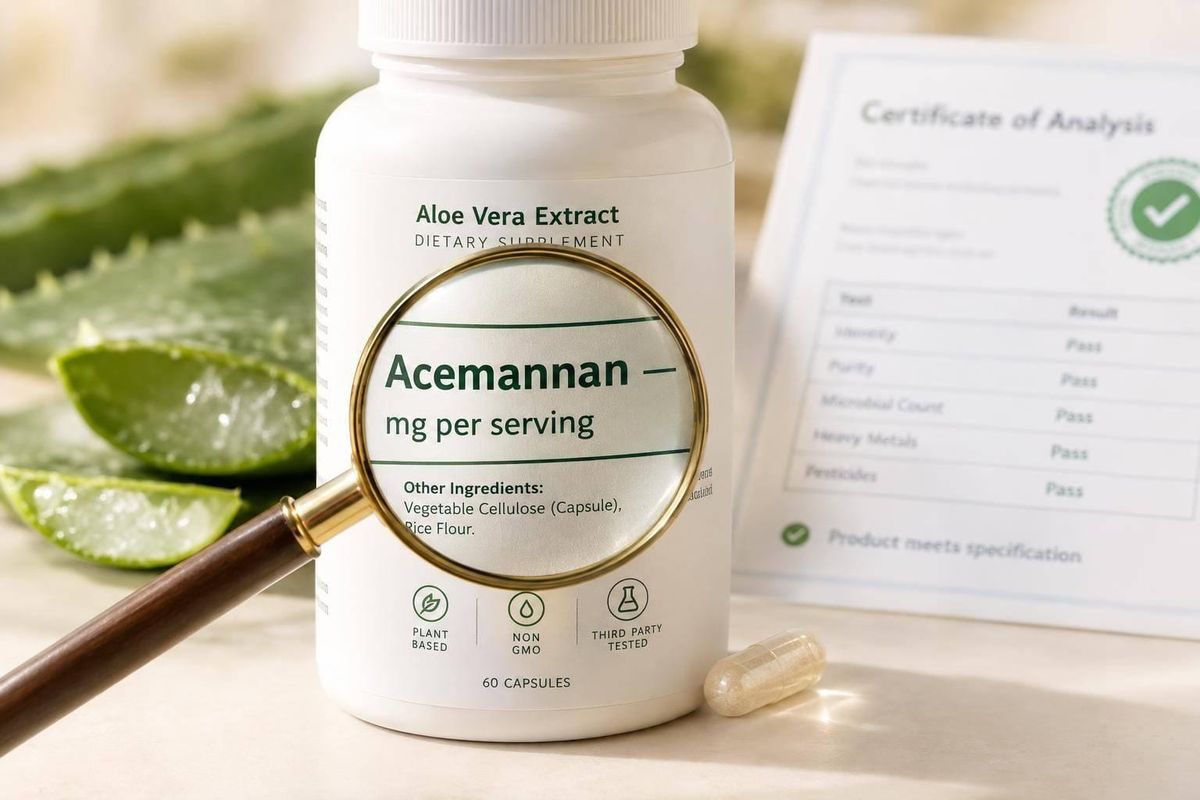
Acemannan supplements have no established oral dose or proven role in preventing or treating disease. Before buying, check the measured acemannan in milligrams per serving - not just the aloe amount - and request batch test results for aloin and contaminants.
Acemannan comes from aloe’s inner-leaf gel. Most research involves cells or animals; topical and dental studies don’t establish the same effects from swallowed supplements.
Whether choosing capsules, powders, liquids, or aloe drinks, check:
- The ingredient: Plant part, processing method, and acemannan amount.
- The testing: Lot-specific results for acemannan, aloin, heavy metals, and microbes.
- The safety: Possible side effects, medication interactions, and health conditions that warrant medical advice.
A clear label and clean test results help assess product quality - not whether it works.
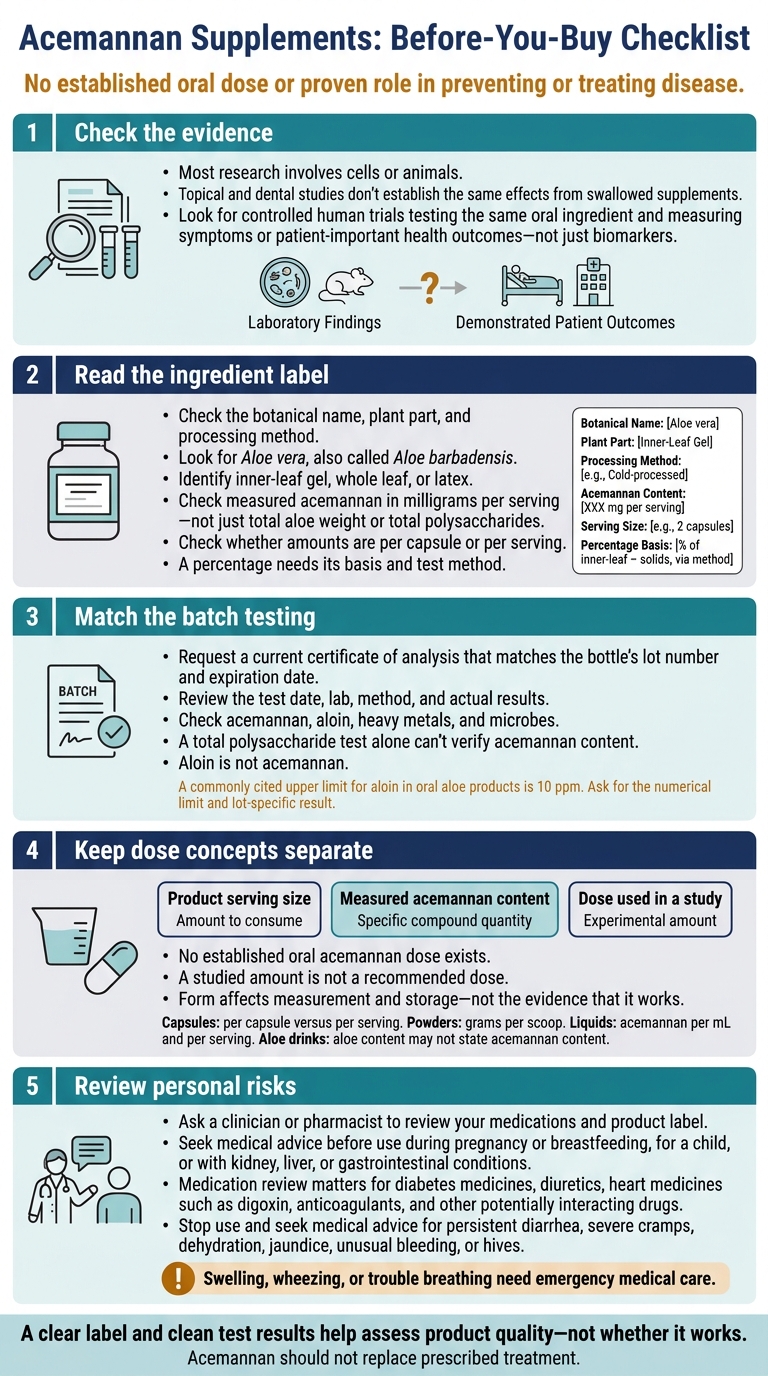
Acemannan Supplements: Before-You-Buy Checklist
What Research Says About Proposed Benefits
Most research comes from lab and animal studies. Human results vary by preparation and dose.
| Proposed use | Laboratory or animal findings | Human evidence | Are clinical outcomes established? |
|---|---|---|---|
| Immune signaling | Studies report macrophage activation, dendritic-cell maturation, lymphocyte responses, cytokine release, and increased phagocytic activity. | Small or older studies report changes in immune markers. An HIV trial using 1,600 mg/day found no statistically significant change in CD4 decline. | Not established |
| Gut or intestinal function | Studies suggest interactions with intestinal immune pathways and changes in the microbiome. Findings depend on the aloe preparation. | No clear evidence shows that oral acemannan reliably relieves digestive symptoms, prevents intestinal disease, or improves microbiome health. | Not established |
| Wound healing and tissue repair | Cell and animal studies report effects on fibroblasts, macrophages, cytokines, and tissue repair. | Human studies have tested topical, oral-mucosal, skin, and dental applications. These findings do not establish whole-body benefits from oral supplements. | Not established for oral use |
| Inflammation and oxidative stress | Experimental studies report changes in inflammatory cytokines and antioxidant effects. | Human evidence is too limited and specific to each preparation to show reliable reductions in systemic inflammation or disease symptoms. | Not established |
Immune Signaling and Gut Function
Lab studies show that acemannan can change immune-cell activity. But a change in a marker does not prove better immunity or fewer infections. Differences between preparations also help explain why lab findings may not carry over to oral supplements.
The same caution applies to gut health. Changes in microbes, cytokines, or gut-barrier markers do not establish relief from constipation, irritable bowel symptoms, or inflammatory bowel disease. Look for human studies that measure symptoms or quality of life - not just lab markers.
Tissue Repair and Inflammation
Most wound-healing evidence comes from topical or dental use. It does not establish the same effects from oral supplements. Antioxidant or anti-inflammatory activity in experimental models also does not prove less pain, faster healing, or better disease control in people.
What Users Can Expect
For buyers, human results remain inconsistent and specific to the product tested.
In a 48-week trial of 63 men with advanced HIV, 1,600 mg/day did not significantly affect CD4 decline.
This finding does not support using acemannan to treat HIV. Any benefits remain uncertain rather than predictable.
To assess a claim, check whether a controlled human trial tested the same oral ingredient and measured symptoms or health outcomes that matter to patients - not just biomarkers. No reliable dose-response relationship has been established, and acemannan should not replace prescribed treatment.
sbb-itb-b88dd21
How to Read Acemannan Supplement Labels
Study results depend on the exact preparation used. That means the label needs to state the acemannan dose, not just the amount of aloe.
| Label feature | Why it matters | Warning sign |
|---|---|---|
| Measured acemannan in milligrams per serving | States the amount of the target ingredient | Only total aloe weight or a marketing claim appears |
| Percentage basis | Clarifies whether the percentage applies to dry powder, extract, or another material | A percentage appears without its basis or test method |
| Numerical aloin limit | Helps assess exposure to aloe latex compounds | Aloin-free appears without a detection limit or test result |
| Lot-specific test records | Links reported results to the bottle purchased | Only third-party tested or high purity appears |
Aloe Source and Acemannan per Serving
Start with the botanical name and plant part. Look for Aloe vera, also called Aloe barbadensis, and check whether the product uses inner-leaf gel, whole leaf, or latex. Check the processing method, too. It can affect polysaccharide content and composition.
Read the serving size and servings per container alongside acemannan in milligrams per serving. If the amount is listed for two capsules, it isn't the amount in one capsule. Total aloe weight and total polysaccharides don't establish the acemannan dose. A proprietary blend may also leave individual amounts unclear.
Use milligrams per serving when possible. Percentages help only when the label explains what they measure and how they were tested. These details let you compare the ingredient, amount, and processing with those used in research.
Aloin Limits and Other Label Details
Aloin is not acemannan. It is associated with aloe latex and laxative effects. A commonly cited upper limit for aloin in oral aloe products is 10 ppm, but labels usually don't state the actual amount. Ask for both the numerical limit and the lot-specific test result, especially for whole-leaf preparations.
Review the Other ingredients section for fillers, binders, preservatives, sweeteners, flavors, capsule materials, and anything that matters for allergies or dietary restrictions. Check storage directions, manufacturer or distributor contact details, the expiration or best-by date, and the lot or batch number.
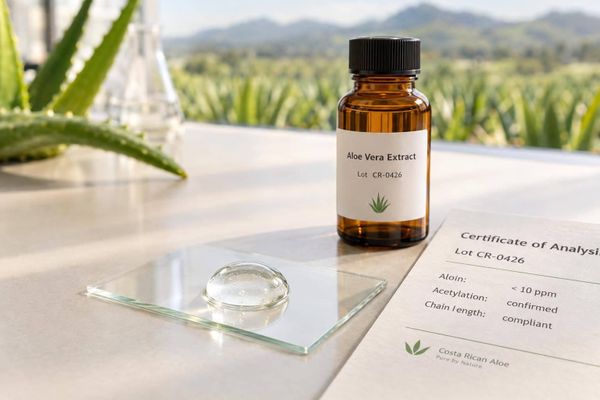
A product name doesn't prove dose or purity. Match the bottle's lot number to the certificate of analysis, then check the test date, lab, method, and actual results for acemannan, aloin, and contaminants.
Supplement Forms and What We Know About Dosing
No established oral acemannan dose exists. Keep three things separate: the product’s serving size, its measured acemannan content, and the dose used in a study. Aloe amounts and label claims alone don’t tell you how much acemannan you’re taking.
Capsules, Powders, Liquids, and Aloe Drinks
The form mainly affects how you measure and store the product - not the evidence that it works. Apply the label and testing checks above, then check these details.
| Form | Dose measurement | Stability and label details |
|---|---|---|
| Capsules | Check milligrams per capsule versus per serving; total capsule powder is not the acemannan amount | Consistent servings depend on uniform filling and testing |
| Powders | Check grams per scoop; scoop accuracy affects how much you take | Follow mixing and moisture-control instructions |
| Liquids | Check acemannan per mL and per serving; use an accurate measuring device | Check refrigeration requirements after opening and expiration instructions |
| Aloe drinks | Labels often list aloe content without stating the acemannan amount | Check dilution, serving volume, calories, and sugar |
How to Read Study Doses
To interpret a study dose, you need the preparation, acemannan amount, route, frequency, duration, and population studied. Research that reports only aloe weight cannot establish an acemannan dose. Neither can non-oral studies or studies in animals.
Even equal milligram amounts can differ because of extraction and processing. A studied amount is not a recommended dose or a reason to increase your serving. Safety and quality also need attention.
Discussing Use With a Health Professional
Follow the labeled amount, but treat it as a guide - not proof that the product works or is safe. Before use, ask a clinician or pharmacist to review the label, your medications, and how long you plan to take it. This is especially important when the acemannan content is unclear.
Short-term oral aloe-gel studies last up to 42 days. They do not establish long-term safety or an acemannan dose. Before taking a product, check its safety information, possible side effects, and batch-testing results.
Safety and Quality Checks Before Use
Dose alone doesn’t make a product safe. Product quality and contamination matter, too. Check the label and testing results rather than relying on the word “purified.”
Side Effects and Who Should Seek Medical Advice
Aloe latex and poorly purified whole-leaf products may contain aloin, which can cause cramps and diarrhea. Other possible side effects include nausea, loose stools, and allergic reactions. Oral aloe leaf extracts have been linked to acute hepatitis, but those reports don’t prove that purified acemannan causes the same effect.
Before taking oral acemannan, get medical advice if you’re pregnant or breastfeeding, if the product is for a child, or if you have a kidney, liver, or gastrointestinal condition. Bring the label for review if you take diabetes medicines, diuretics, heart medicines such as digoxin, anticoagulants, or other drugs that may interact with it.
Stop use and seek medical advice for persistent diarrhea, severe cramps, dehydration, jaundice, unusual bleeding, or hives. Swelling, wheezing, or trouble breathing may signal a serious allergic reaction and need emergency medical care.
Independent Testing and Batch Records
Ask for a current certificate of analysis that matches the bottle’s lot number and expiration date.
Check whether the lab used an acemannan-specific test. A total polysaccharide test alone can’t verify acemannan content. Review independent lab results for the amount of acemannan per serving, aloin, heavy metals, and microbial contamination. Passing results support the batch’s quality - not its clinical effectiveness.
Conclusion: Your Checklist Before Using Acemannan
Before buying or opening the bottle, check its form, measured acemannan amount, contamination results, and your personal risk factors. Weigh those findings against the uncertainty around benefits and dosing.
FAQs
How can I verify an acemannan lab report?
Request a lot-specific Certificate of Analysis (COA) that matches your product’s batch number. It should come from an independent, ISO/IEC 17025–accredited laboratory.
Look for numerical results, not just “pass” or “conforms.” The COA should report acemannan per serving or as a percentage of dry weight. For oral products, it should also show aloin below 10 ppm.
Check that it lists the testing methods - NMR, HPLC, or AOAC Official Method 2018.14 - and includes dates for finished-product testing and sample collection.
Does processing affect acemannan quality?
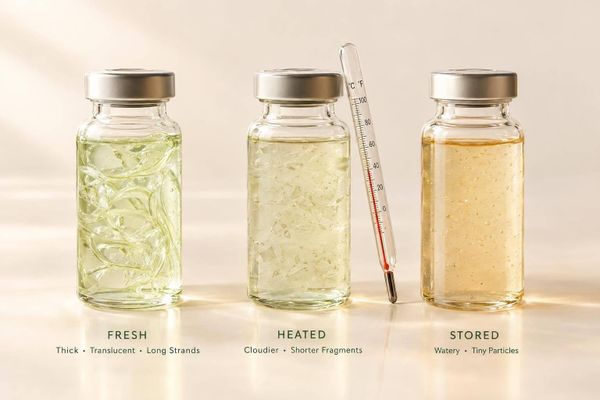
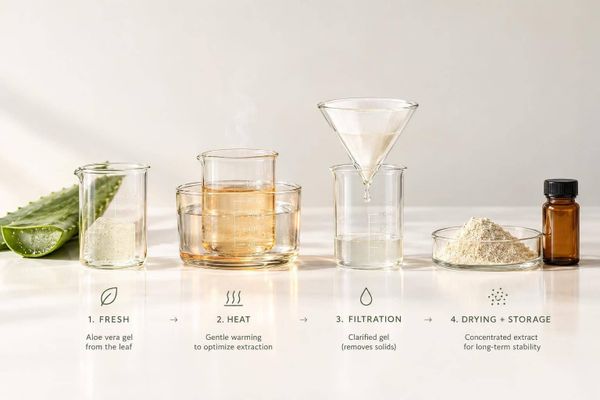
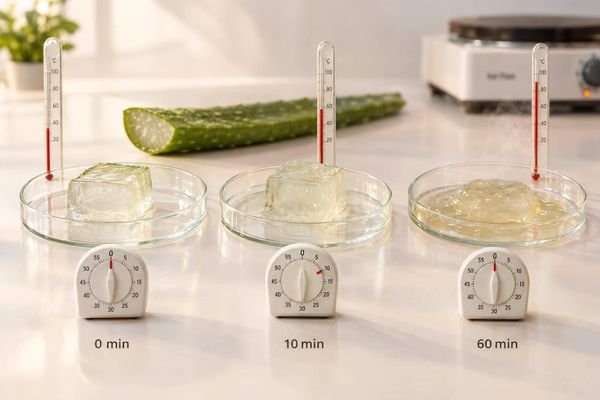
Yes. Acemannan is sensitive to heat, moisture, pH, and handling. Processing and storage can change its molecular weight, chain length, and degree of acetylation. Heat can shorten its chains and reduce acetylation. Spray drying can reduce both yield and structural integrity.
A label alone doesn’t guarantee that acemannan has been preserved. Ask for lot-specific test results for the finished product that confirm the acemannan amount, molecular-weight distribution, and acetylation levels.
How should I weigh uncertain benefits against risks?
Keep expectations modest. Most claims come from laboratory and animal studies. Human safety data are limited, especially for daily use beyond 42 days.
Choose purified inner-leaf gel. Before buying, check its acemannan content, aloin levels, and independent testing. Supplements aren’t FDA-approved for safety or efficacy.
Talk with a healthcare professional before use, particularly if you’re pregnant, breastfeeding, managing diabetes or kidney disease, or taking medications that may interact with aloe.