Acemannan Processing: Heat, Storage, and Immune Claims
Heat and storage change acemannan’s structure—product-quality tests matter, but only human trials prove immune benefits.

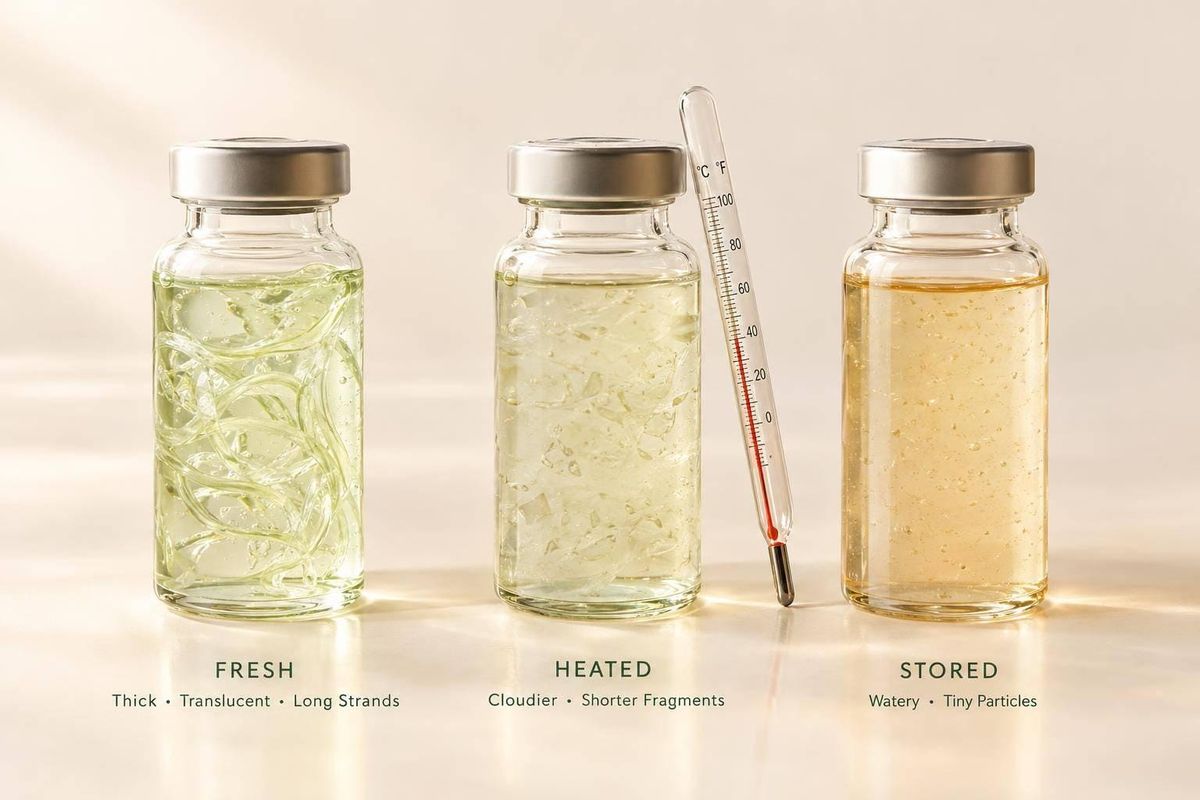
Heat and storage can change acemannan, but those changes do not prove immune benefits in people. A useful product check starts with lot-specific tests for acemannan content, chain size, and acetylation - not “cold-processed” or “heat-stable” labels alone.
- Heat and drying: Changes have been reported above 140°F (60°C), but time, pH, and processing steps also matter. No single temperature guarantees preservation.
- Storage: Refrigeration does not stop every change. Stability tests should match the product’s packaging, shelf life, and handling after opening.
- Immune claims: Cell responses and animal findings do not establish fewer infections in people. Human trials must test the preparation and health outcome being claimed.
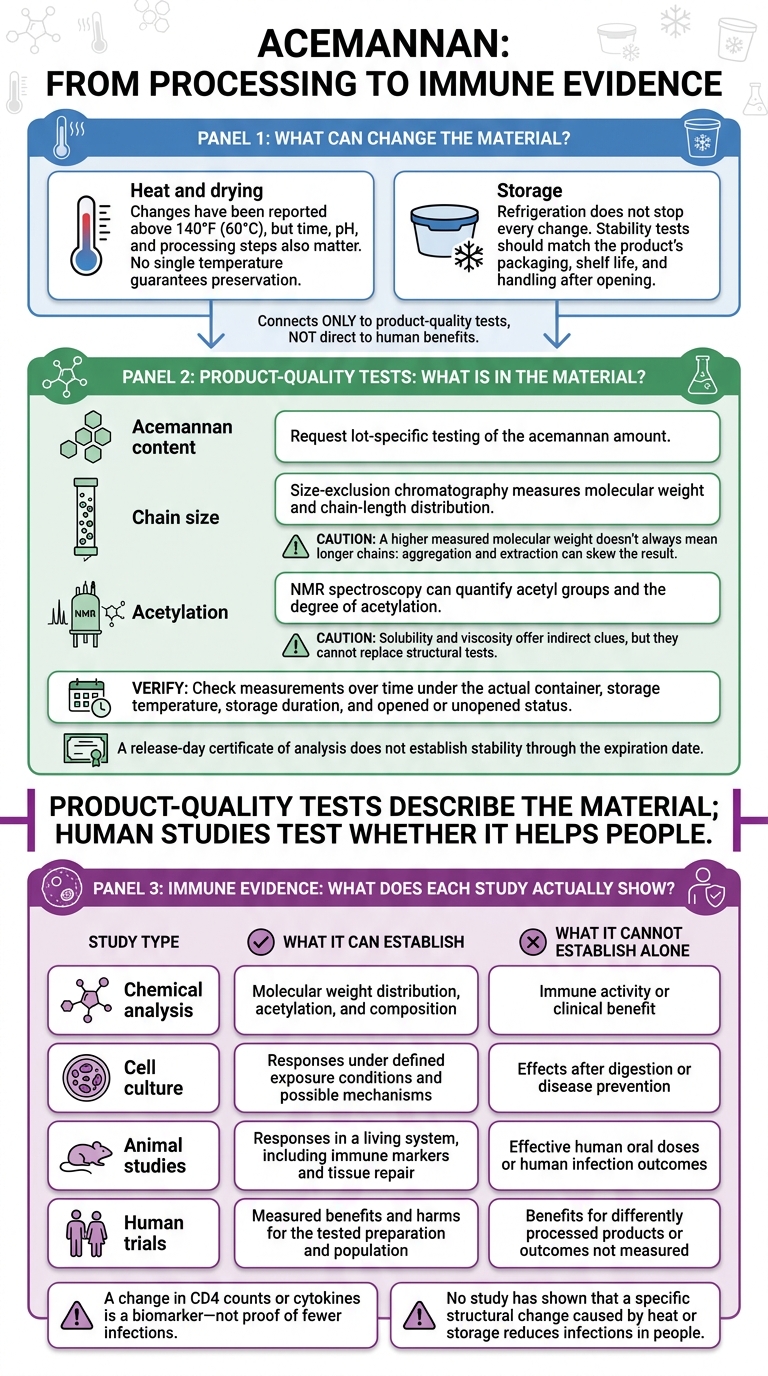
The key distinction: product-quality tests describe the material; human studies test whether it helps people.
Acemannan Evidence: Product Quality vs. Immune Benefits
How Heat and Drying Affect Acemannan
Heating Temperature and Duration
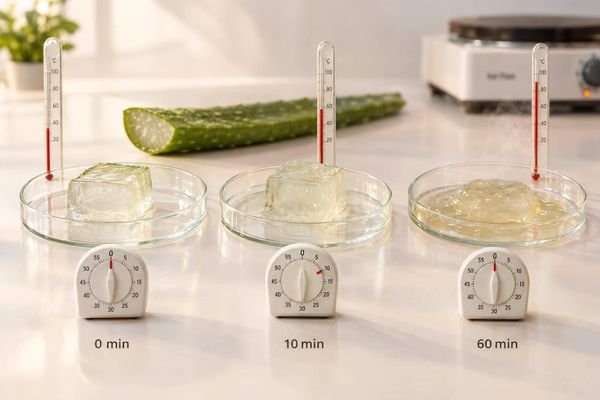
Temperature alone doesn’t predict preservation. Time, pH, and preparation method matter, too. Available sources report marked structural changes above 140°F (60°C), including deacetylation. But they do not establish a universal temperature below which acemannan stays unchanged. These same factors also affect its stability during storage.
Changes in Chain Length, Acetylation, and Solubility
Structural changes do not prove immune benefits. Heating or dehydration can change chain integrity, acetylation, and how the material dissolves. A higher measured molecular weight doesn’t always mean longer chains: aggregation and extraction can skew the result. Other plant fibers or additives, such as maltodextrin, can also affect viscosity.
Size-exclusion chromatography measures molecular weight and chain-length distribution. NMR spectroscopy can quantify acetyl groups and the degree of acetylation. Solubility and viscosity offer indirect clues, but they cannot replace structural tests.
Processing Methods: What the Tests Can and Cannot Show
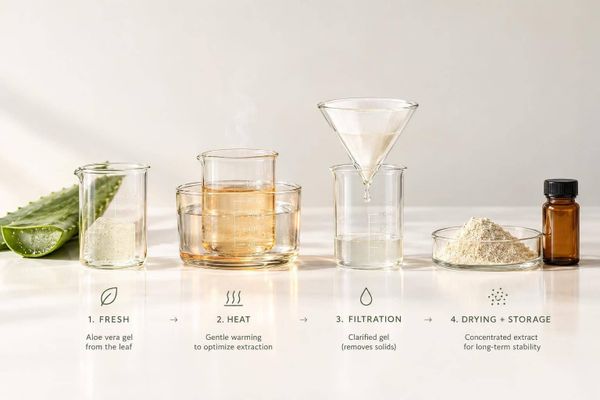
Cold extraction and freeze-drying are separate steps, so either label tells only part of the story. The actual temperature, exposure time, and starting material matter more than the method’s name.
| Processing method | Preparation and tested conditions | Reported changes or purpose | Evidence limits |
|---|---|---|---|
| Unprocessed gel | Newly collected inner-leaf gel in its native state | Baseline for comparison | Preparation and extraction can affect the starting profile. |
| Moderate heating | Mild heat exposure | Possible deacetylation and changes in physical behavior | Effects depend on duration and pH. |
| High-temperature short-time treatment | Brief high-heat exposure | Designed to balance microbial safety with structural preservation | Requires tight control to avoid chain cleavage. |
| Prolonged heating | Extended heat exposure | Marked deacetylation and loss of cell-based activity | No universal heat cutoff applies to every preparation. |
| Freeze-drying | Non-thermal vacuum dehydration | Helps preserve native chain length and acetylation | Cannot reverse damage from earlier heating or extraction. |
| Spray-drying | Liquid exposed to heated air | Can cause deacetylation and fragmentation | Results depend on starting material and process settings. |
Microbial counts measure contamination; macrophage assays measure cell response. Neither proves that chains stayed intact or that the material provides immune benefits in people. Structural tests and cell assays can support or weaken a processing claim, but only human trials can support an immune claim.
Processing-related changes often continue during storage, especially with continued exposure to moisture or heat.
sbb-itb-b88dd21
How Storage Affects Acemannan
After processing, storage is the next test of stability. It can change acemannan’s measured structure: measured acetylation can decline even under refrigeration. Browning alone does not prove acemannan damage, and changes in solubility do not, by themselves, prove chain degradation.
Storage Risks by Product Form
Stability depends on water content, formulation, packaging, and handling.
| Product form | Moisture and air exposure | Microbial risk | Possible appearance or texture changes |
|---|---|---|---|
| Liquid gel | Water-rich; opening introduces air | Requires appropriate preservation and storage | Viscosity changes or aggregation |
| Juice | Repeated opening increases exposure | Contamination after opening | Consistency changes |
| Dried powder | Can absorb moisture | Lower while dry | Clumping or reduced solubility |
| Purified dry or liquid preparations | Depends on whether the product is dry or in solution and how well it is sealed | Depends on water content and handling | Aggregation or altered solubility |
To assess stability, ask for test results that match the actual container, storage temperature, storage duration, and opened or unopened status. Look for acetylation and molecular-weight measurements over time, along with moisture measurements for powders and microbial counts for liquids. A release-day certificate of analysis does not establish stability through the expiration date.
Following Storage and Handling Instructions
Follow the product’s stated temperature range, refrigeration requirements, light protection, expiration date, and after-opening directions. Reseal containers promptly and keep powders dry. Refrigeration cannot prevent all deterioration, and no single shelf life is supported for every acemannan preparation.
Changes in odor, color, texture, or dissolution can signal deterioration. But appearance cannot confirm microbial safety or show whether acemannan’s structure remains intact. Visible changes may point to instability; they do not prove an immune effect. Storage markers describe stability, not immune activity.
If the product was stored outside its labeled instructions or changed unexpectedly, ask the manufacturer about that lot.
Immune Effects: From Laboratory Tests to Human Studies
Storage can change acemannan’s structure. The next question is whether those changes also affect immune activity.
What Cell and Animal Studies Measure
Cell studies measure macrophage activation, cytokine signaling, and receptor binding, including mannose receptors, TLR4, and TLR5. Some report stronger cell activity in the 5–400 kDa range, suggesting that molecular weight matters.
The preparation and dose matter, too. Animal studies add information about gut barrier integrity, tissue repair, and immune markers. But the administration route makes a difference: an injected preparation cannot show how an oral supplement works.
More immune activity does not automatically mean better health. Immune modulation alone also does not show that a response helps the body or stays under control.
What Human Studies Can Show
When assessing human trials, check the preparation’s measured acemannan content and structure, dose, route, study duration, and participants’ health status. A change in CD4 counts or cytokines is a biomarker - not proof of fewer infections. Mixed aloe extracts also make it harder to tell which effects come from acemannan.
Oral use adds uncertainty about digestion and what happens in the gut. Laboratory findings suggest possible prebiotic effects, but how much reaches the bloodstream remains unclear. No study has shown that a specific structural change caused by heat or storage reduces infections in people.
Study Types and Limits on Immune Claims
A claim that processing affects efficacy needs a direct comparison of clearly defined preparations, with the dose and ingredients controlled. Check whether researchers measured both the structural change and the claimed immune outcome in the same study. Separate chemical and biological studies can support a hypothesis. They cannot prove that preserving a particular structure guarantees immune benefits in people.
Each study type answers different questions:
| Study type | What it can establish | What it cannot establish alone |
|---|---|---|
| Chemical analysis | Molecular weight distribution, acetylation, and composition | Immune activity or clinical benefit |
| Cell culture | Responses under defined exposure conditions and possible mechanisms | Effects after digestion or disease prevention |
| Animal studies | Responses in a living system, including immune markers and tissue repair | Effective human oral doses or human infection outcomes |
| Human trials | Measured benefits and harms for the tested preparation and population | Benefits for differently processed products or outcomes not measured |
Conclusion: What Processing Changes Can Tell Us
Heat, drying, and storage can change acemannan’s molecular weight and acetylation. These measurements describe product quality - not immune efficacy. Structure alone does not prove benefit or harm. Only human evidence can show whether these changes matter clinically. The practical question is whether a change in a lab measurement makes a difference in people.
Checklist for Assessing Claims
Use these checks to separate processing facts from marketing claims.
- Ask for processing details: plant part, extraction and drying methods, temperatures, exposure times, and storage instructions.
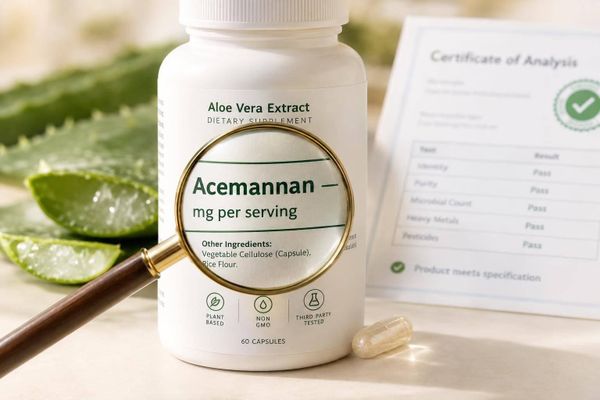
- Request a lot-specific certificate of analysis (COA) that lists the acemannan amount, molecular-weight distribution, and acetylation.
- Check whether stability testing tracks those measurements through the labeled shelf life.
- Treat “heat-stable” as incomplete unless the claim states which measurement stays stable. “More active” needs a direct comparison and a measured outcome. Check the study type and whether the tested preparation matches the claim.
Using Supplement Information With Care
Treat product claims as unverified when they go beyond what the data support. Read Acemannan Supplement for education, not as proof of efficacy. Check product claims against labels, lot-specific COAs, or studies, and follow storage instructions.
“Immune support,” “modulation,” and “increased immune activity” are not interchangeable, and none proves clinical benefit.
FAQs
Can I mix acemannan powder into hot drinks?
Mixing acemannan powder into hot drinks is generally discouraged because heat can break it down. Research shows that temperatures of 176°F (80°C) and above can remove more than 46% of its acetyl groups, which are needed for biological activity. This may weaken its structure and reduce its potential to support immune and gut health. To help preserve acemannan, mix the powder into room-temperature or cool liquids instead.
How do I interpret an acemannan COA?
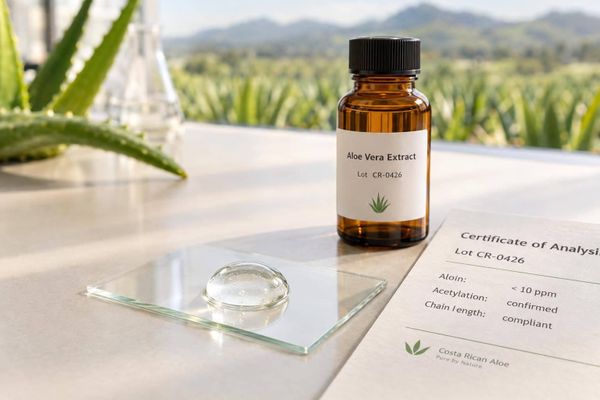
Match the Certificate of Analysis (COA) to your product’s batch number. Check for numerical results - not just “pass” or “conforms” - for acemannan content per serving or as a percentage of dry weight, acetylation levels, and molecular weight distribution.
Confirm that aloin levels are below 10 ppm. Also check that the testing methods are verified - such as NMR, HPLC, or AOAC Official Method 2018.14 - and that the lab is ISO/IEC 17025-accredited.
Does immune research apply to my acemannan supplement?
It depends on the acemannan’s structure, including its acetylation and molecular weight - both of which can change during processing. Most positive findings come from lab or animal studies. Human results remain inconsistent and apply only to the preparation tested.
A label alone doesn’t guarantee effectiveness. Look for a Certificate of Analysis that confirms the amount of acemannan per serving, its molecular weight, and its acetylation levels. These details help you compare your supplement with the preparations used in research [5].
Related Blog Posts
- Preserving What Matters: Why Processing Temperature Is Critical to Acemannan Integrity
- The Acemannan Advantage: How Cold Processing Protects Aloe Vera’s Key Polysaccharides
- Processing Makes the Difference: Investigating Cold Processing and Acemannan Preservation in Aloe Vera
- How Heat Changes Acemannan Structure in Aloe Vera