What to Know Before Buying an Acemannan Supplement Online
Vet acemannan supplements: confirm Aloe barbadensis inner‑leaf, acemannan mg/% and cold processing, require batch COA, and compare cost per serving.
Most acemannan listings leave out the facts you need. Before I buy, I check 5 things: the exact aloe species, the inner leaf source, the acemannan amount, the processing method, and a batch-specific COA.
If even one of those is missing, I slow down. A label that only says “aloe extract” or “polysaccharides” does not tell me how much acemannan I’m getting. And a big extract ratio like 200:1 still does not prove acemannan content. What I want to see is a stated mg amount or a standardized percentage. Many standardized extracts list 10% to 40% acemannan.
Here’s the short version I use before I spend a dollar:
- Check the name: Look for Aloe barbadensis Miller
- Check the plant part: It should say inner leaf gel
- Check the active compound: The label should name acemannan
- Check processing: Look for cold-extracted, freeze-dried, or stabilized
- Check proof: Ask for a COA with batch number, acemannan content, botanical identity, and aloin-free status
- Check dosage math: Compare cost per serving, not just bottle price
- Check the seller: Match label photos, ingredient panel, and return policy
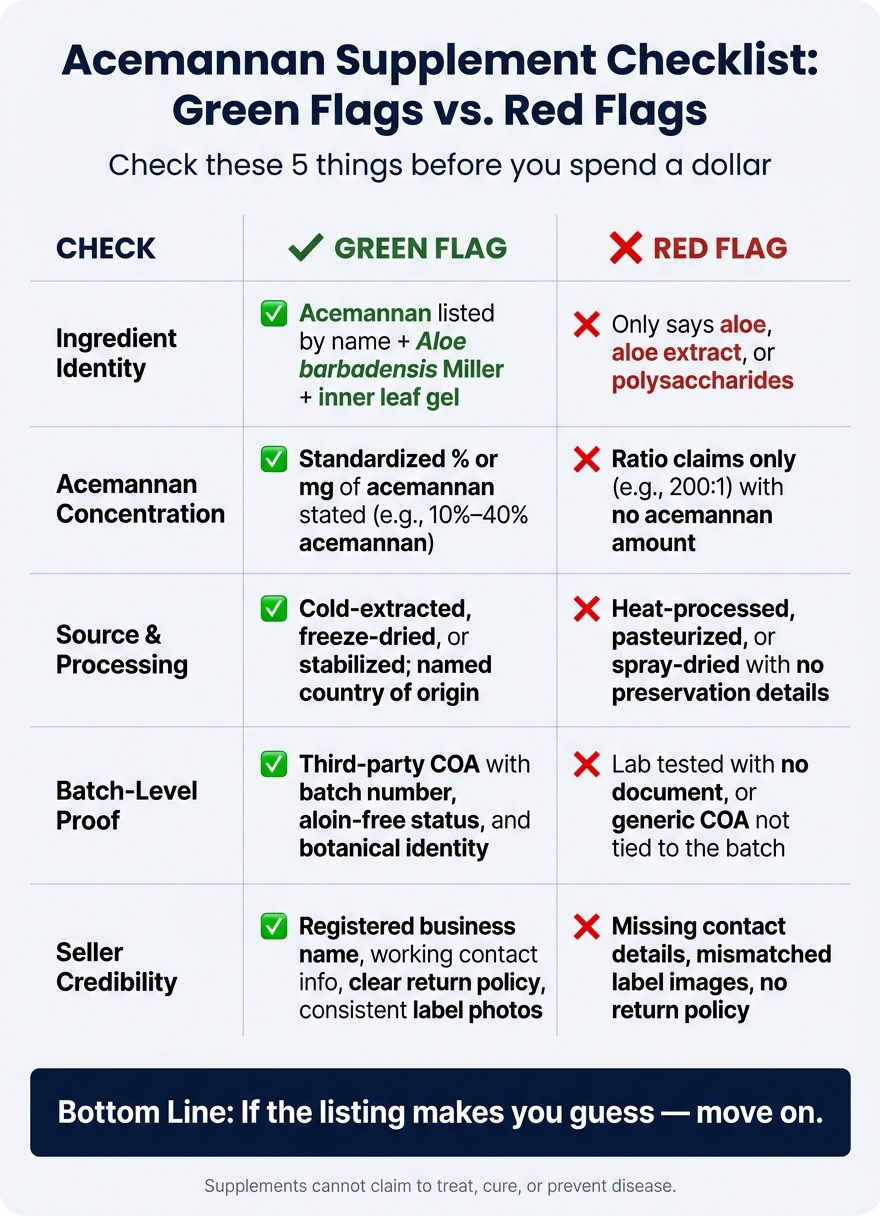
Acemannan Supplement Label: Green Flags vs. Red Flags
Quick Comparison
| What I Check | Good Sign | Red Flag |
|---|---|---|
| Ingredient name | Acemannan listed by name | Only “aloe” or “polysaccharides” |
| Aloe source | Aloe barbadensis Miller + inner leaf | Whole leaf or no plant part listed |
| Processing | Cold-extracted, freeze-dried, stabilized | Heat-heavy processing with no detail |
| Strength | Standardized % or mg of acemannan | Ratio claims only, like 200:1 |
| Testing | Batch-specific COA | “Lab tested” with no document |
| Value | Clear serving size and daily cost | Cheap bottle, vague serving info |
| Seller details | Contact info and return policy | Mixed label details or missing policies |
Bottom line: I treat clear labeling and batch proof as the minimum. If the listing makes me guess, I move on.
sbb-itb-b88dd21
Check the label for clear ingredient disclosure
Start with ingredient disclosure. Terms like “aloe,” “aloe extract,” or “polysaccharides” sound specific, but they do not confirm acemannan.
Verify the botanical name and plant part used
A label worth your time should tell you both the plant and the exact part used. After ingredient disclosure, check the species and plant part.
Look for Aloe barbadensis Miller on the label. That full botanical name confirms the species.
The plant part matters just as much. Acemannan is concentrated in the inner leaf gel. Whole-leaf products can contain aloin, a latex compound with laxative effects, and they’re usually less concentrated than inner-leaf products. If the label says “whole leaf,” or doesn’t name the plant part at all, that’s a red flag.
At a bare minimum, you want three facts before taking a listing seriously:
- Species
- Plant part
- Compound name
Without those, it’s hard to judge whether the product is even worth a closer look.
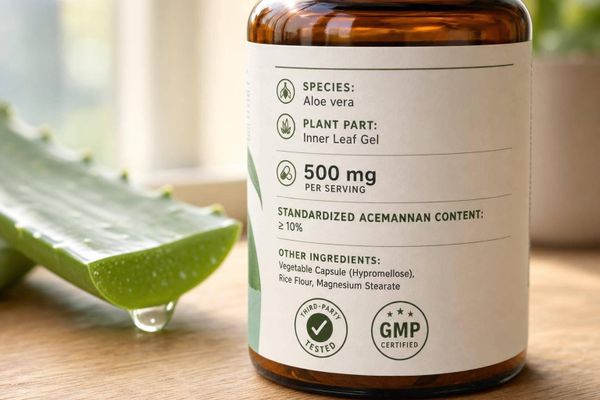
Look for acemannan on the Supplement Facts or ingredient panel
A clear label names acemannan directly in the Supplement Facts or ingredient panel. If it only says “aloe vera extract” or “aloe polysaccharides,” that still doesn’t confirm acemannan.
"If a label doesn't tell you how much acemannan you're actually getting, you're guessing." - Stephanie Thomas
When a label names acemannan, you have something concrete to compare. Broad aloe terms don’t give you that.
Once the label is clear, the next step is to check the aloe source, processing method, and concentration.
Review aloe source, processing method, and acemannan concentration
Next, check how the raw material was handled after harvest. This part matters more than many labels make it seem.
Check source origin and processing details
Where the aloe was grown and how it was processed both matter. Some listings name a country or region of origin, which gives you a clearer trail for where the aloe came from. If a listing skips that detail, it becomes much harder to verify.
Acemannan degrades after harvest and can be damaged by heat or moisture. That’s why terms like cold extraction, freeze-drying, or stabilization are worth looking for.
If the origin is vague or the processing sounds rough, the product is harder to trust. Those details affect both potency and value.
Read milligrams, percentages, and standardized claims carefully
A milligram number on a label can point to two very different things: the total weight of the aloe extract or the weight of acemannan itself. That’s a big difference.
A more useful label will state that the product is standardized to a set percentage of acemannan. Standardized extracts list a measurable percentage of acemannan in each batch. Many standardized extracts show 10% to 40% acemannan.
A 200:1 ratio means 200 parts aloe gel were concentrated into 1 part powder, but it does not confirm acemannan content.
So if a label only says "high in aloe" or "maximum strength" without a clear mg amount or standardized percentage, treat that as marketing, not proof of quality.
Clear-label signals vs. red flags: a comparison table
Use these signals to scan product pages fast.
| Feature | Clear-Label Signal | Red Flag |
|---|---|---|
| Source | Named country or region of origin | Vague "Aloe Vera" or no origin listed |
| Plant Part | 100% Pure Inner Leaf | Whole leaf or unspecified aloe part |
| Processing | Cold-extracted, freeze-dried, or stabilized | Heat-processed, pasteurized, spray-dried, or dehydrated without preservation details |
| Standardization | Specific % or mg of acemannan | No mention of active polysaccharide levels |
| Additives | No unnecessary fillers or flow agents | Contains fillers, flow agents, or gelatin |
Confirm testing, dosage, and batch-level proof
After you check the label and source, pause before comparing prices. Batch data comes first. A product can look solid at a glance and still fall apart once you dig into the testing and dosage.
Look for third-party testing and a matching Certificate of Analysis
“Lab tested” on a product page doesn't tell you much by itself. It's often just marketing copy. What you want is NSF certification or clear proof of GMP-compliant manufacturing, not fuzzy testing language.
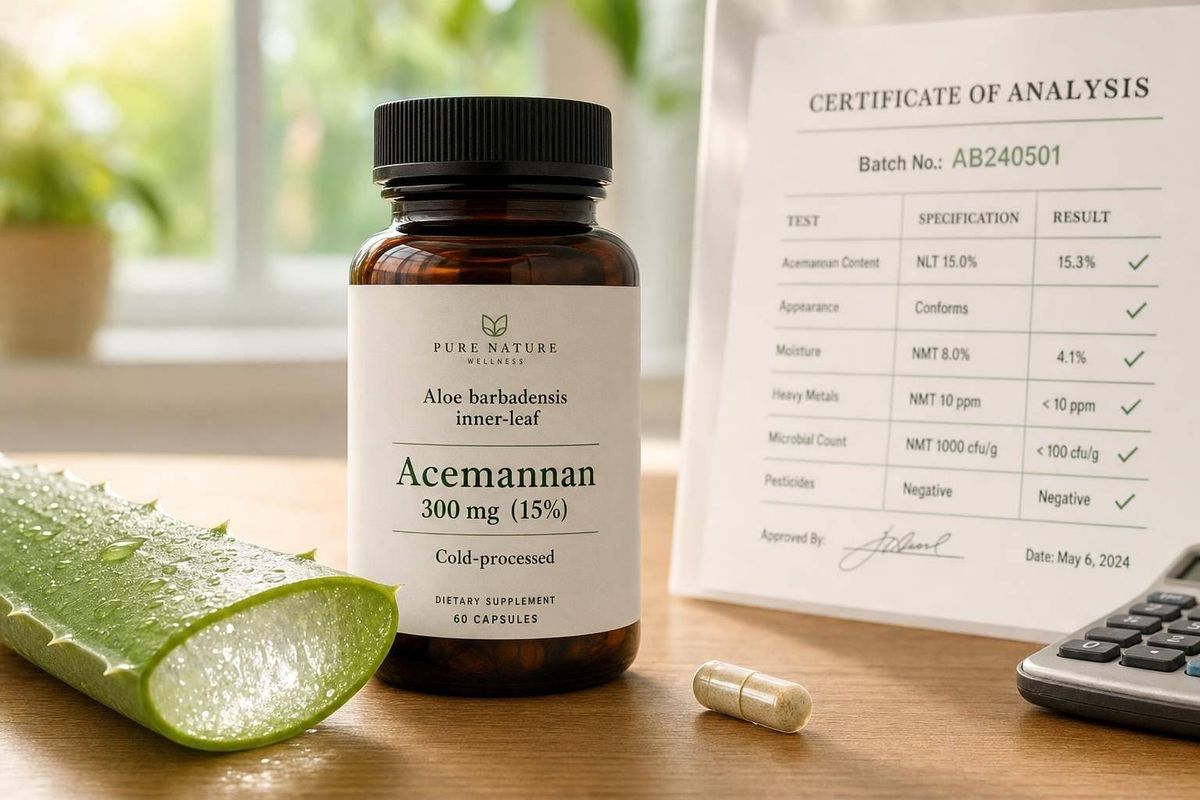
Then check for a Certificate of Analysis (COA). The COA should match the product you're buying, not just some generic document buried on the site. A proper COA should list the batch number, acemannan content, aloin-free status, and botanical identity for Aloe vera inner-leaf gel.
If you can't find the COA on the listing, ask the seller before you buy. No batch proof? That's a red flag.
Check serving size, daily dosage, and cost per serving
Once the COA lines up with the label, look at the serving size and work out the daily cost. Bottle price by itself can fool you. The better move is to divide the total price by the number of servings on the label, not by the capsule count. That gives you the actual cost per serving.
This matters more than it seems. A product with a higher-dose label may still cost more per day if it asks you to take several capsules. A one-capsule daily serving is much easier to compare than a multi-capsule routine.
If the serving size is vague, or the batch proof doesn't line up, skip it and move to the seller credibility check.
Assess seller credibility, spot red flags, and make your final decision
With the label and batch data confirmed, the seller is your last checkpoint.
Check contact details, policies, and label consistency
Once the label and COA look good, look at the company behind the listing. A seller you can trust should show a registered business name, a working customer support email or phone number, and clear links to their "About Us", "Contact Us", and return policy pages. If those basics aren't there, move on.
Take a close look at the product photos too. The label in the images should match the ingredient panel and the product description. If the serving size, ingredient name, or milligram amount changes from one place to another, that's a red flag. You should also see a clear return policy and a 30-day money-back guarantee.
Watch for marketing red flags before checkout
Next, read the sales copy with a skeptical eye. Some listings try to sound impressive, but the wording tells you a lot.
One of the biggest warning signs is a proprietary blend. If acemannan is buried inside one, you have no way to know how much you're getting.
There's also a legal line sellers can't cross. Supplements may support immune or digestive health, but they cannot claim to treat, cure, or prevent disease.
And if the price looks unusually low, slow down. A bargain can be fine, but a very cheap product deserves a closer look, especially if it doesn't disclose standardized acemannan.
Conclusion: The 5 checks that matter most
Use these five checks before you make the call.
| Check | What to Confirm |
|---|---|
| Ingredient identity | "Inner leaf" specified; label details match the product photos and description |
| Acemannan concentration | Standardized percentage or milligram amount disclosed |
| Source and processing | Cold-extracted or freeze-dried; aloin-free confirmed |
| Batch-level proof | Third-party COA with batch number available on request or via QR code |
| Seller credibility | Registered contact info, clear return policy, consistent listing details |
A label-first approach cuts through most of the noise.
FAQs
How much acemannan should a supplement provide per serving?
There’s no universal daily intake guideline for acemannan. And that matters, because supplement quality and concentration can be all over the map.
When you check a label, look for one of two things:
- A standardized dry-weight percentage
- A specific milligram amount per serving
Here’s a good starting point: the International Aloe Science Council uses 5% acemannan by dry weight for raw materials. Higher-end products may test at 10% or more.
One small but important detail: when you compare products, make sure the percentage is shown on a dry-weight basis. If it isn’t, you’re not making a like-for-like comparison.
Why is inner leaf better than whole leaf?
Inner leaf is often the better pick because it naturally has high levels of acemannan, the bioactive polysaccharide tied to immune and digestive support.
Whole-leaf products use the outer rind and latex too. That matters because those parts contain aloin, a strong laxative. To make whole-leaf aloe safe for oral use, manufacturers need extra processing. And here’s the tradeoff: that extra processing can strip out some helpful compounds along with the aloin.
Using only the inner gel skips those laxative compounds in the first place while helping preserve bioactive purity.
What should I do if a seller will not share a batch COA?
Treat it as a major red flag for transparency and product quality. A batch-specific Certificate of Analysis helps verify acemannan concentration, aloin levels, and heavy metals.
Without it, you can't confirm that the label matches what's in the bottle. In that case, it's best to avoid the product and look for a seller that prioritizes disclosure and testing.