What to Look for in a High-Quality Aloe Vera Supplement
Five label checks to pick safe, potent aloe vera supplements: source, processing, aloin, acemannan, and third‑party testing.
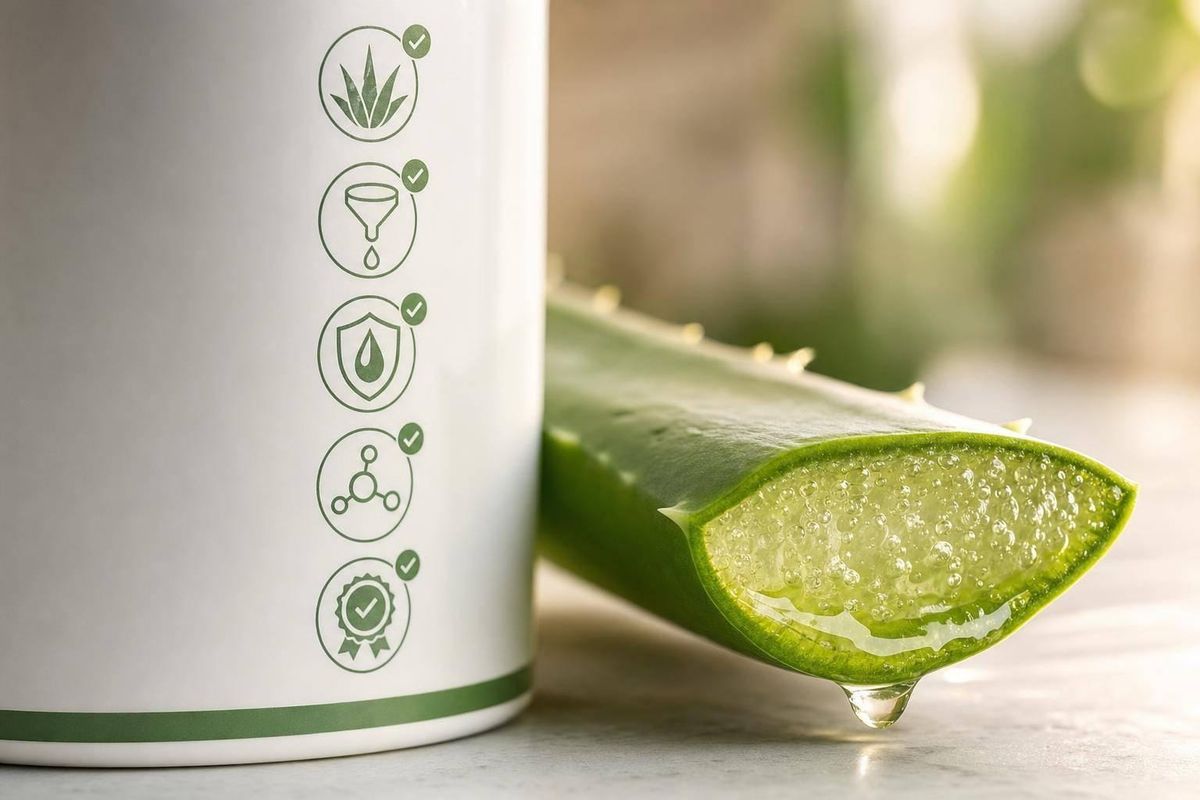
Most aloe vera supplements look similar, but the gap in quality can be huge. In one 2017 analysis, only 3 out of 9 commercial aloe juices had enough acemannan, the main marker used to judge aloe strength.
If I wanted to judge an aloe product fast, I’d check 5 things first:
- Plant part: I’d look for inner-leaf gel or inner-leaf juice
- Processing: I’d want cold-processed or freeze-dried, not vague terms
- Safety: I’d check for Aloin <10 ppm
- Strength marker: I’d look for acemannan % or mg
- Proof: I’d want IASC, a batch COA, and a lot number
Here’s the short version: ignore front-label hype. A strong aloe supplement should clearly show where the aloe came from, how it was processed, what was removed, and what was tested. If the label skips those details, I’d move on.
Quick Comparison
| Check | What I’d want to see | Red flag |
|---|---|---|
| Source | Aloe barbadensis Miller | Just “aloe vera” |
| Plant part | Inner-leaf / inner fillet | Whole leaf with no cleanup note |
| Processing | Cold-processed / freeze-dried | No process listed, or only “200X” |
| Safety | Aloin <10 ppm | No aloin number |
| Ingredients | Aloe listed first | Water, syrup, or sweeteners first |
| Strength | Acemannan 5%+ dry basis | “Maximum strength” with no numbers |
| Testing | Batch COA + lot match | Generic test sheet only |
If I can’t confirm those points in a minute or two, I’d skip the product.
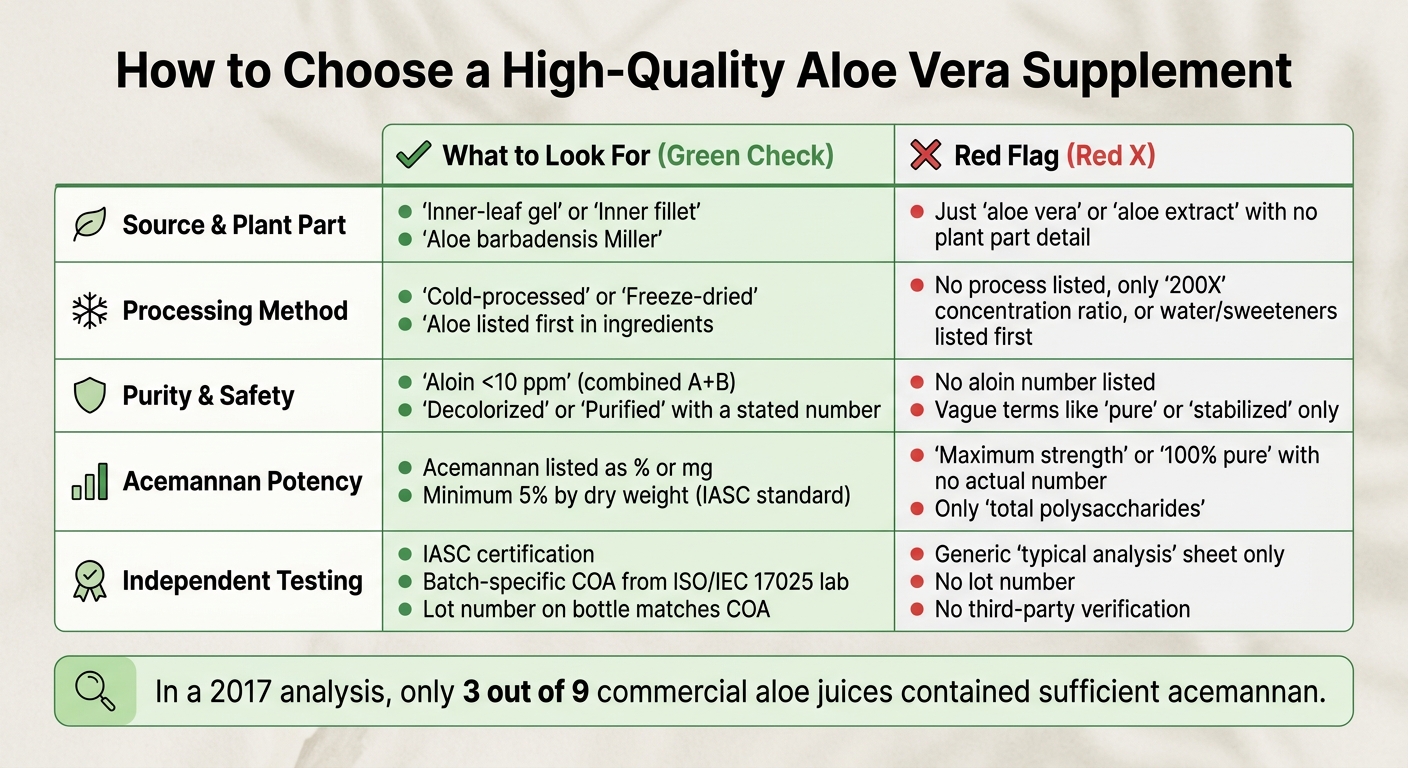
How to Choose a High-Quality Aloe Vera Supplement: 5-Point Label Checklist
Avoid Fake Aloe Vera! 5 Tips for Picking a Supplement that Actually Works
Check the Aloe Source and Processing First
After source, processing is the next quality check. Once you know where the aloe came from, processing tells you how much of its activity likely made it through.
Inner Leaf vs. Whole Leaf on the Label
Look for terms like "inner-leaf gel", "inner fillet," or "inner-leaf juice" on the label. These point to the inner gel, the clear center tissue that naturally has very little aloin.
Whole-leaf aloe is different. It needs to be decolorized or purified to bring aloin down. If a whole-leaf product doesn't say either of those things, that's a red flag.
Inner-leaf products tend to come with lower aloin risk and better acemannan potential. Whole-leaf products can vary a lot, and filtration may change the active compounds.
After source, processing is what tells you whether the aloe still has much left to offer.
Processing Terms That Can Preserve or Weaken Aloe
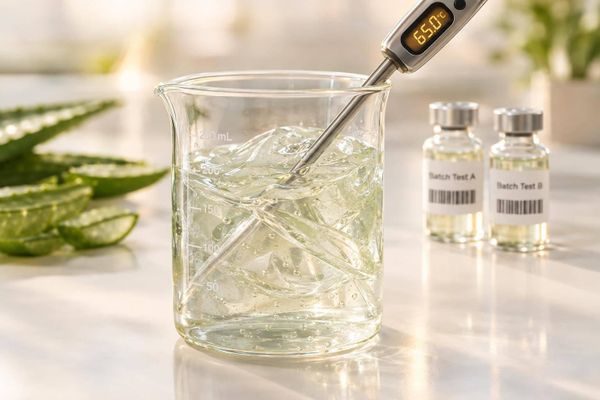
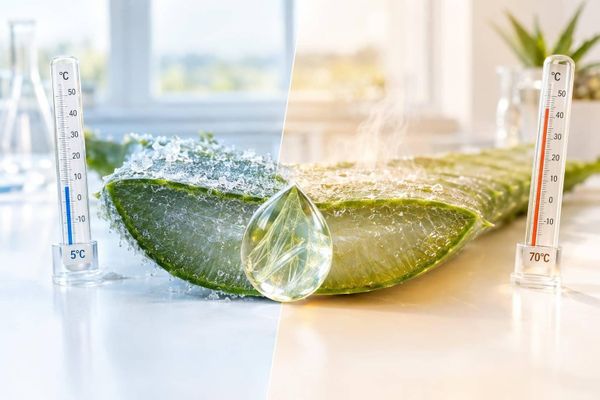
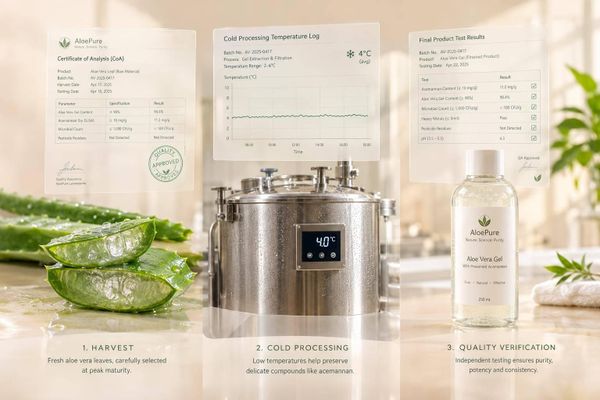
Look for cold-processed or freeze-dried. Heat can damage acemannan. Freeze-drying tends to protect aloe better than spray-drying, which uses heat and often includes carriers such as maltodextrin.
The ingredient list matters too. In a liquid supplement, aloe should show up before water or sweeteners. If water or sweeteners come first, the aloe amount is probably low.
That gives you a simple gut check: if aloe is the star, it should look like the star on the label.
What Strong and Weak Liquid Labels Look Like
Strong label example: Organic Aloe Barbadensis Leaf Juice (Inner Fillet). Cold-processed. Aloin <10 ppm.
Here, aloe comes first, the source is clear, the processing method is named, and the aloin level is listed.
Weak label example: Purified Water, High Fructose Corn Syrup, Aloe Vera Extract (Whole Leaf).
In this case, water and sugar lead the list, "extract" doesn't tell you much, and there's no note about decolorization or processing.
You can use the same approach when comparing juices, gels, capsules, and powders.
Look for Purity, Low Additives, and Safety Markers
After you check the source and processing, move to the ingredient list. This is where you can spot filler ingredients, safety flags, and how clean the formula actually is. Purity and safety come before potency claims. If the formula isn’t clean, the rest doesn’t matter much.
How to Spot Aloin, Latex, and Other Safety Concerns
For oral products, look for terms like "decolorized", "purified," or "Aloin <10 ppm" for combined aloin A and B, which is the common IASC benchmark.
Here’s the key difference: "Purified" is vague. "Aloin <10 ppm" is specific. A stated aloin limit tells you more than loose label terms like "pure" or "stabilized." If the label doesn’t list an aloin number, treat "purified" as only part of the story.
Additives That Affect Purity and Gut Tolerance
A label that says "100% stabilized" can still include added preservatives. Many aloe liquids use potassium sorbate, sodium benzoate, or ascorbic acid to extend shelf life, and undisclosed additives make the formula harder to trust.
There’s a tradeoff here. Fewer preservatives often mean a shorter shelf life and possible refrigeration after opening.
Once the formula looks clean, the next step is to see whether potency is actually measured.
Organic and Clean-Label Cues
A few quick checks can tell you a lot about overall formula quality:
- Primary ingredient: Look for "Aloe Vera Inner Leaf Juice" first on the list, not water or a vague "Aloe Vera Blend"
- Additives: Thickeners like xanthan gum and carrageenan, sweeteners like high fructose corn syrup and sucralose, and undisclosed preservatives point to a more processed formula
- Safety disclosure: If there’s no stated aloin limit and no purity claim, the product is harder to trust for regular internal use
Next, check whether the label lists acemannan content, third-party testing, and a clear dose.
sbb-itb-b88dd21
Confirm Potency with Acemannan, Testing, and Clear Dosage
Once the ingredient list looks clean, the next step is proving potency and testing. Source and purity matter, but acemannan, third-party verification, and dosage clarity are what help you decide if an aloe product is actually worth your money.
Acemannan and Polysaccharide Content on the Label
Look for acemannan listed by percentage or mg, not a fuzzy “total polysaccharides” claim. That total can make the number look bigger without showing aloe potency.
The IASC standard sets a minimum of 5% acemannan by dry weight for raw aloe materials. So if a product shows acemannan at 5% or more on a dry basis, that gives you a solid point of reference. If the label only says “maximum strength” or “100% pure” and leaves out the actual number, that’s ad copy, not proof of potency.
Also, check whether the acemannan number is shown on a dry basis. Wet-basis numbers can get thrown off by moisture.
And those concentration ratios like 100X or 200X? They tell you how much liquid went into making the powder. They do not tell you how much acemannan made it through processing. So they’re not a stand-in for potency.
Third-Party Testing and Certifications That Add Confidence
A clean-looking label can still fall apart once you look for proof. That’s where testing and certifications come in. They show whether anyone outside the brand checked the product.
| Quality Marker | What It Verifies | Why It Matters |
|---|---|---|
| IASC Certification | Aloe identity and minimum 5% acemannan content | Shows the product contains aloe and meets baseline potency and aloin standards |
| COA (Batch-Specific) | Lab results tied to the exact production lot | Shows that your lot was tested |
| ISO/IEC 17025 | Lab accreditation and method validity | Shows testing was done by a qualified, independent facility |
| 1H NMR Testing | Molecular identity and absence of adulterants | Finds fillers like maltodextrin and confirms acemannan is present |
| Lot/Batch Number | Traceability to a specific production run | Lets you match the bottle to the right lab results |
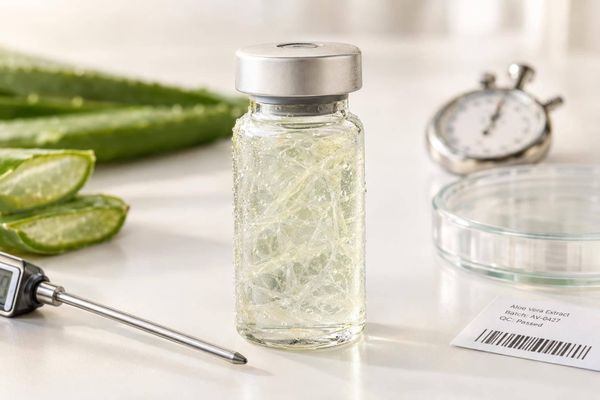
Match the lot number on the bottle to a batch-specific COA. A generic “typical analysis” sounds nice, but it doesn’t confirm what’s in the product you bought. Certification gives you a baseline. Batch-level testing tells you about the exact lot in your hands.
If possible, use the lot number on the bottle to check the COA before you buy.
Dosage Transparency Across Juices, Capsules, and Powders
After potency and testing, look at the serving size. It should be stated in units that are easy to compare.
- For juices and gels, serving size should be listed in milliliters (mL)
- For capsules and powders, it should be listed in milligrams (mg) or grams (g)
- If there’s a carrier like maltodextrin, that should be listed separately
That last part matters. Carriers such as maltodextrin are often used for stability, but undeclared maltodextrin counts as adulteration under IASC standards.
Conclusion: A Simple Checklist for Choosing Better Aloe Vera Supplements
Use this checklist to compare aloe vera supplements by source, processing, purity, potency, and testing.
5 Label Checks to Use Before You Buy
After you review the source, processing, purity, and potency, run this five-point label check before you buy.
- Source and plant part - The label should name inner-leaf gel or inner-leaf juice. If it only says “aloe extract” or “aloe vera,” you don’t have enough detail to judge quality.
- Processing transparency - Look for terms like cold processed or freeze-dried. Be careful with products that push concentration ratios like 200X but don’t show the starting material or the aloe dry basis.
- Purity and safety - Check for low aloin and a stated combined aloin A+B level below 10 ppm. The label should also disclose additives or carriers, such as maltodextrin.
- Acemannan content - Look for a clear acemannan percentage or mg amount. The IASC benchmark for raw material quality is at least 5% by dry weight.
- Independent testing - Look for an IASC seal, NSF certification, or a batch-specific COA from an independent ISO/IEC 17025 lab. Before you buy, match the lot number on the bottle to the COA.
If a label can’t answer these five questions, skip it.
Pick the product that names its source, states how it was processed, lists acemannan, and supports the label with independent testing.
FAQs
How can I compare aloe juice and capsules fairly?
Look beyond the label and compare the standardized acemannan content. That’s one of the clearest ways to judge what you’re actually getting.
It also helps to check that the product uses 100% pure inner-leaf gel, not whole-leaf aloe. Whole-leaf products may contain anthraquinones, which can lead to digestive distress.
A good pick should also come with a Certificate of Analysis (COA) from third-party testing. And pay attention to how it’s made: cold-extraction or freeze-drying are better options, since heat processing can reduce acemannan’s effectiveness.
Does higher acemannan always mean a better aloe supplement?
No. More acemannan does not automatically mean a better or more effective supplement.
That number is only part of the story. Its value also depends on the polymer chain size and the way the ingredient was processed. Heat can lower acemannan’s bioactivity even when the reported level still looks high.
So, quality comes from protecting its structure through gentle processing, not just chasing a bigger percentage on the label. It also helps to look for third-party verification for purity and to confirm the product is free from harmful additives like anthraquinones.
When should I avoid whole-leaf aloe products?
Avoid whole-leaf aloe products if you want to limit exposure to anthraquinones. These compounds are most concentrated in the outer rind.
One of them, aloin, can work as a laxative. That may lead to digestive discomfort, toxicity, or other side effects.
Some whole-leaf products go through purification to reduce these compounds. Even so, inner-leaf-only products start with less risk because they leave the rind out.