Acemannan vs. Other Antioxidants: Key Differences
Compares acemannan with vitamins, glutathione, CoQ10 and polyphenols by mechanism, location, and duration of antioxidant effect.

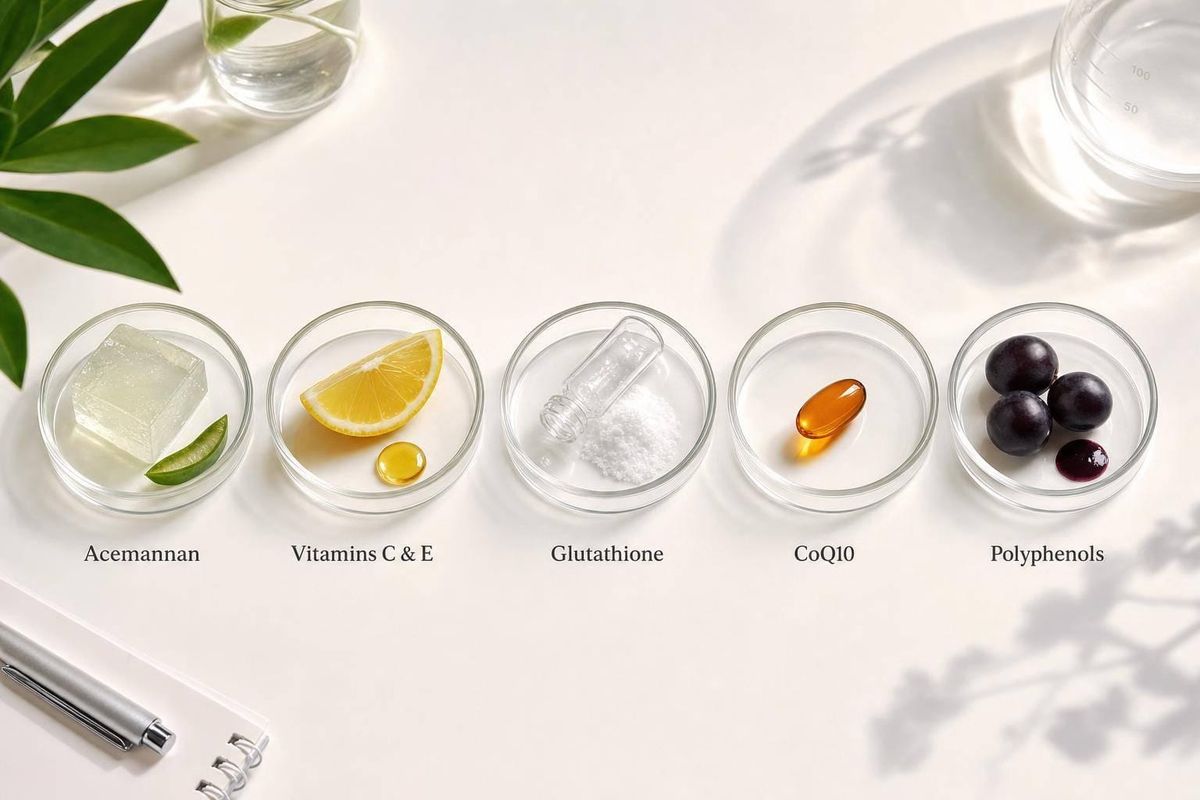
Acemannan is not like vitamin C, vitamin E, glutathione, CoQ10, or polyphenols. I’d sum it up this way: it works more like a large signaling polysaccharide than a standard small antioxidant.
If you want the short answer, here it is:
- Acemannan is a large O-acetylated polysaccharide from Aloe vera
- It can show about 45% radical scavenging in DPPH testing
- Its antioxidant activity can stay steady for 21 to 24 hours
- It acts a lot through cell-surface receptors like mannose receptors, TLR4, and TLR5
- Vitamin C works mainly in water-based spaces
- Vitamin E works mainly in fat-rich cell membranes
- Glutathione works mainly inside cells
- CoQ10 works mainly in the mitochondrial membrane
- Polyphenols often act fast, then taper off sooner than acemannan
In other words: if you’re comparing these compounds, the big differences are size, location, mechanism, and how long the effect lasts. Acemannan stands apart because much of its role appears tied to acetylation, immune signaling, and support around damaged tissue, not just direct free-radical neutralization.
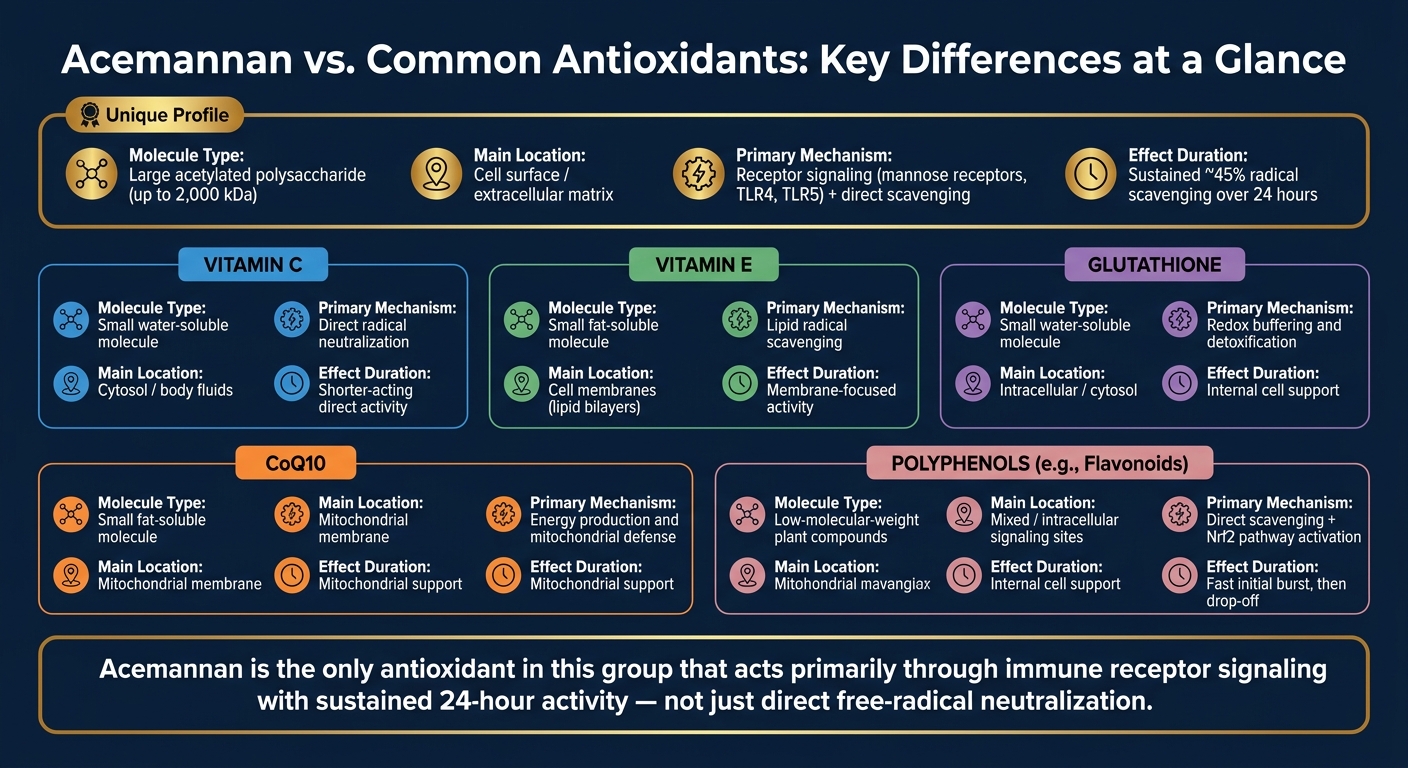
Acemannan vs. Common Antioxidants: Key Differences at a Glance
Quick Comparison
| Compound | Main form | Main location | Main role | Timing pattern |
|---|---|---|---|---|
| Acemannan | Large acetylated polysaccharide | Cell surface / extracellular matrix | Direct scavenging + receptor signaling | Steady over 24 hours |
| Vitamin C | Small water-soluble molecule | Cytosol / body fluids | Direct radical neutralization | Shorter-acting direct activity |
| Vitamin E | Small fat-soluble molecule | Cell membranes | Lipid protection | Membrane-focused activity |
| Glutathione | Small water-soluble molecule | Inside cells | Redox balance | Internal cell support |
| CoQ10 | Small fat-soluble molecule | Mitochondrial membrane | Energy and oxidation control | Mitochondrial support |
| Polyphenols | Small plant compounds | Mixed; often intracellular signaling sites | Direct scavenging + Nrf2-related effects | Fast start, then drop-off |
My takeaway: if you think all antioxidants work the same way, this comparison shows they do not. Acemannan looks different not only because of what it is, but also because of where it works and how it supports cells.
sbb-itb-b88dd21
Acemannan: Structure, Mechanisms, and Cellular Protection
Acemannan’s effects come down to its structure. Its acetylation pattern and polymer size help decide how it behaves inside cells. That becomes especially important when you compare acemannan with fast-acting small-molecule antioxidants.
How Acetylation Affects Antioxidant Activity
Acetylation plays a big role in acemannan’s activity. It influences the compound’s stability, how it interacts with receptors, and how well it scavenges radicals.
"The acetyl group is a prominent part of the structure of acemannan and is responsible for its biological properties, including antioxidant effects." - BMC Complementary Medicine and Therapies
Higher acetylation is linked to increased immunostimulatory activity, which reduces its ability to induce cell proliferation and immune responses.
How Acemannan Supports Cells
Acemannan helps cells through both direct and indirect routes. On the direct side, it shows about 45% radical scavenging in DPPH assays, and that activity stays stable over 21–24 hours. That’s a different pattern from small molecules like malvidin, which tend to spike early and then fade.
The indirect side is just as important, if not more so. Acemannan binds to mannose receptors, TLR4, and TLR5 on macrophages and dendritic cells, which shapes immune signaling. So unlike vitamin C or glutathione, acemannan is not mainly a direct radical quencher. Its receptor-mediated actions sit at the center of its cell-protective role.
That cell support shows up in model systems too. In fibroblast studies, acemannan has been shown to recover cell viability after hydrogen peroxide-induced damage.
The table below sums up acemannan’s baseline profile before moving into side-by-side comparisons with vitamin C, vitamin E, glutathione, and CoQ10.
Comparison Table: Acemannan Baseline Profile
| Feature | Acemannan Baseline Profile |
|---|---|
| Molecule Type | Acetylated polysaccharide (glucomannan) |
| Main Mechanism | Free radical scavenging; receptor-mediated immune and cellular signaling |
| Primary Cellular Targets | Macrophages, dendritic cells, fibroblasts, keratinocytes, cells and tissues under oxidative stress |
| Effect Duration | Sustained antioxidant activity over 24 hours |
Acemannan vs. Vitamin C, Vitamin E, Glutathione, and CoQ10
The main difference comes down to where each antioxidant does its job.
Vitamin C and Vitamin E: Water- and Fat-Soluble Protection
Vitamin C and vitamin E differ mostly in solubility. Vitamin C is water-soluble, so it works in water-based parts of the body, such as the cytosol and blood. There, it helps neutralize free radicals and recycle other antioxidants.
Vitamin E works differently. It’s fat-soluble, so it sits inside lipid membranes and helps guard them against peroxidation.
Acemannan doesn’t fit either pattern. It’s a large polysaccharide, and it works mostly at cell surfaces and in the extracellular matrix. That matters because acemannan acts less like a classic direct antioxidant and more like a signaling molecule.
Glutathione and CoQ10: Intracellular and Mitochondrial Defense
Glutathione and CoQ10 work from inside the cell. Glutathione operates in the cytosol, where it helps maintain redox balance and supports detoxification. CoQ10 is fat-soluble and sits in the mitochondrial membrane, where it supports energy production and mitochondrial defense.
Acemannan takes a different route. It acts through cell-surface receptors to affect immune signaling, and it also supports repair-related growth signals. So while glutathione and CoQ10 protect internal cell compartments directly, acemannan helps shape the response around damaged tissue.
That split shows up in testing too. In a 24-hour DPPH radical scavenging assay, acemannan reached a 45% oxidative radical clearance rate and showed sustained activity across the full 24 hours. That longer-lasting activity sets it apart from the smaller antioxidants below.
Comparison Table: Acemannan vs. Major Small-Molecule Antioxidants
The table below sums up these compartment-level differences.
| Molecule | Molecule Type | Solubility | Main Cellular Location | Primary Mechanism | Key Compartment Protected |
|---|---|---|---|---|---|
| Acemannan | Polysaccharide | Water-soluble | Cell surface / extracellular matrix | Receptor binding and signaling | Extracellular matrix and tissues |
| Vitamin C | Small molecule | Water-soluble | Cytosol / extracellular fluid | Direct neutralization and recycling | Aqueous environments |
| Vitamin E | Small molecule | Fat-soluble | Cell membranes | Lipid radical scavenging | Lipid bilayers |
| Glutathione | Small molecule | Water-soluble | Intracellular / cytosol | Redox buffering | Intracellular environment |
| CoQ10 | Small molecule | Fat-soluble | Mitochondrial membrane | Energy production and mitochondrial defense | Mitochondrial membrane |
Acemannan vs. Polyphenols and Other Dietary Antioxidants
Polyphenols are a different class of plant-derived antioxidants. Unlike acemannan, they’re low-molecular-weight compounds, and that changes how they behave in cells. In plain English, the big difference comes down to speed vs. staying power.
How Polyphenols Work Differently
Polyphenols mainly work in two ways: they directly neutralize free radicals, and they affect signaling pathways such as Nrf2, which helps the body switch on its own antioxidant enzymes. A lot of polyphenols act fast, then taper off.
Acemannan works in a different lane. It’s a high-molecular-weight polysaccharide that acts mainly through innate immune signaling. So while polyphenols lean more on direct scavenging, acemannan is driven more by receptor-linked signaling.
Where Acemannan Stands Out
The clearest difference shows up in how long the effect lasts, not just how strong the first burst is.
Acemannan showed sustained scavenging across 24 hours, unlike the faster rise-and-fall pattern seen in many polyphenols.
"Acemannan is an antioxidant with long-term and stable antioxidant activity and possesses a high clearance rate, representing its highest radical scavenging ability." - BMC Complementary Medicine and Therapies
Acemannan also stands out in radiation-related oxidative stress. Research shows it can help scavenge free radicals generated by ionizing radiation while also supporting macrophage-dependent hematopoiesis through TLR4 activation. That effect depends heavily on acetylation. When those acetyl groups are removed, its biological activity drops.
The table below shows how this split plays out.
Comparison Table: Acemannan vs. Polyphenols
| Feature | Acemannan | Polyphenols (e.g., Flavonoids) |
|---|---|---|
| Mechanism Category | Innate immune signaling and receptor-linked activity | Direct scavenging and Nrf2 signaling |
| Molecular Size | High-molecular-weight polysaccharide (up to 2,000 kDa) | Low-molecular-weight small molecules |
| Biological Targets | Mannose receptors, TLR4, TLR5, macrophages | ROS, Nrf2 pathway, intracellular signaling |
| Action Profile | Long-term and stable (24+ hours) | Rapid initial activity, declining over time |
| Key Structural Factor | Degree of O-acetylation | Phenolic ring structure and hydroxyl groups |
| Best-Documented Protection | Radiation-related oxidative stress | General oxidative stress and UV protection |
Conclusion: The Key Differences That Make Acemannan Distinct
Acemannan is not a classic small-molecule antioxidant. It’s a high-molecular-weight acetylated polysaccharide, and that alone puts it in a different category from the small, discrete molecules behind most common antioxidants. That structural gap helps explain why it acts differently.
Its O-acetyl groups help drive its biological activity, including antioxidant effects. Put simply, structure shapes function here. Acemannan doesn’t just scavenge free radicals. It also sends signals.
That’s one of the biggest differences. Unlike direct radical scavengers, acemannan can also work through mannose receptors, TLR4, and TLR5 to affect immune signaling.
Its large size matters too. Much of its activity stays at cell surfaces and in tissues, instead of acting only inside cells.
And in DPPH assays, acemannan showed sustained radical scavenging over 24 hours. So while it does offer antioxidant support, it behaves less like a classic antioxidant and more like a signaling polysaccharide. For more research summaries, see Advanced Acemannan.
FAQs
Is acemannan really an antioxidant?
Yes. Multiple studies and reviews describe acemannan, a polysaccharide from Aloe vera, as having antioxidant activity.
Reported effects include reducing oxidative stress, such as DPPH radical clearance in vitro, and antioxidation among its biological functions.
Why does acemannan last longer than polyphenols?
Acemannan tends to last longer because its acetylated polysaccharide structure makes it more stable and helps keep its bioactivity in place.
Its acetyl groups and hydroxyl groups help support thermal stability, structural integrity, and physical traits like viscosity. Put simply, those features help Acemannan stay effective over time.
Does acemannan work better with other antioxidants?
Yes. Acemannan can work well with other compounds and may strengthen the effects you get from a formula.
Research suggests that adding acemannan to aloe vera juice may help reduce post-meal metabolic issues by increasing overall antioxidant capacity. Put simply, it may help the body handle the stress that can show up after eating.
It’s also used in composite formulations. For example, combining acemannan with chitosan has been shown to support faster wound healing by promoting granulation tissue formation and tissue repair.