Aloe Vera Supplements for Everyday Wellness: What Smart Shoppers Ask First
Practical checklist for choosing safe aloe vera supplements: pick a form, verify inner-leaf source, acemannan %, aloin <10 ppm, and COAs.

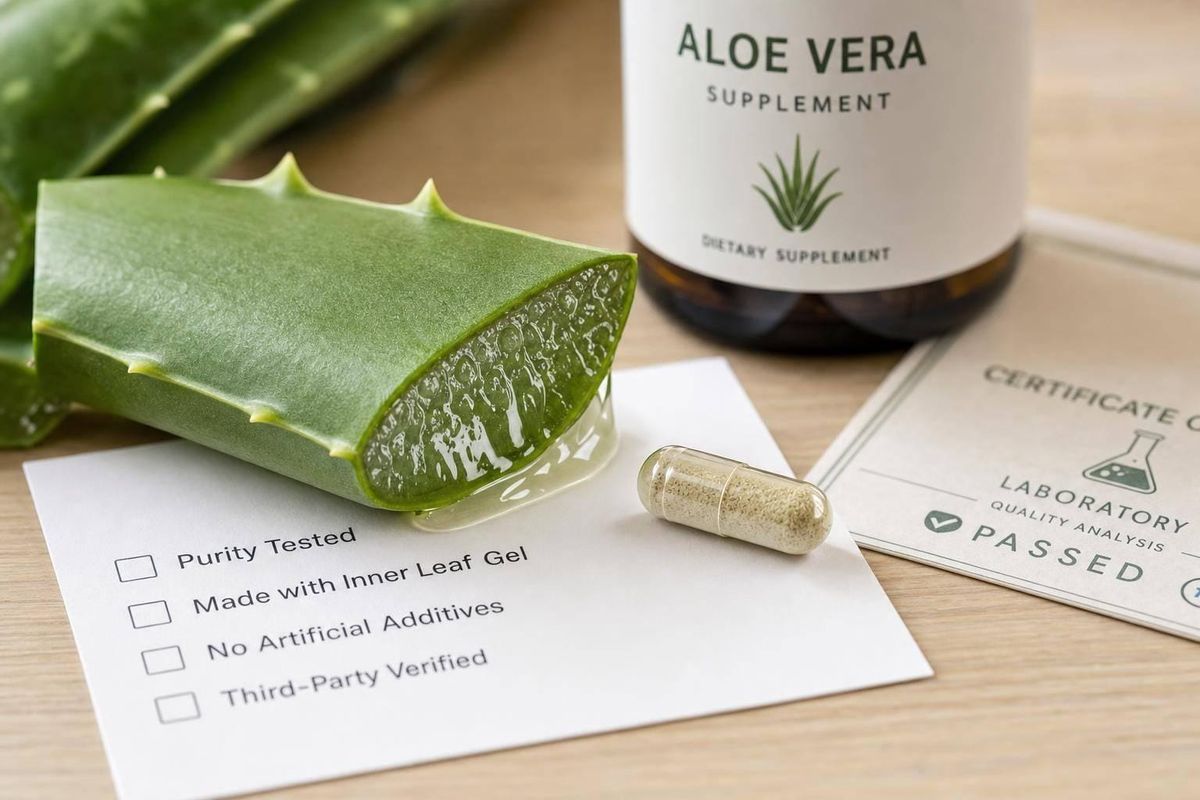
Most aloe vera supplements are easy to find. The hard part is knowing if the label backs up the claim.
If I were shopping today, I’d check 5 things first: the form (capsule, juice, or gel), the plant part (inner leaf vs. whole leaf), the acemannan level, the aloin limit (under 10 ppm), and whether the brand offers third-party testing or a batch-specific COA. That matters because one study found that only 9 out of 18 aloe products tested had measurable polysaccharides.
Here’s the short version:
-
Choose the form you’ll stick with
- Capsules: simple, portable, measured in mg
- Juices/gels: often 15–25 mL per serving, but mostly water
-
Check the source
- Look for inner-leaf gel or inner-leaf juice
- Be more careful with whole-leaf products unless they say decolorized, carbon-filtered, or aloin removed
-
Look for acemannan
- This is the main polysaccharide in aloe gel
- A good label should show a measured amount or say it meets the 5% dry-weight standard
-
Confirm safety
- Oral aloe products should keep aloin below 10 ppm
- Aloe may affect blood sugar, blood clotting, and potassium
-
Match the product to your goal
- Digestive comfort
- Antioxidant support
- General wellness or immune support
Quick Comparison
| What to check | Better sign on label | Watch out for |
|---|---|---|
| Form | Capsule for ease; liquid if you like drinkable formats | Liquid with vague aloe amount |
| Plant part | Inner-leaf gel/juice | Whole-leaf with no purification note |
| Acemannan | Measured % or standardized amount | Generic “aloe extract” only |
| Aloin | <10 ppm or “aloin removed” | No aloin statement |
| Testing | Third-party tested + lot-specific COA | “Tested” with no proof |
Bottom line: I’d buy based on label proof, not front-label promises. If the brand can’t show what part of the plant it used, how much acemannan is inside, and whether aloin was removed, I’d move on.
sbb-itb-b88dd21
Which Aloe Vera Supplement Form Works Best for Your Routine?
The best form is the one you'll actually use on a regular basis.
How capsules, gels, and drinks differ from each other
Capsules are usually the easiest option to carry and use. They don't have much taste, and their serving size is listed in milligrams (mg). Liquid forms, like drinks and drinkable gels, are listed in milliliters (mL) or ounces (oz). A common serving is about 15 mL to 25 mL, or roughly 1 to 2 tablespoons. Aloe juice is mostly water, so each serving tends to give you less aloe than a capsule.
| Feature | Capsules | Drinks / Juices | Drinkable Gels |
|---|---|---|---|
| Serving Size | Measured in mg | 15–25 mL (about 1–2 tbsp) | 15–25 mL |
| Concentration | High | Low | Less concentrated than capsules |
| Taste | Neutral | Often flavored | Thicker, mildly bitter to flavored |
| Portability | High; no refrigeration needed | Lower; requires refrigeration after opening | Lower; requires refrigeration after opening |
| Label Clue to Check | mg per serving | mL or oz per serving; aloe juice % | mL or oz per serving |
Once you've found a form that fits your day-to-day life, the next step is simple: check the label to see what you're getting.
How to pick the form that fits your daily habits
If you're on the go a lot, or you just don't want to deal with aloe's taste, capsules are often the easiest fit. If you like something drinkable, or want to add it to a morning smoothie, a drink or drinkable gel can make sense. Just store it the right way and plan to use it within about a week after opening.
Go with the format that feels easy to stick with. If you're buying a liquid, look past the front of the bottle and read the ingredient list and storage directions. Bottled aloe drinks and drinkable gels can include preservatives like potassium sorbate or sodium benzoate, and those details aren't always front and center on the label.
Form comes first. Then the label tells you if the product is worth your money.
What to Check on the Label Before You Buy
The label is your next filter. It tells you if the product lines up with what you want. Read it in this order: plant part first, then acemannan, then testing.
Inner leaf vs. whole leaf: why the wording on the label matters
The plant part on the label tells you a lot about what’s in the bottle. Look for "inner-leaf gel" or "inner-leaf juice." These use the clear inner portion of the leaf and are naturally lower in aloin.
Labels such as "whole leaf", "purified whole leaf", "leaf powder," or just "aloe vera leaf juice" can include rind and latex. That means the label should also show how the product was purified. For oral products, the International Aloe Science Council (IASC) quality standard calls for less than 10 parts per million (ppm) of aloin.
If a whole-leaf product doesn’t say "decolorized", "aloin removed," or "carbon-filtered" somewhere on the label, it deserves a closer look. And if the plant part is vague, the acemannan number matters even more.
What acemannan content, purity markers, and processing details tell you
A label that gives a measured acemannan or polysaccharide percentage is far more useful than "aloe vera extract." The IASC raw-material standard requires a minimum of 5% acetylated mannan by dry weight. Independent testing of commercial aloe powders found acemannan levels ranging from about 1% to 10% w/w, so standardization claims matter.
Extract ratios can sound impressive, but they need context. A "10:1" extract means 10 units of starting material produced 1 unit of extract. But that only means something if the label also tells you what the starting material was. In the same way, a 200X powder refers to liquid equivalency. It does not automatically mean it has twice the active content of a 100X product.
| Label Field | What It Tells You |
|---|---|
| Plant Part | Inner leaf is naturally lower in aloin; whole leaf needs more filtration |
| Aloin Level | Look for a number, such as <10 ppm, not just "purified" |
| Acemannan % | Shows the strength of the main active compound |
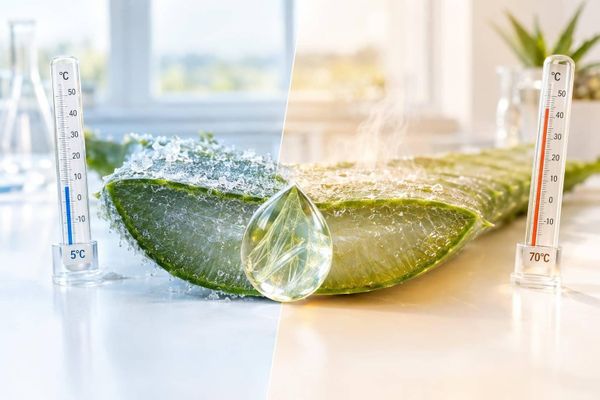
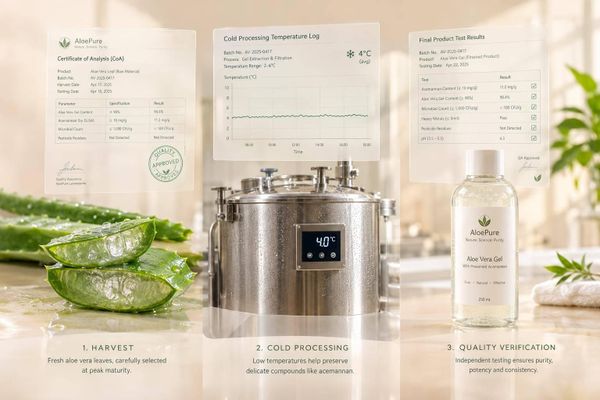
| Processing Method | Freeze-dried or cold-processed may help keep more active polysaccharides |
| Extract Ratio | Only useful if the starting material is also defined |
| Carrier Ingredients | Can show fillers like maltodextrin that may not appear on the front label |
After you check potency, look at whether the batch was tested and who did the testing.
Third-party testing and other signs of a transparent product
Look for labels that say "independently third-party tested" instead of just "independently tested." That shorter phrase may only point to in-house checks.
It also helps to ask for a batch-specific COA. That’s a lab report tied to a lot number. If the package shows a lot number, you can ask the brand for the COA and verify the acemannan content and aloin levels for that exact batch.
The IASC seal is another strong sign. It shows that the product meets the 5% acemannan minimum and the 10 ppm aloin limit. If you can get a batch-specific COA or spot the IASC seal, you have the clearest label check available.
Do the Claimed Benefits Match the Dose, Safety Notes, and Your Wellness Goal?
Once the label looks solid, the next step is simple: match the claim to your goal, the dose, and the safety tradeoffs.
What benefits are realistic for digestive comfort, antioxidant support, and general wellness
Aloe vera fits best into a few everyday use cases.
For digestive comfort, the polysaccharides in inner-leaf gel, mainly acemannan, support gut mucosal integrity and may help with digestive comfort. For antioxidant support, bioactive compounds in aloe can scavenge free radicals and help reduce oxidative stress. For immune support, acemannan may support normal immune activity.
Here’s the practical breakdown:
| Intended Benefit | Evidence-Based Rationale | Common Label Dosing | Key Safety Consideration |
|---|---|---|---|
| Digestive Comfort | Supports gut mucosal integrity and may help soothe the digestive tract | 15–25 mL juice once or twice daily, or 250–500 mg extract | Avoid latex-containing products if you have Crohn's disease or ulcerative colitis; check for aloin removal |
| Antioxidant Support | Scavenges free radicals and may reduce oxidative stress | Varies by concentration of phenolic compounds | May interact with some liver-metabolized medications |
| Immune Support | May support normal immune activity | Often standardized to acemannan content, such as 5% dry weight | May interfere with immunosuppressant therapies; stop use at least 2 weeks before surgery |
This is where labels can get slippery. A product may promise a lot, but if the dose is vague, the claim doesn’t mean much.
How serving size and timing affect daily use
If a label lists a benefit but skips a clear serving size, treat that as a red flag.
Clinical studies have used 15 mL daily for up to 42 days. So if a product tells you to take much more than that without saying why, it’s fair to pause and look closer.
For digestive comfort, check whether the directions say once or twice daily and stick with that pattern. Also look for clues about duration. Is this meant for a short run, or for daily use over time?
That matters because aloe gel is usually the better fit for short-term oral use, while whole-leaf or latex products are not a good pick for long-term daily use. If the label is fuzzy on that point, ask the brand before you buy.
Safety questions to ask before starting aloe vera
Now for the part that matters most: safety.
Aloe latex, the yellow layer just under the leaf skin, contains aloin, a stimulant laxative. Taking just 1 gram of aloe latex daily can be fatal. For any oral supplement, you need to confirm that aloin has been removed.
Aloe can also lower blood sugar. That can be a problem if you use insulin or drugs like glyburide. It may slow blood clotting too, which matters if you take anticoagulants or antiplatelets such as warfarin or aspirin.
There’s more. If you take digoxin or diuretics, aloe latex can drop potassium to dangerous levels. And oral latex-containing products should be avoided if you are:
- pregnant or breastfeeding
- under age 12
- dealing with kidney problems
- living with active intestinal disease
If any of those apply to you, talk with a healthcare provider before adding aloe to your routine.
Use these checks to narrow your options before the final checklist.
Conclusion: A Buying Checklist for Aloe Vera Supplements
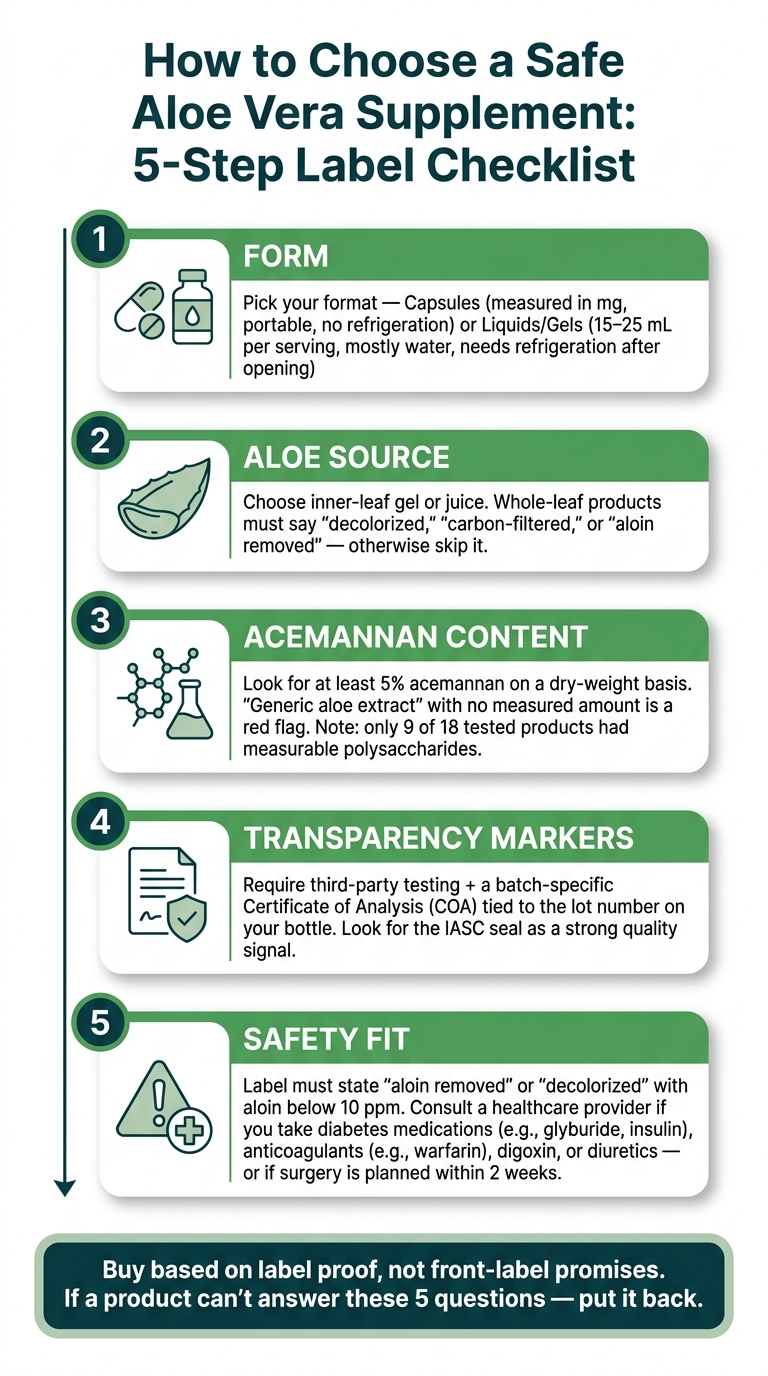
How to Choose a Safe Aloe Vera Supplement: 5-Step Label Checklist
You’ve got the label checks. Now use them as a last filter before you buy.
5 checks to make before you add aloe vera to your cart
Run these five checks in order:
- Form: Pick the form that fits your routine. Juices and gels are the more old-school option, but they’re mostly water and usually need refrigeration after opening.
- Aloe source: Go with inner-leaf gel or juice. Whole-leaf products include the outer rind and latex, which contain aloin. That aloin should be removed from oral products.
- Acemannan content: Look for a product standardized to at least 5% acemannan on a dry weight basis.
- Transparency markers: Check for third-party testing. Then ask the brand for a Certificate of Analysis (COA) tied to the exact lot number on your bottle.
- Safety fit: The label should clearly say "aloin removed" or "decolorized," with aloin levels below 10 ppm. If you take diabetes or heart medications, or if you have surgery planned in the next 2 weeks, talk to a healthcare provider first.
The big idea is simple: buy based on label proof, not front-label promises. If a product can’t answer these five questions, put it back on the shelf.
FAQs
How do I compare aloe strength across forms?
Compare verified acemannan with any standardized marker using the same reporting method - not “10:1,” “100X,” “200X,” or vague, watery-looking claims.
Look for 100% pure inner leaf instead of whole-leaf powder. It also helps to choose cold-extracted or cold-processed products. Then check that the label numbers match third-party testing or COAs for purity and potency.
One more thing: capsules and drinks can vary in acemannan levels and deacetylation because processing can change the final product.
What should I ask for if a brand claims testing?
Ask for the current Certificate of Analysis (COA) for the exact lot you’re buying. Make sure it lists the product and lot number, names the outside lab, and shows the test categories, measured results, and pass limits.
A COA helps you check that the bottle matches the label, not just the marketing copy. Common areas include identity, potency, and purity/safety.
When should I avoid taking oral aloe?
Avoid oral aloe during pregnancy or while breastfeeding. It’s also not for children under 12.
Aloe latex should be avoided if you have:
- Crohn’s disease
- ulcerative colitis
- bowel obstruction
Talk with your healthcare provider before using oral aloe if you have an autoimmune condition or kidney disease, or if you take diabetes or immunosuppressive medications.
If you have surgery scheduled, stop taking oral aloe at least 2 weeks beforehand.