How to Choose an Acemannan Aloe Supplement That Fits Your Wellness Routine
Match form to routine and verify acemannan level, processing, aloin limits, and batch COAs before buying aloe supplements.

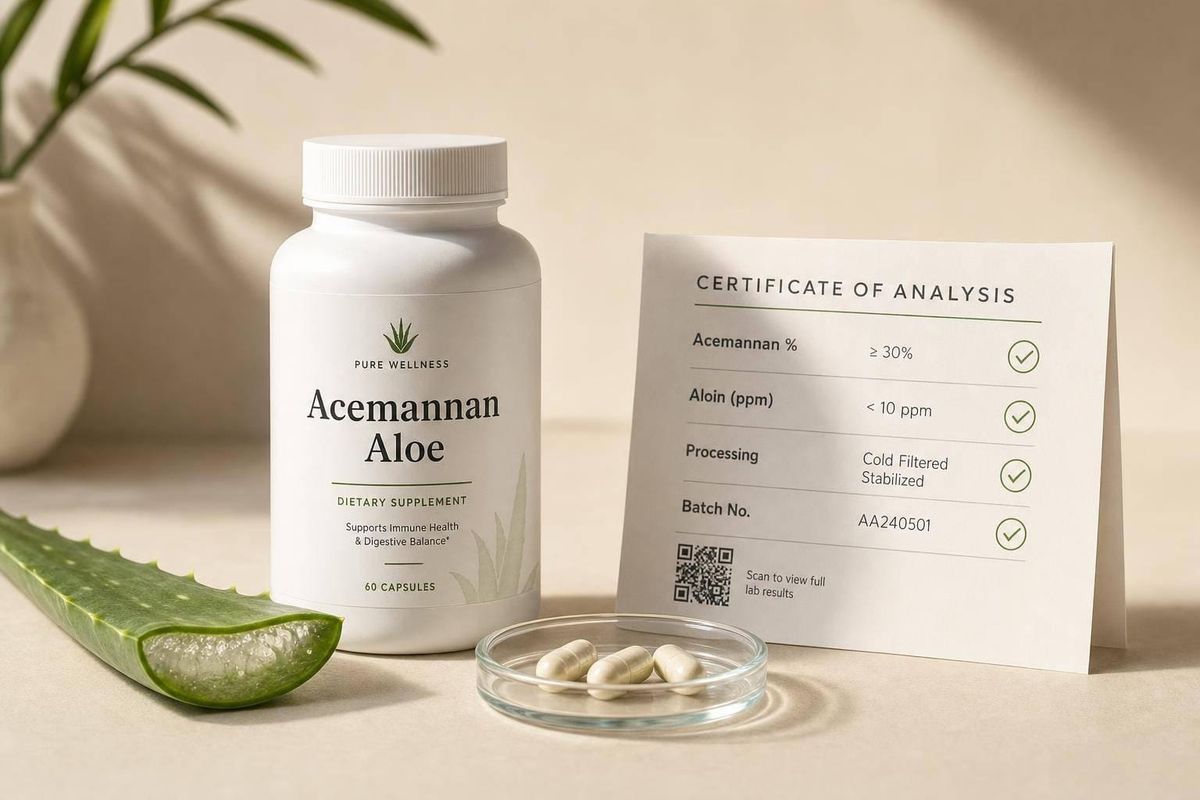
Most aloe supplements are easy to compare the wrong way. If I want an acemannan product that fits my routine, I focus on four things first: the goal, the form, the label, and the test results.
Here’s the short version:
- Pick the form I’ll use every day: capsules, powder, juice, or gel
- Check for stated acemannan, not just “aloe,” “polysaccharides,” or “200X”
- Look for inner-leaf aloe and low-heat processing like freeze-dried or cold-processed
- Confirm aloin control: oral aloe products should stay under 10 ppm
- Ask for a batch-specific COA with numbers for acemannan, aloin, heavy metals, and microbes
One number matters early: the IASC benchmark for raw aloe material starts at 5% beta-(1,4)-acetylated mannan by dry weight, and some standardized products list up to about 18%. That tells me far more than a vague aloe claim.
If I’m shopping fast, I use this rule: skip any product that hides acemannan content, gives no processing details, and won’t share test documents.
Quick comparison
| Form | Best for | Main upside | Main drawback |
|---|---|---|---|
| Capsules | Travel, busy days, fixed dosing | Easy to carry and simple to take | Dose is less flexible |
| Powder | Smoothies, custom serving sizes | Can be mixed and adjusted | Needs measuring |
| Juice | At-home daily use | Easy to drink | Bulky and often needs refrigeration |
| Gel | Digestive-focused home routine | Direct liquid format | Storage and label quality can vary |
So when I choose, I don’t start with branding or “concentrate” claims. I start with what I want it for, then I check whether the product clearly proves what’s inside.
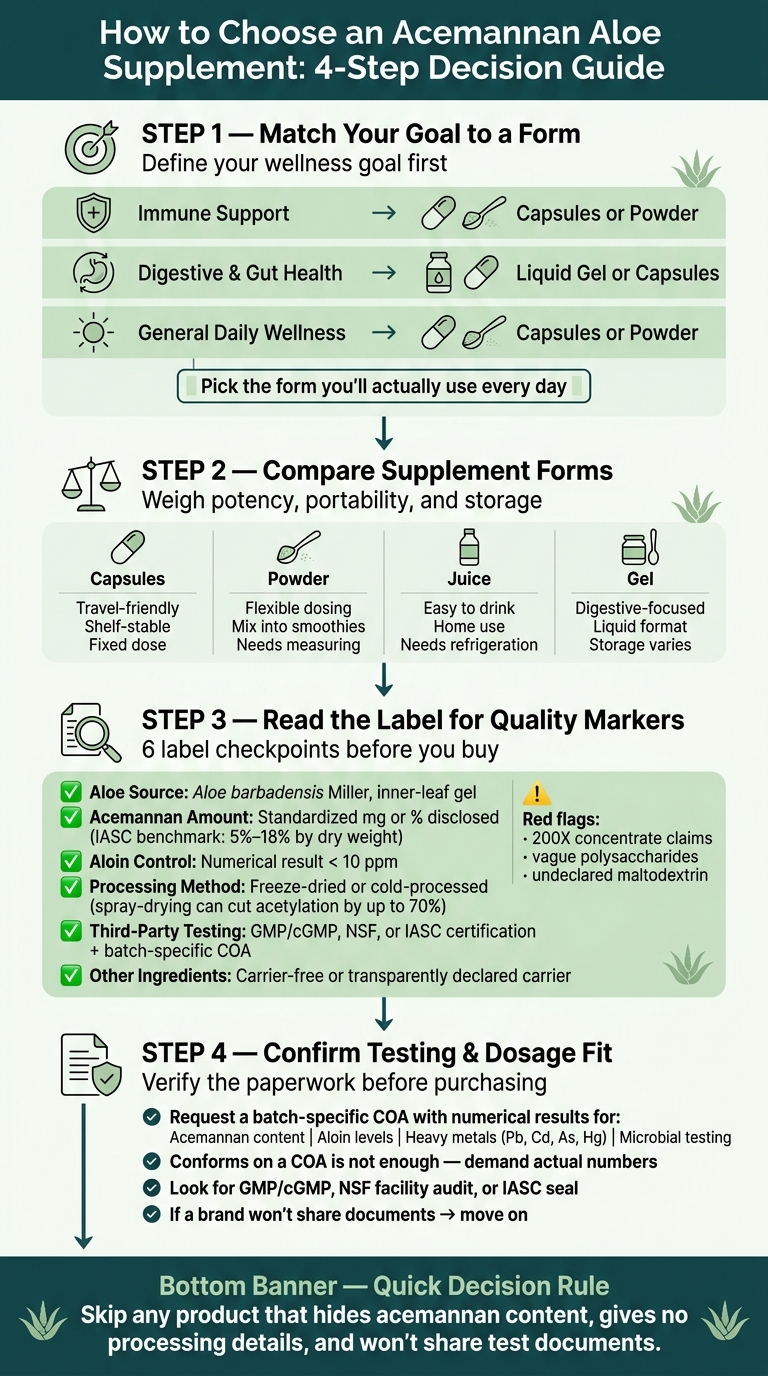
How to Choose an Acemannan Aloe Supplement: 4-Step Decision Guide
Step 1: Match the Supplement to Your Wellness Goal and Daily Routine
Start with your goal and daily routine. Form and label details come after that.
Define your main use case before comparing products
Before you compare labels or prices, get clear on what you want the supplement to do. Your goal should guide the pick. Start with the outcome you want, then choose the form you can stick with day after day. That will usually narrow things down to juice, gel, capsules, or powder.
| Goal | Best Fit | Why |
|---|---|---|
| Immune support | Capsules or powder | Easy to dose each day; no refrigeration needed |
| Digestive and gut health | Liquid gel or capsules | Liquid form may support gut contact directly |
| General daily wellness | Capsules or powder | Simple, steady, and easy to pack |
Consider convenience, storage, and consistency
The best supplement is the one you’ll actually take every day. That means picking a form that fits your routine, not just one with a nice-looking label.
Liquid aloe juice or gel can work well if you already have a steady morning kitchen habit and don’t mind measuring a serving. Capsules are easier to store and bring with you. Liquids usually need refrigeration after opening. Capsules also give you a set dose, which makes them a good fit for busy schedules and steady daily use.
Build a simple checklist before you start shopping
Use these questions before you open a product page:
- Which format will I take every day? Capsules are often easier for twice-daily routines.
- Do I have steady refrigerator access? If not, rule out most juices and gels.
- Am I sensitive to taste or texture? If yes, capsules are usually the easiest option.
- Am I trying to skip extra sweeteners, flavors, or fillers? Powders and capsules often have fewer additives than flavored liquid products.
This quick checklist helps narrow your options fast and makes it easier to pick the format you’re most likely to use on a steady basis.
sbb-itb-b88dd21
Step 2: Compare Juice, Gel, Capsules, and Powders
Now it’s time to narrow things down by form. Juice, gel, capsules, and powders each work a little differently when you look at potency, portability, and storage.
A simple way to do this: start with the format that fits your daily routine, then weigh the trade-offs.
What each form offers in a daily routine
Juices and drinkable gels tend to fit best into home routines. They’re easy to take, but potency can vary unless the product is stabilized.
Capsules are usually the most stable, portable, and consistent pick. They also help you skip aloe’s taste, don’t need measuring, and are easy to carry.
Powders give you more flexibility with dosing and mix well into drinks or smoothies. The catch is that concentration labels don’t always tell you how much acemannan you’re getting.
Trade-offs in potency, portability, and storage
| Form | Best Fit | Practical Advantages | Key Limitations | Storage Needs |
|---|---|---|---|---|
| Juice / Liquid Gel | Home routines; fits a digestive-support routine | Easy to consume; long history of use | Variable potency; bulky; may require refrigeration | Often requires refrigeration after opening |
| Capsules | Travel; busy schedules; precise dosing | No mess; tasteless; highly portable | Fixed serving size; cannot be easily customized | Shelf-stable; store in a cool, dry place |
| Powders | Smoothies; flexible or custom dosing | Higher concentration potential; versatile; mixable | Requires measuring; risk of clumping; concentration claims may reflect liquid equivalency, not acemannan content | Keep tightly sealed; sensitive to humidity |
Once you narrow the form, the label becomes the next filter. After you choose one, check for acemannan content, processing method, and testing.
Step 3: Read the Label for Acemannan Content and Quality Markers
Once you've picked the form, the label tells you if the product is worth your money. A lot of aloe labels sound precise, but when you look closer, they don't say much about acemannan.
Look for acemannan specifics, not vague polysaccharide claims
Use the label to sort a solid supplement from a generic aloe product. The word "polysaccharides" is too broad. It doesn't tell you if you're getting acemannan. What you want to see is "acemannan" or "acetylated mannan", along with either mg per serving or a % by dry weight.
IASC raw-material benchmarks start at 5% beta-(1,4)-acetylated mannan by dry weight, and some standardized products reach about 18%.
If the label only says "aloe extract" or "aloe complex" and skips the active content, take that as a warning sign and keep looking. The same goes for "100X" or "200X" claims. Those numbers may refer to liquid equivalency, not tested acemannan potency.
A better sign is when the label names the test method, such as HPLC or NMR.
Check source, processing method, and additive choices
Two parts of the label matter most here: plant part and drying method. Aim for inner-leaf aloe with documented aloin control and low-heat processing.
Acemannan is concentrated in the inner-leaf gel of Aloe barbadensis Miller. That's the most studied source and the variety with the highest acemannan content. Whole-leaf products aren't an automatic no, but they should come with clear purification details and aloin control. The IASC oral-safety standard sets a maximum of 10 ppm for combined aloin A and B.
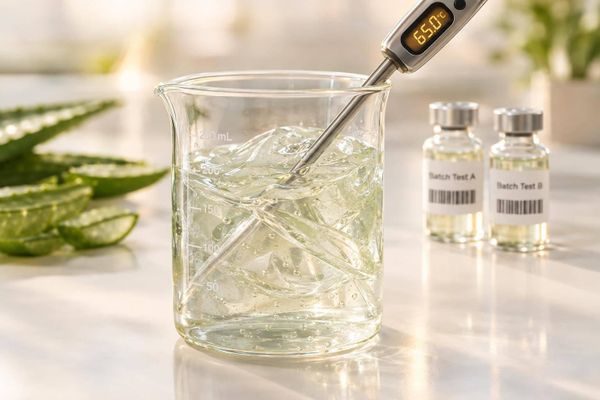
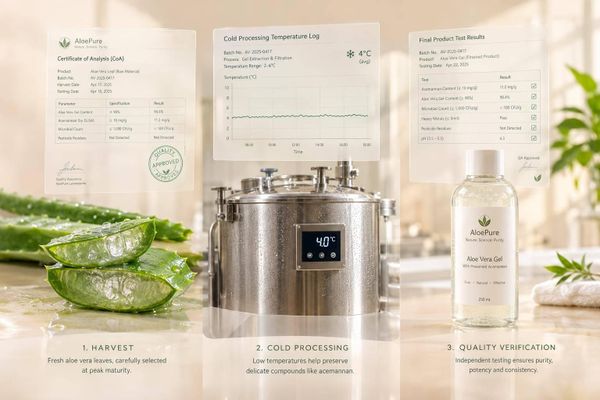
Processing matters too. Freeze-dried or cold-processed aloe helps keep acemannan's acetyl groups intact. Spray-drying can cut acetylation by as much as 70%. If the label says nothing about drying, note that.
Then check the extra ingredients. A cleaner formula is either carrier-free or clearly tells you what carrier was used, like organic rice flour or a listed percentage of maltodextrin. Undeclared maltodextrin is a red flag.
Use a pass-or-caution label checklist
Before you buy, run through these six checks:
| Checkpoint | Preferred (Pass) | Caution | Why It Matters |
|---|---|---|---|
| Aloe Source | Aloe barbadensis Miller, inner-leaf gel | "Aloe extract" or whole-leaf without purification details | Inner-leaf gel limits aloin and better reflects acemannan-rich material. |
| Acemannan Amount | Standardized mg or % disclosed | Vague active-ingredient claim | Confirms the label names the active compound. |
| Aloin Control | Numerical result < 10 ppm | No number listed | Shows whether the product stays within oral-safety limits. |
| Processing Method | Freeze-dried, cold-processed, or stabilized within 24 hours of harvest | Spray-dried or no drying method listed | Heat can lower acemannan quality. |
| Third-Party Testing | GMP/cGMP compliance, NSF certification, or IASC certification; batch-specific COA with numerical acemannan and aloin results | "Lab certified" or internal testing only | Verifies label claims and batch consistency. |
| Other Ingredients | Carrier-free or transparently declared carrier (e.g., organic rice flour or a listed maltodextrin percentage) | Undeclared maltodextrin or unspecified fillers | Keeps the formula to fewer additives. |
After the label passes these checks, the next step is to confirm batch testing and choose a dose you can stick with.
Step 4: Confirm Testing, Dosage Fit, and Your Final Buying Decision
Look for third-party testing and quality documents
Once the label checks out, the last step is simple: verify the paperwork and make sure the dose fits your routine.
Ask for a batch-specific Certificate of Analysis (COA). Also ask for the TDS and SDS for that same lot. A useful COA should include numerical results for acemannan content, aloin levels, heavy metals (lead, cadmium, arsenic, and mercury), and microbial testing. If the COA just says "conforms" instead of listing numbers, skip it.
Think of it this way: the COA shows proof for that specific batch, while certifications show proof of how the product is made overall. GMP/cGMP, NSF, and IASC can help back up the COA and show the product came from a controlled process. NSF audits the facility, not just the finished product. An IASC seal means the raw material meets industry benchmarks for acemannan and aloin control. If a brand won't share these documents when asked, that's a strong sign to move on.
Pick a dosage format you can stick with
Once you've checked quality, pick the form you'll use on a regular basis.
Go with the format that fits a habit you already have. If your mornings are rushed or you travel a lot, vegetable capsules are easy to carry, have no taste, and give you a measured dose.
Always follow the serving directions on the label. If you take diabetes medication, are pregnant, or use immunosuppressants, check with a clinician before starting.
Conclusion: Choose the Simplest Product That Fits Your Goal and Routine
The decision comes down to five steps: define your wellness goal, pick the form that fits your schedule, verify a stated acemannan potency on the label, review ingredient and processing quality, and confirm third-party testing before you buy. If a product clears all five, it doesn't need to cost a lot or come with extra fluff. It just needs to be clear about what's inside and steady in how it's made.
FAQs
How much acemannan should I look for per serving?
Don’t focus only on the total amount of acemannan. Research suggests its activity depends a lot on specific molecular fractions, especially those between 50,000 and 400,000 daltons.
There isn’t one set dosage that fits every product. So instead, check for a stated potency percentage. Well-made standardized products may list concentrations like 18%.
It also helps to see whether the manufacturer shares clear documentation that confirms both the total acemannan content and its molecular profile.
Is whole-leaf aloe okay, or should I only choose inner-leaf?
It comes down to how the aloe is processed.
Acemannan is found mostly in the inner-leaf gel. Whole-leaf aloe can be used too, but it needs strict purification - often with activated-carbon filtration - to remove latex-related compounds such as aloin.
Because inner-leaf processing naturally separates the gel from those outer-leaf compounds, it’s often the better pick for oral supplements. If you go with a whole-leaf product, check that it has been specifically purified to meet safety standards for aloin content.
What should I do if a brand will not share a batch-specific COA?
If a brand won’t share a batch-specific Certificate of Analysis (COA), treat that as a red flag for transparency and product quality.
It’s smart to lean toward brands that offer independent, third-party verification, like NSF certification or cGMP compliance. That extra layer matters. It shows an outside organization has checked the brand’s production and testing standards instead of asking you to just take the company at its word.