Cold-Processed Aloe: What It Means for Supplement Quality
Cold-processed alone is marketing — true aloe quality requires standardized acemannan, inner-leaf sourcing, 24-hour stabilization, and third-party proof.

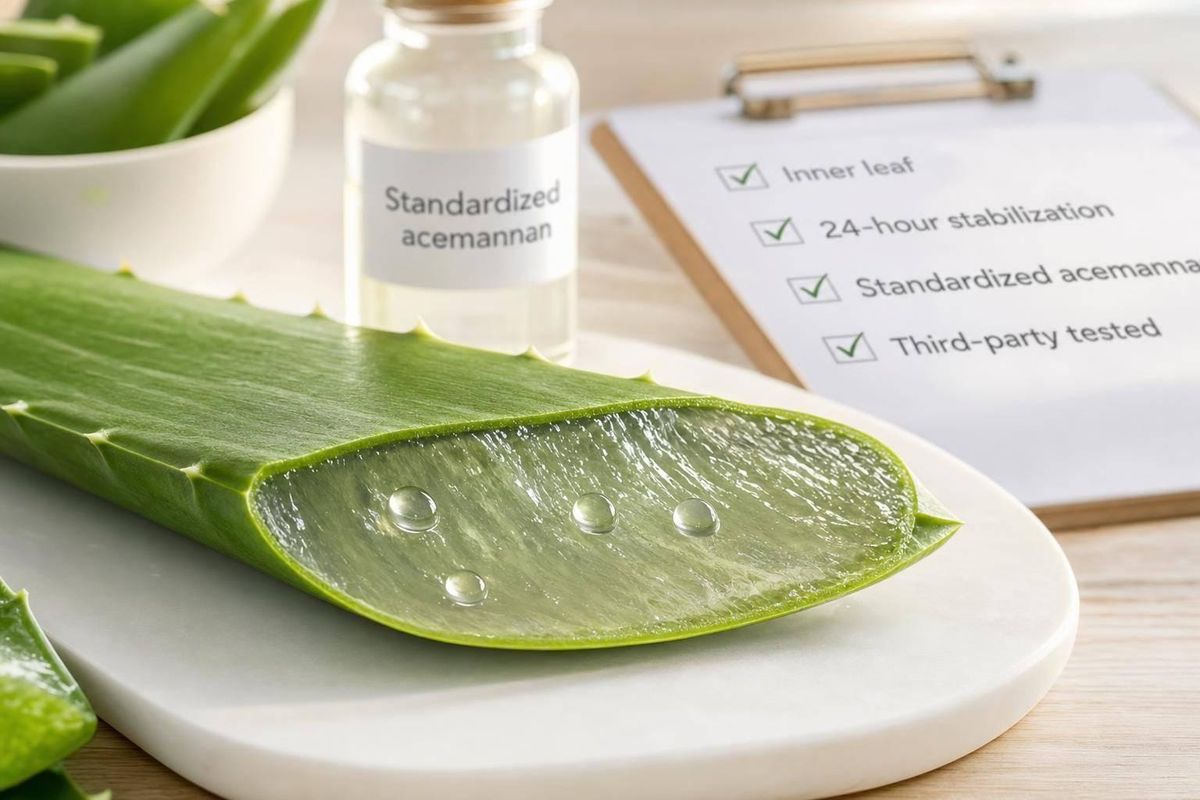
“Cold-processed” on an aloe label is not proof of a better supplement. What I’d check first is simple: acemannan listed on the label, inner-leaf source, processing within 24 hours of harvest, and third-party testing.
Here’s the short version:
- Cold-processed usually means low or no heat during extraction.
- That matters because heat can damage acemannan, a main aloe polysaccharide tied to acemannan's health benefits.
- But the claim alone does not tell me how much acemannan is left in the final product.
- I’d trust labels more when they show:
A few facts stand out. The article notes that aloe compounds can start breaking down within hours after cutting, and that delays before stabilization can cut into quality. It also points out that spray drying and other high-heat steps can strip acetyl groups from acemannan, which can leave a less active end product.
If I were shopping, I would ignore big “cold-processed” text unless the brand also shows the details above. That’s the difference between a label claim and usable proof.
| What to check | What I want to see | What I’d avoid |
|---|---|---|
| Acemannan | Specific % or mg | No acemannan listed |
| Aloe source | 100% inner leaf | Whole-leaf or vague source |
| Processing | Low-heat or cold-processed with details | Heat-based or not stated |
| Stabilization | Done within 24 hours | No timing given |
| Testing | Third-party, batch-specific results | “Lab tested” with no proof |
Bottom line: I’d treat “cold-processed” as a starting point, not a verdict. The better buy is the one that shows clear acemannan numbers and plain proof of how the aloe was handled.
Cold-Processed Aloe: What the Term Actually Means
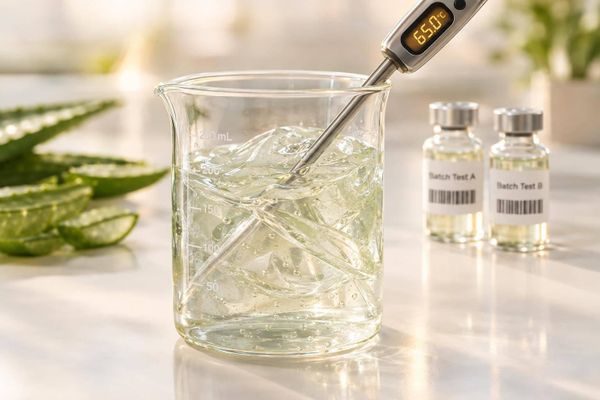
"Cold-processed" usually means the aloe was extracted and stabilized with little or no heat. There isn't one industry-wide temperature range behind that claim. So the phrase points to a lower-heat method, not to a proven acemannan level. What matters after that is simple: does the label show how the process was controlled?
What the Claim Tells You and What It Does Not
A cold-processed label can suggest that a brand is paying attention to how heat may affect aloe's bioactive compounds. But that claim, by itself, doesn't tell the whole story. Final quality still depends on a few things the label may leave out.
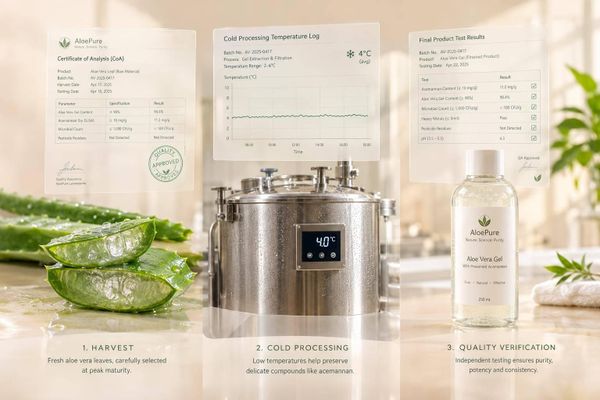
Raw material quality matters because growing conditions can affect acemannan levels. Acemannan also needs to be stabilized soon after harvest - ideally within 24 hours of cutting - to help preserve biological activity. If that step is delayed, the upside of cold processing can disappear.
Leaf type matters too. Inner leaf usually contains more gel. Whole-leaf formulas may dilute acemannan content and can cause digestive upset.
So if a product doesn't disclose acemannan, explain its processing controls, show its stabilization method, or provide third-party testing, the cold-processed claim doesn't tell you much about product quality. That's why the next things to check are processing temperature, acemannan disclosure, stabilization method, and testing.
sbb-itb-b88dd21
Why Processing Matters for Acemannan
This matters because acemannan is the compound most likely to show whether processing kept aloe's value intact. It's also heat-sensitive, so the way a supplement is made has a direct effect on how much acemannan is still there in the final product.
Put simply: if processing is rough, acemannan takes the hit first.
The next step is looking at what processing does to that structure.
How Heat Can Damage Sensitive Aloe Compounds
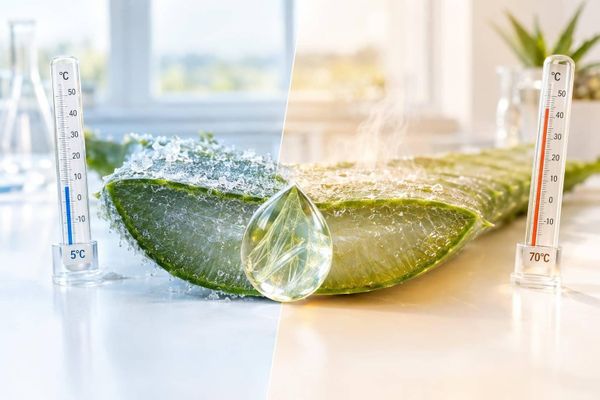
The biggest threat is heat. High-heat steps like spray drying can break apart acemannan's chains or remove the acetyl groups that help hold its structure together. When that happens, you end up with less bioactive material.
Timing matters too. Acemannan starts to degrade within hours of harvest, which is why fast stabilization after cutting is so important. If aloe sits too long before it's stabilized, some of that material can start breaking down before processing even gets going.
Heat Processing vs. Cold Processing vs. Stabilization: A Side-by-Side Look
These three methods are not the same thing. Each comes with a different level of risk for acemannan, and each gives you a different clue about what you're buying.
| Method | Preservation Risk | Impact on Acemannan | What It Tells You |
|---|---|---|---|
| Heat-based processing (such as spray drying) | High | Degrades chains and strips acetyl groups. | Often points to lower bioactive value. |
| Cold processing | Low | Limits thermal stress and helps protect acemannan's natural structure. | Suggests a formula made to protect bioactivity, but acemannan disclosure still matters. |
| Rapid stabilization after harvest | Minimal | Helps prevent post-harvest breakdown and preserves molecular structure. | Points to a more controlled process that supports better-preserved potency. |
Cold processing lowers the risk from heat. But rapid stabilization and acemannan disclosure give you the clearest signal of quality. That's why the label details matter next.
Quality Markers to Check on the Label
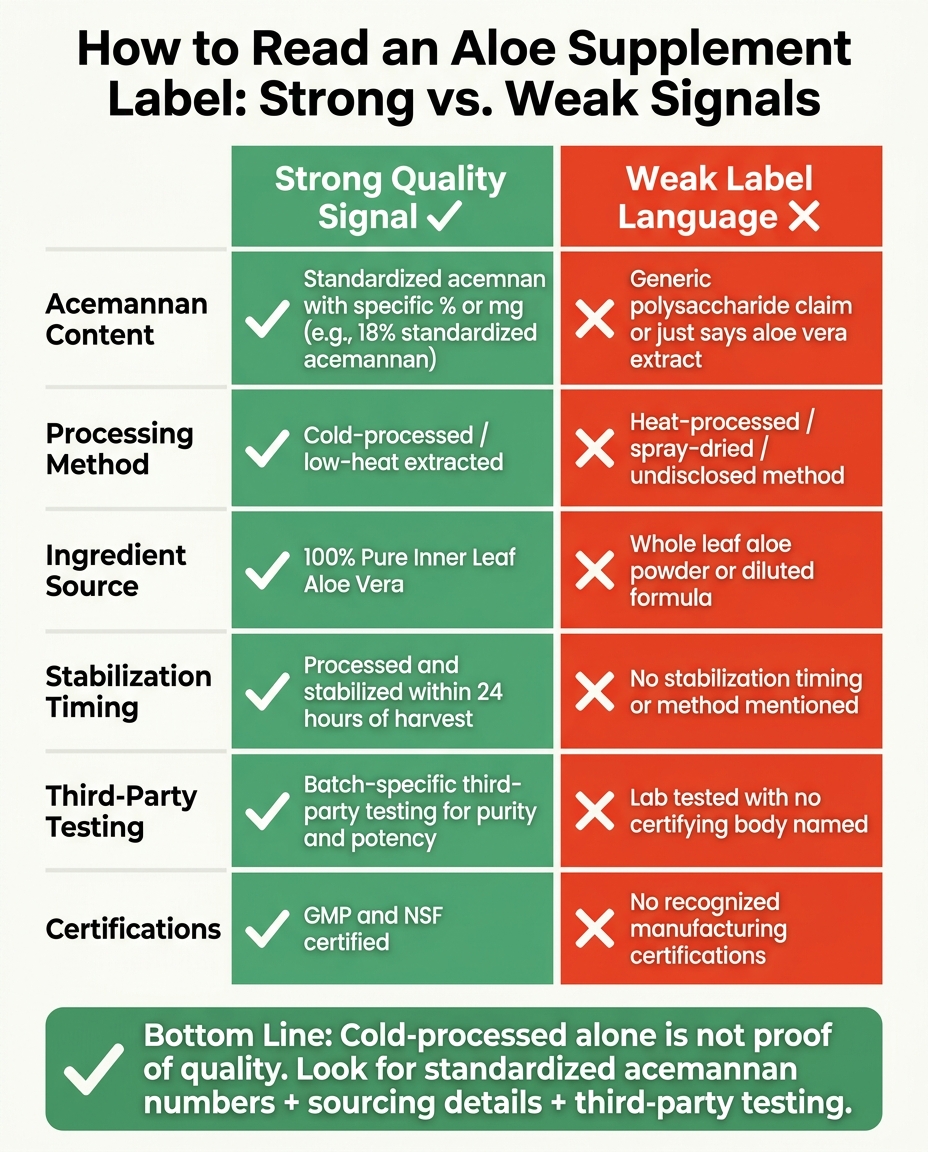
Cold-Processed Aloe Supplement: Strong vs. Weak Label Signals
A label can tell you a lot. Once you know processing affects aloe quality, the next step is simple: check whether the product gives clear proof that it was preserved well. In many cases, the best clues are right on the bottle.
Start with the part that matters most: potency.
Processing Temperature Claims and Acemannan Disclosure
Look for standardized acemannan content or a clearly stated potency level. A label that gives a specific percentage tells you far more than one that just says "aloe vera extract" or makes a broad polysaccharide claim.
If the label doesn't list acemannan content, there's no clear way to judge potency.
That standardization matters because it shows the product is meant to deliver a set amount, not just make a loose marketing claim. Put simply, these details give you a better read on quality.
Stabilization Method, Ingredient Source, and Third-Party Testing
Acemannan isn't the only thing worth checking. Three other label details can help you sort strong products from weak ones.
First, look for 100% Pure Inner Leaf Aloe Vera. Inner leaf usually holds onto acemannan better than whole leaf.
Second, check for wording that says the aloe was processed and stabilized within 24 hours of harvest. If the label says nothing about timing or how the product was stabilized, that's a gap.
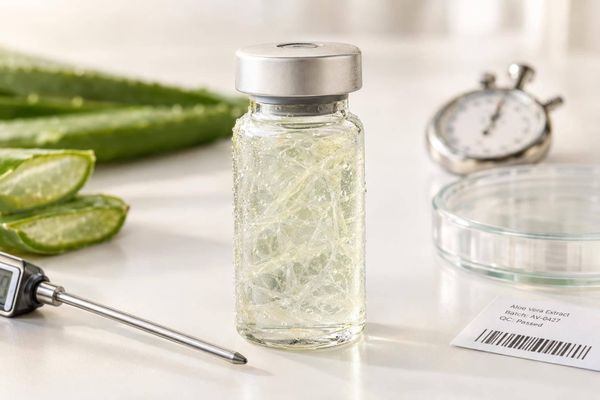
Third, look for third-party testing with batch-specific results for purity, potency, and safety. Certifications such as GMP and NSF add one more layer of proof.
Strong Label Signals vs. Weak Label Language
Here's a quick side-by-side view of what to look for.
| Feature | Strong Quality Signal | Weak Label Language |
|---|---|---|
| Acemannan Content | Standardized acemannan with a specific percentage | Generic polysaccharide claim or "aloe vera extract" |
| Processing Method | Cold-processed / low-heat extracted | Heat-processed / spray-dried / undisclosed |
| Ingredient Source | 100% Pure Inner Leaf Aloe Vera | Whole leaf aloe powder or diluted formula |
| Testing & Verification | Third-party tested with batch-specific results | "Lab tested" with no certifying body named |
| Stabilization | Processed within 24 hours of harvest | No stabilization timing or method mentioned |
| Certifications | GMP and NSF certified | No recognized manufacturing certifications |
How to Decide If a Cold-Processed Aloe Supplement Is Worth Buying
After you check the label claims, use a few simple rules to decide if a product earns its price. The label should drive the decision, not the sales copy. The clearest signal is standardized acemannan, backed by plain sourcing details and testing info.
When you compare products, focus on standardized acemannan, not total aloe weight. A label that gives a percentage or an exact mg amount is much easier to judge. And when you think about price, measure it against acemannan content, not just the total extract weight.
Price by itself doesn't tell you much. A lower-cost product can still be a weak buy if it uses heat processing, relies on whole-leaf aloe, or skips third-party testing. On the other hand, a product that clearly states an inner-leaf source and explains how it was made gives you something solid to judge.
A Simple Checklist for Smarter Purchase Decisions
If the label can't answer these points in plain English, you don't have enough proof to judge quality.
| Question to Ask | What a Strong Product Shows |
|---|---|
| Is acemannan content disclosed? | Specific percentage or mg count, such as 18% standardized acemannan |
| What extraction method was used? | Cold-processed or low-heat extraction with clear stabilization details |
| Was it stabilized within 24 hours of harvest? | Explicitly stated on the label or product page |
| Is the source inner leaf only? | "100% Pure Inner Leaf" |
| Has it been third-party tested? | Batch-specific third-party testing for purity and potency, ideally with GMP or NSF certification |
Think of this checklist as a filter. If a product clears these points, you have a much better shot at knowing what you're paying for.
FAQs
Does cold-processed mean higher acemannan?
Usually, yes. Cold processing helps preserve acemannan because it’s a delicate polysaccharide that can break down when exposed to high heat, harsh processing, or too much moisture.
When the extraction method protects that bioactive structure, acemannan is more likely to stay intact, functional, and bioavailable. And that usually means a higher-quality, more potent supplement.
Why is inner-leaf aloe preferred?
Inner-leaf aloe is often the better pick because that’s where acemannan is most concentrated. This is aloe’s main bioactive polysaccharide, and it’s a big part of why people look for aloe in the first place.
When a product starts with inner-leaf gel, you’re more likely to get this functional ingredient in a meaningful form. By contrast, formulas made with whole-leaf parts may rely on diluted powders that contain very little acemannan.
There’s another point here too: inner-leaf gel can help protect the structure of these delicate polysaccharides, which play a role in immune and digestive health.
How can I verify third-party testing?
Confirm that the brand states every batch is third-party tested and shares details on purity, potency, and safety rather than leaning on vague marketing language.
For Advanced Acemannan, the product description says each batch is third-party tested for purity, potency, and safety with radical transparency. It also helps to check whether the company ties that testing to its quality control process and mentions polysaccharide verification for acemannan content.