Processing Makes the Difference: Investigating Cold Processing and Acemannan Preservation in Aloe Vera
Explains why cold-processing labels don't prove acemannan preservation and which finished-product tests to request.

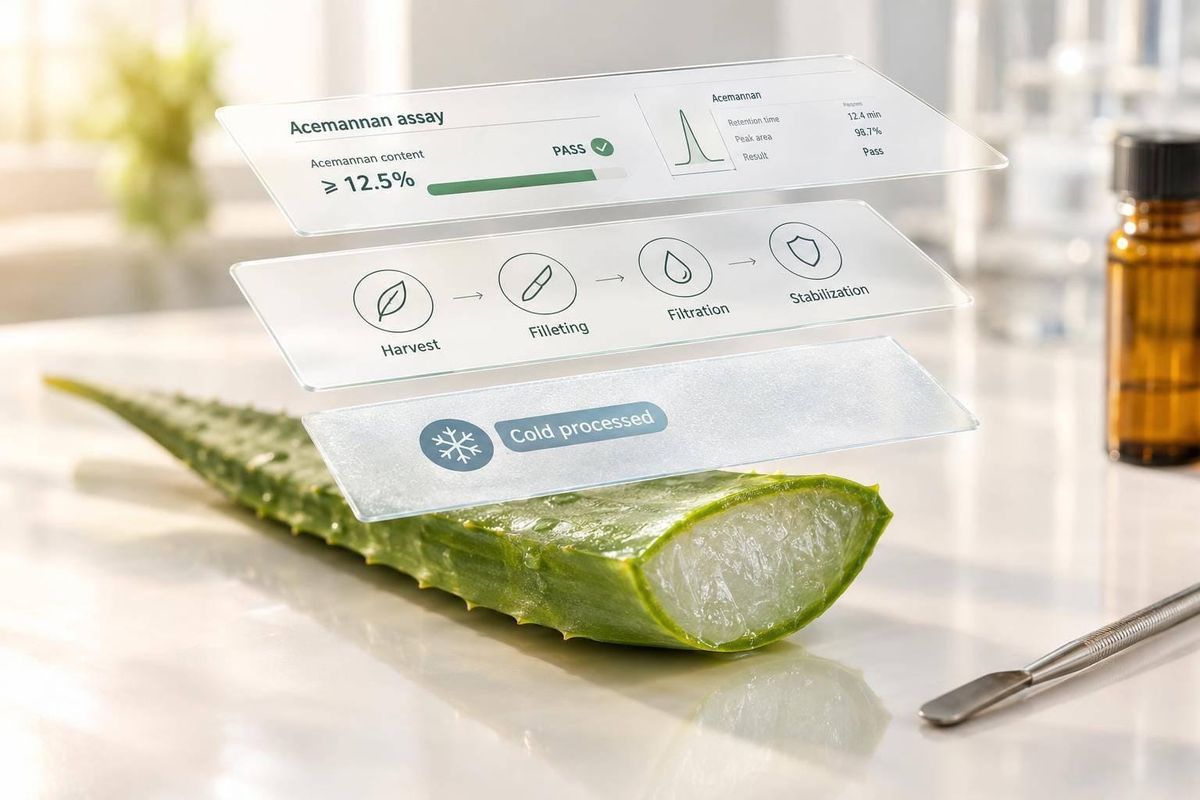
“Cold processed” doesn’t prove acemannan is preserved. I look for finished-product tests - not just a label - to check how much acemannan remains, its acetylation, and its molecular size.
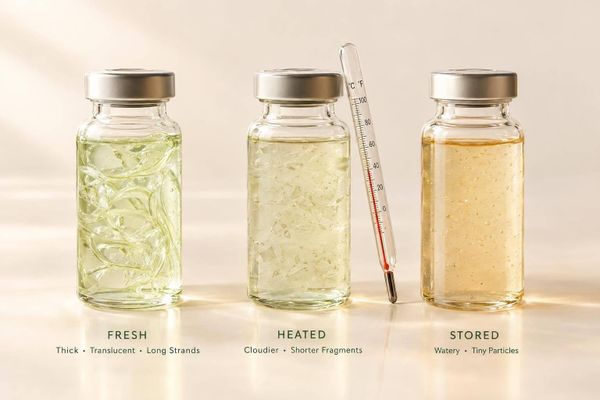
Why does that matter? In one dehydration study, deacetylation exceeded 46% at 176°F (80°C) or above, compared with about 14% at 140°F (60°C) under the study’s conditions. That’s not a universal temperature rule: time, moisture, pH, and storage also affect the result.
Here’s what I’d ask for before choosing an aloe product:
- The full processing history: temperatures, exposure times, drying steps, and later heating.
- Finished-lot test results: acemannan amount, acetylation, and molecular-size data - not just total polysaccharides or aloe percentage.
- Safety and shelf-life records: microbial tests, contaminant results, and storage data for the product in its final packaging.
My takeaway: <u>check the finished product, not just the processing claim</u>. Cold processing may limit heat damage, but neither cold nor heat processing alone proves quality. And preserved acemannan does not prove a health effect - that takes human studies of the specific product.
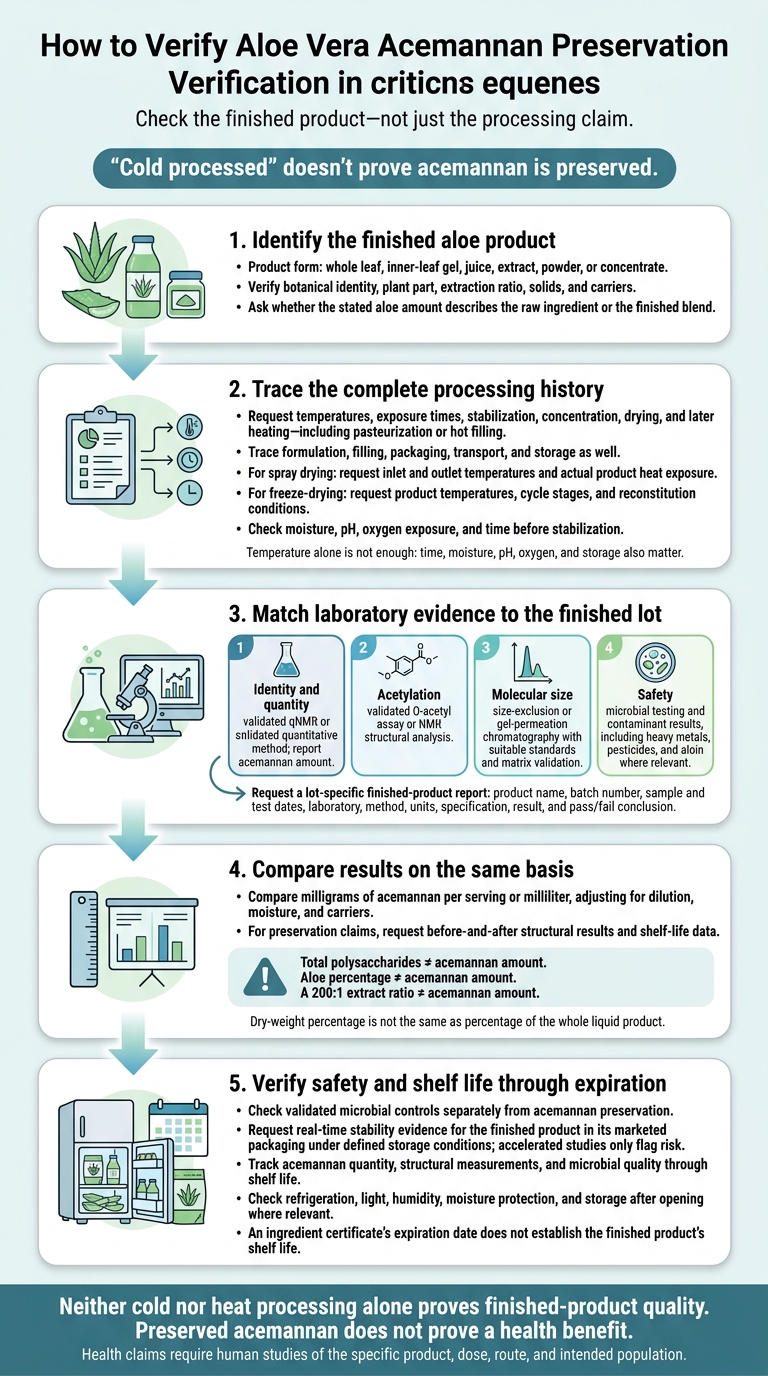
How to Verify Aloe Vera Acemannan Preservation
2. Cold Processing vs. Heat Processing
Cold processing means handling and stabilizing aloe gel without intentionally applying heat. If the claim covers the whole product, it must hold true at every stage - from raw gel to finished product. Heat processing includes pasteurization, concentration, evaporation, or drying.
A label only tells the full story when the process matches it from extraction through packaging. Check three areas: temperature exposure, microbial control, and finished-product testing.
| Criterion | Cold processing | Heat processing | Verification needed |
|---|---|---|---|
| Temperature exposure | No intentionally applied heat during the stated process | Heat used during pasteurization, concentration, or drying | Product temperature, exposure time, and equipment logs |
| Microbial control | May use filtration, ultraviolet treatment, refrigeration, preservatives, or combined controls | May use pasteurization or another validated thermal process | Validated microbial-reduction study and finished-product microbiology |
| Acemannan content and structure | Requires content and structural testing | Requires content and structural testing | Quantitative acemannan assay, degree of acetylation, and molecular-structure testing |
| Shelf stability | Often requires refrigeration, preservatives, aseptic filling, and validated packaging | May improve microbial stability, but heating and drying can alter the polymer | Real-time and accelerated stability data under documented storage and packaging conditions |
| Manufacturer records | Should document cold-chain control and nonthermal stabilization steps | Should document every heating and drying step | Certificate of analysis, batch record, deviation log, and finished-product specifications |
The question isn't just whether heat was used. It's how much heat, for how long, and in what form.
How Temperature, Time, and Drying Affect Acemannan
Acemannan responds to temperature, time, moisture, and pH - not temperature alone. The same temperature can produce different results as moisture and exposure time change. Research reports relative stability up to 158°F (70°C) under some conditions, yet changes near 140°F (60°C) during dehydration.
| Treatment | Temperature and time | Moisture conditions | Key limitation |
|---|---|---|---|
| Moderate heating | 140°F (60°C) for 30 minutes | Wet gel | Findings do not establish a universal safe limit. |
| Higher-temperature heating | 176–212°F (80–100°C) for 30 minutes | Wet gel | Results cannot be equated with prolonged dry heating. |
| Thermal dehydration | 140–212°F (60–100°C) for approximately 15–20 hours | Water progressively removed | Deacetylation exceeded 46% at 176°F (80°C) or above, versus approximately 14% at 140°F (60°C), under the study conditions. |
Lower acetylation in commercial beverages doesn't reveal the exact processing history or prove that biological activity was lost. Raw materials, dilution, pH, storage, and assay choice can also affect results. A valid conclusion requires batch records, quantitative acemannan measurement, and degree-of-acetylation analysis. Any claim about biological activity also needs an appropriate biological study.
Cold-Processing Claims: What Proof Is Needed?
Avoiding heat doesn't prove acemannan quantity, purity, safety, or shelf life. UV treatment, filtration, refrigeration, and preservatives each need separate validation.
| Claim | Evidence needed | What is not enough |
|---|---|---|
| “Preserves nutrients” | Before-and-after composition tests identifying nutrients and percentages retained | A cold-processing label |
| “Retains active acemannan” | Quantitative acemannan assay, degree of acetylation, structural analysis, and molecular-size or fingerprinting data; biological research for functional claims | Content or identity testing alone |
| “Requires no preservatives” | Validated microbial challenge testing, routine pathogen and spoilage testing, real-time stability, package-integrity data, and documented storage conditions | An ingredient list that omits preservatives |
Acemannan can still change after extraction, so testing can't stop there.
Processing and Storage After Extraction
Trace the full chain: stabilization, concentration, drying, formulation, filling, packaging, transport, and storage.
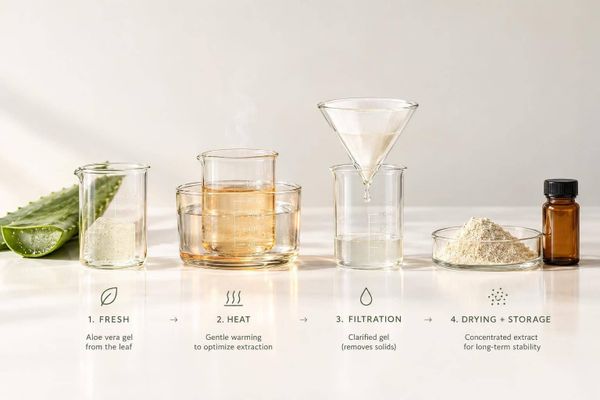
Spray drying atomizes liquid into hot gas. Freeze-drying removes ice by sublimation under vacuum, but freezing, concentration during ice removal, and secondary drying can still change acemannan.
For spray drying, request inlet and outlet temperatures plus the product's actual heat exposure. For freeze-drying, request product temperatures, cycle stages, and reconstitution conditions. Also check final moisture, water activity, transport and storage conditions, and finished-product results.
sbb-itb-b88dd21
3. How to Test Acemannan Content and Structure
Processing claims are only part of the picture. Testing should show whether the finished product contains preserved acemannan.
Test the finished product, not just the raw aloe ingredient. IASC treats acemannan as an identity marker - not proof of its concentration or intact structure.
Identity, Quantity, and Structure: Different Measurements
Validated quantitative nuclear magnetic resonance spectroscopy (qNMR) can detect and measure acemannan in suitable aloe matrices. Ask whether the method was validated for the product’s matrix and whether it reports detection limits, recovery, precision, matrix effects, and reporting units.
Identity, amount, structure, and microbial quality need different tests.
| Claim | Useful test | What the result establishes |
|---|---|---|
| Aloe identity | Validated qNMR analysis of acemannan, supported by other aloe markers when needed | Confirms aloe identity; a non-detect result calls that identity into question. |
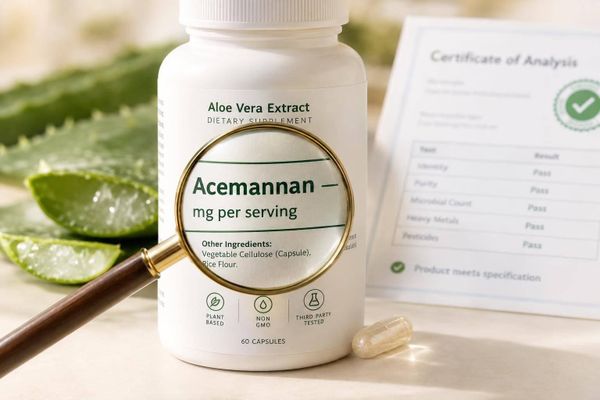
| Acemannan quantity | Quantitative NMR or another validated quantitative method, reported in milligrams per milliliter, milligrams per serving, or percentage of dry weight | Measures acemannan in the tested lot - not the amount of aloe listed on the label. |
| Degree of acetylation | Validated O-acetyl assay or NMR structural analysis | Shows how much acetylation remains, but does not establish molecular size or full structural integrity. |
| Molecular-size characteristics | Size-exclusion or gel-permeation chromatography with suitable standards and matrix validation | Describes molecular-size distribution and possible degradation or fragmentation. |
| Microbial quality | Total aerobic microbial count, yeast and mold testing, and relevant pathogen tests | Establishes microbiological quality for the tested lot - not acemannan identity or quantity. |
Total polysaccharides, aloe percentage, and a 200:1 extract ratio are not acemannan measurements. None tells you how much acetylated polysaccharide remains or whether its structure is preserved. Check the reporting basis, too: a dry-weight percentage is not the same as a percentage of the whole liquid product.
Batch Reports, Quality Limits, and Shelf-Life Testing
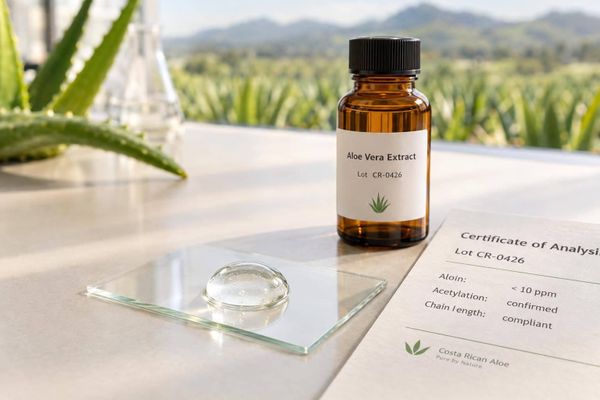
Request a lot-specific finished-product report that includes the product name, batch number, sample and test dates, lab, method, units, specification, result, and pass/fail conclusion. Compare reports across lots, including results for contaminants such as heavy metals, pesticides, and aloin.
IASC’s raw-material minimum of 5% acetylated mannan by dry weight applies to raw materials. It should not be presented as a universal requirement for finished products.
Finished-lot testing also needs to address stability from release through expiration. Shelf-life evidence should cover the product in its marketed packaging under defined storage conditions, with intermediate testing of acemannan quantity, structural measurements, and microbial quality.
Use real-time stability data to support shelf-life claims; accelerated studies only flag risk. Include opening and moisture exposure when relevant.
4. Checklist for Checking Processing Claims
Use this checklist to check a cold-processing claim on a finished product. Cold processing still requires lot-level proof that acemannan has been preserved.
Identify the finished aloe form: whole leaf, inner-leaf gel, juice, extract, powder, or concentrate. Verify the botanical identity, plant part, extraction ratio, solids, and carriers. Also confirm whether the stated aloe amount refers to the raw material or the finished blend.
Trace the full heat history. Request exact temperatures, holding times, and any later heating steps, including pasteurization, hot filling, concentration, or drying. For powders, ask for drying inlet and outlet temperatures, residence time, and post-drying test results. Check pH, oxygen exposure, and the time before stabilization, too.
Match the evidence to the finished lot. Confirm that the batch-specific certificate of analysis covers that finished lot and lists the laboratory, methods, results, units, and limits. Check separately for measured acemannan, acetylation, molecular-weight or chain-size data, and microbial results. Verify microbial control as a separate check.
Compare on the same basis: milligrams of acemannan per serving or milliliter, adjusted for dilution, moisture, and carriers. For preservation claims, request before-and-after structural test results and shelf-life data.
Check storage instructions and expiration support. Review requirements for refrigeration, light, humidity, and storage after opening. Verify that preservation testing covers the container and closure, moisture protection for powders, and repeated opening where relevant. An expiration date on an ingredient certificate does not establish the finished product’s shelf life.
5. Conclusion: Processing Labels Need Test Results
Cold processing may limit heat-related changes, but acemannan stability also depends on temperature, time, moisture, pH, oxygen, and the specific processing step. Neither cold nor heat processing alone proves finished-product quality. Batch-level testing is the only reliable way to check a processing claim.
Processing labels matter only when finished-product data confirm preservation. The strongest evidence combines processing records with finished-product tests for acemannan identity, quantity, and structure, plus validated microbial controls and shelf-life testing. A favorable acemannan result cannot replace safety controls or shelf-life evidence.
Preservation shows product quality, not clinical benefit. Acemannan can remain present and intact without proving that the product works. Health claims require human studies of the specific product, dose, route, and intended population.
FAQs
How do I interpret acemannan test results?
Review a batch-matched Certificate of Analysis (CoA) for the finished, dried product. Check the laboratory, test date, methods, acceptance ranges, and acemannan amount, rather than generic polysaccharide counts. Confirm that results include units and specify a dry-weight or as-is basis.
To assess whether the structure remains intact, check the degree of acetylation, measured by NMR, and the molecular-weight distribution. These measurements help show whether acetyl groups remain and whether chains have fragmented. Higher values don’t automatically mean better quality or greater health benefits.
What if a manufacturer won't share batch tests?
Hold off on buying if the manufacturer won’t share batch-specific test results. A cold-processed label alone doesn’t prove quality or structural integrity.
Ask for a lot-specific Certificate of Analysis that includes numerical acemannan results with units, the test method, the laboratory’s name, and proof of ISO/IEC 17025 accreditation. Without these records, you can’t confirm that processing preserved the acemannan structure.
Can shipping heat affect acemannan preservation?
Yes. Heat, moisture, oxygen, and light during shipping can break down acemannan, changing its chain length and acetyl groups.
Keep products tightly sealed in a cool, dry place out of direct sunlight, and follow the manufacturer’s storage instructions. To check how well acemannan has been preserved, the finished product needs testing for acetylation, molecular weight distribution, and polysaccharide profiles. Initial processing claims alone aren’t enough.
Related Blog Posts
- Why Cold Processing Matters: Preserving Acemannan Integrity in Aloe Vera
- From Harvest to Finished Product: How Cold Processing Helps Preserve Acemannan in Aloe Vera
- Preserving What Matters: Why Processing Temperature Is Critical to Acemannan Integrity
- The Acemannan Advantage: How Cold Processing Protects Aloe Vera’s Key Polysaccharides