How to Read an Aloe Supplement Label Like a Pro
Judge aloe supplements fast: check species, plant part, mg per serving, acemannan, additives, and testing seals.
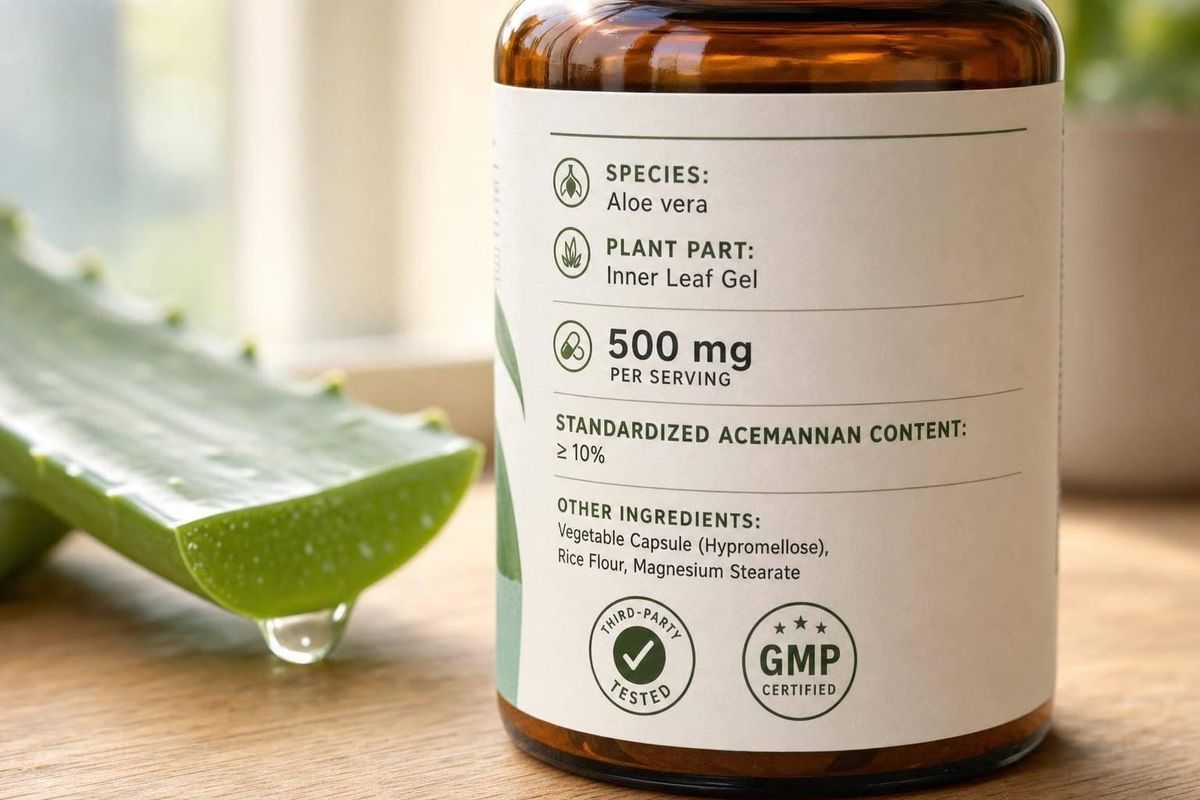
Most aloe labels tell you less than you think. If I want to judge an aloe supplement fast, I ignore the front first and check four things on the back: the species, the plant part, the amount per serving, and whether acemannan or polysaccharides are listed.
Here’s the short version:
- Check the species: I look for Aloe vera or Aloe barbadensis Miller.
- Check the plant part: I want inner leaf for oral use. If it says whole leaf, I look for decolorized or a note that aloin was reduced.
- Check the dose: The label should show a clear serving size and a specific mg amount per serving.
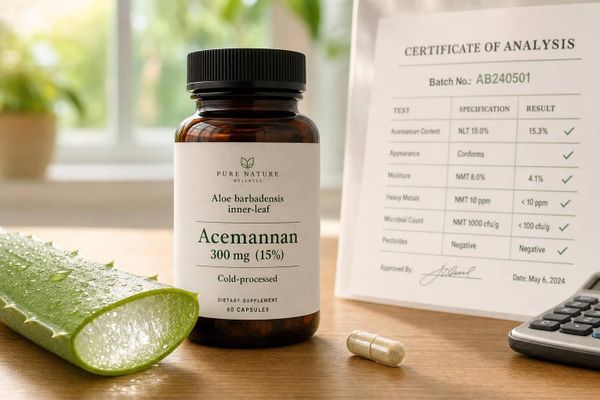
- Check for acemannan: This is the main aloe compound linked with gut and immune support in the article.
- Check extras: I scan for sugar, honey, maltodextrin, preservatives, and capsule fillers.
- Check processing and testing: Terms like cold-processed, plus seals such as GMP, NSF, or IASC, can help me judge how much detail the maker gives.
One point stands out: if a label says only “aloe powder” or “aloe extract” with no plant part, no acemannan detail, and no mg amount, I still don’t know what I’m getting. And if water or sugar comes before aloe in a liquid formula, aloe may not be the main part of the product.
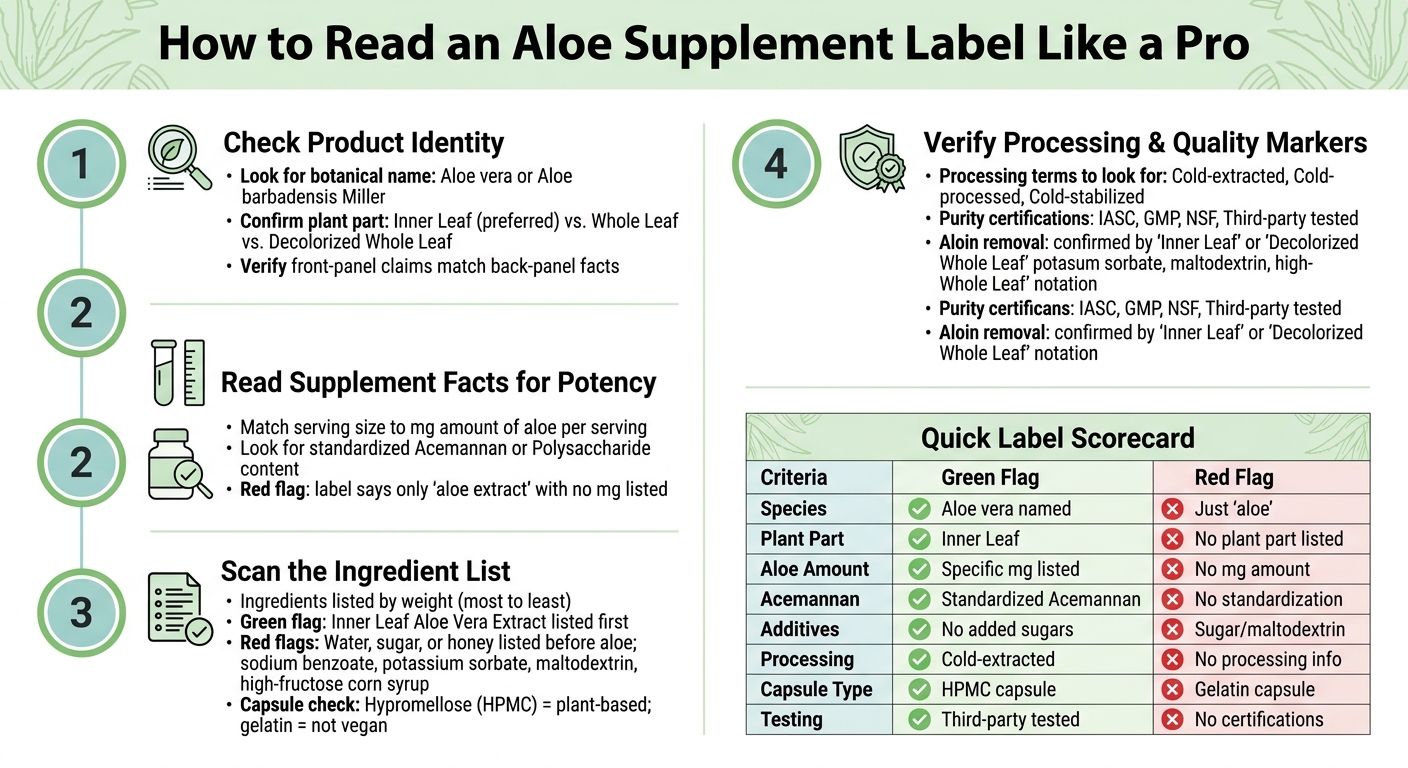
How to Read an Aloe Supplement Label: 4-Step Checklist
ER Nurse Explains: How to Read Supplement Labels 💊 | iHerb
sbb-itb-b88dd21
Quick Comparison
| What I check | What I want to see | What makes me pause |
|---|---|---|
| Species | Aloe vera / Aloe barbadensis Miller | Just “aloe” |
| Plant part | Inner leaf | Whole leaf with no decolorized note |
| Amount | Clear serving size + mg per serving | No mg listed |
| Key compound | Acemannan or polysaccharide standardization | No standardization |
| Additives | Short ingredient list | Sugar, maltodextrin, many fillers |
| Purity notes | Aloin reduced/removed, third-party tested | Big claims with no proof |
In other words: a strong aloe label is specific. I want facts I can compare, not broad claims I can’t check.
Step 1: Check the Product Identity, Species, and Plant Part
Start with the basics: the species name, the plant part, and whether the claim on the front matches what the back panel says.
Find the Species Name and Statement of Identity
Look for the botanical name - Aloe barbadensis Miller or Aloe vera - to confirm the source. If the label says only "aloe", the identity isn’t complete.
Confirm Inner Leaf, Whole Leaf, or Decolorized Whole Leaf
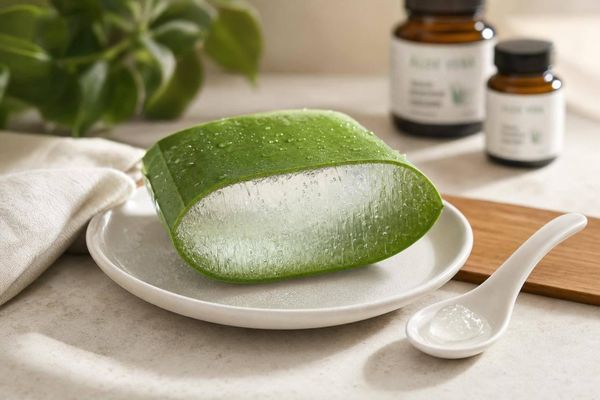
Next, check the plant part in the Supplement Facts or ingredient list. This matters because acemannan is concentrated in the inner leaf gel, not the rind.
| Aloe Material | Source | Note |
|---|---|---|
| Inner Leaf Gel | Clear internal pulp | Usual choice for oral supplements |
| Whole Leaf | Entire leaf (rind + gel) | Contains aloin |
| Decolorized Whole Leaf | Filtered whole leaf | Aloin reduced through processing |
For oral supplements, inner leaf is the usual pick. If the product uses whole leaf, the label should say "decolorized" or note that it was filtered to reduce aloin.
After that, check whether the Supplement Facts list acemannan or another standardization marker.
Treat Front-Panel Claims as a Starting Point, Not Proof
Front-panel claims like "aloin-free" or "immune support" are just a starting point. The back panel is where you verify them.
If a product says aloin-free, the ingredient list should show inner leaf extract or decolorized whole leaf. If it only says "aloe vera powder" and doesn’t name the plant part, you can’t verify the claim.
| Front-Panel Claim | What to Check on the Back Panel |
|---|---|
| Aloin-Free | "Inner Leaf" or "Decolorized Whole Leaf" in ingredient list |
| Cold-Processed | "Cold extraction" or "cold ethanolic extraction" in processing description |
| Digestive / Immune Support | Standardized acemannan or polysaccharide content in Supplement Facts |
| High Potency | Actual milligram amount of aloe matched to serving size |
Use the front panel as a clue. Use the back panel as proof.
Once you’ve pinned down the species and plant part, move to the Supplement Facts to see how much aloe - and how much acemannan - you’re getting.
Step 2: Read the Supplement Facts for Serving Size and Potency
Now that you know the species and plant part, the next move is simple: check whether the Supplement Facts panel gives you enough detail to compare one product with another.
Match Serving Size to the Amount of Aloe Provided
Serving size tells you the dose format. The milligram amount tells you how much aloe you’re actually getting.
So if the label says the serving size is 1 capsule, it should also say how many milligrams of aloe extract or standardized acemannan are in that capsule. If that number is missing, the potency is hard to judge.
Interpret Concentrate Ratios, Fresh-Gel Equivalents, and mg Amounts
The clearest label shows milligrams per serving. That gives you something concrete to compare.
If the label doesn’t say how many milligrams of aloe or acemannan you get per serving, you can’t tell how strong the product is. And if it only says “aloe extract” or “aloe powder” with no milligram amount, you still don’t know how much active aloe is in the dose.
Look for Acemannan or Polysaccharide Standardization
The strongest clue on an aloe label is standardized acemannan or polysaccharide content. That kind of wording gives you a firmer sense of potency than broad aloe claims.
A label that names a minimum amount is more open than one that stays vague. And if the product lists standardized acemannan and also mentions stabilization, you get a clearer picture of quality.
Once you’ve checked serving size and potency, move to the ingredient list and look for sugars, preservatives, and fillers.
Step 3: Scan the Ingredient List for Sugars, Preservatives, and Additives
The ingredient list shows the full formula. After you check potency, read this part next. It tells you whether aloe is the main base or just one piece of a bigger blend, and whether that aloe is watered down by everything around it.
Check Ingredient Order and Identify the Main Base
In the U.S., supplement ingredients are listed by weight, from most to least. So if aloe juice or extract is the main ingredient, it should show up first.
For a liquid aloe supplement, look for inner leaf aloe vera juice or extract near the top of the list. If water, sugar, or honey appear before aloe, those make up more of the formula than the aloe does. A clear label puts inner leaf aloe first and keeps sweeteners farther down.
Spot Added Sugars, Sweeteners, and Common Preservatives
Pay attention to added sugars and shelf-life helpers. Common ones include:
- Cane sugar
- Honey
- High-fructose corn syrup
- Sodium benzoate
- Potassium sorbate
- Citric acid
Sodium benzoate and potassium sorbate are often used to extend shelf life. Citric acid can do that too, and it also helps balance pH.
Review Capsule Fillers and Other Ingredients
Capsule-based aloe supplements often contain added ingredients like cellulose, rice flour, silica, and magnesium stearate. These usually work as fillers or flow agents.
If you want a plant-based capsule, look for hypromellose, also called HPMC. It's a plant-derived cellulose often used for veggie capsules. HPMC capsules help protect moisture-sensitive aloe compounds.
The table below shows how ingredient lists can look when a formula is cleaner versus when it leans harder on extra ingredients:
| Feature | Clearer Label | Heavier Additive Load |
|---|---|---|
| Primary Ingredient | Inner Leaf Aloe Vera Extract | Water or Whole Leaf Aloe Powder |
| Sweeteners | None | Cane sugar, honey, or high-fructose corn syrup |
| Capsule/Base | Hypromellose (HPMC) | Gelatin or less stable materials |
| Additives | Minimal fillers | Multiple fillers and preservatives |
Next, verify the processing and purity markers that support the label.
Step 4: Verify Processing, Purity, and Quality Markers
The ingredient list tells you what’s in the bottle. Processing terms tell you how much of those ingredients may still be intact. After you review the ingredient list, check how the aloe was handled before it got bottled.
Understand Processing Terms That Affect Aloe Quality
After ingredients, look at processing. It matters because handling can change what ends up in the finished product. Acemannan is sensitive to heat, and high-heat or rough processing can weaken its structure. That’s why labels with terms like cold-extracted, cold-processed, or cold-stabilized can be a good sign. They suggest the product was handled in a way meant to help preserve delicate compounds.
Check for Aloin Limits, Purity Statements, and Certifications
Then check whether the label explains how the aloe was purified and tested. For oral supplements, look for inner leaf sourcing or a clear statement that aloin has been removed. Third-party testing and seals such as IASC, GMP, or NSF can give you more confidence in purity, potency, and manufacturing quality.
Use Label Transparency to Match Your Wellness Goals
Now tie the label back to your goal. If you want lower aloin, look for inner leaf. If your focus is acemannan, look for standardized polysaccharides. If preserving compounds matters most to you, pay attention to cold processing.
With processing and purity checked, the last step is comparing labels side by side for the best fit.
Conclusion: A Simple Checklist for Comparing Aloe Labels
You can now size up an aloe supplement label in just a few minutes. Focus on the details that shape quality, potency, and safety.
Use this checklist to compare labels fast:
| What to Check | What a Strong Label Shows |
|---|---|
| Species | Aloe vera (L.) Burm. f. |
| Plant Part | Inner Leaf |
| Serving Size | Clearly stated (e.g., 1 capsule) |
| Aloe Amount | Specific mg per serving |
| Acemannan Disclosure | Standardized Acemannan or Polysaccharides |
| Processing | Cold-extracted |
| Additives | No added sugars or fillers |
| Capsule Type | Hypromellose (HPMC) Veggie Capsule |
| Testing | Third-party tested; GMP/NSF |
This kind of label makes comparison much easier. When those details are easy to find, you get a better sense of what you're buying and how strong and clean the product may be.
FAQs
How can I tell if an aloe label is too vague?
A vague aloe label skips the details that matter. Be careful with products that don’t say which aloe source they use or which part of the plant it comes from. The same goes for labels that fail to list acemannan as a percentage or in mg per serving. And if you see terms like 100X or 200X, take a step back. Those claims don’t mean much unless the product also explains its active content.
The Certificate of Analysis deserves the same level of scrutiny. If it doesn’t give hard numbers for acemannan and aloin, that’s a red flag. Some documents only use vague terms like “conforms” or “pass,” which sounds fine on the surface but tells you almost nothing. Another common issue is ingredients tucked inside proprietary blends, where you can’t see how much of each ingredient you’re actually getting.
Why does inner leaf matter more than whole leaf?
Inner leaf gel is usually the better pick because it’s the main source of acemannan, a bioactive polysaccharide tied to immune and digestive support.
Whole leaf uses the outer rind and latex too. Those parts contain anthraquinones such as aloin, which acts as a strong laxative. To get whole leaf aloe down to safe levels, manufacturers have to purify it heavily. And that process can strip out some of the helpful compounds found in the inner gel.
What should I do if a label lists aloe but no acemannan?
Skip it.
If a product doesn’t list a specific, measurable amount of acemannan - like a standardized percentage or milligrams per serving - you have no clear way to judge the dose or verify that the amount means anything.
And don’t get pulled in by marketing labels like 100X or 200X. Those terms refer to liquid equivalency, not actual potency.
If the acemannan content isn’t listed, you’re guessing on quality.