The Acemannan Advantage: How Cold Processing Protects Aloe Vera’s Key Polysaccharides
Explains how cold processing affects acemannan, which tests verify preservation, and why batch data matters.

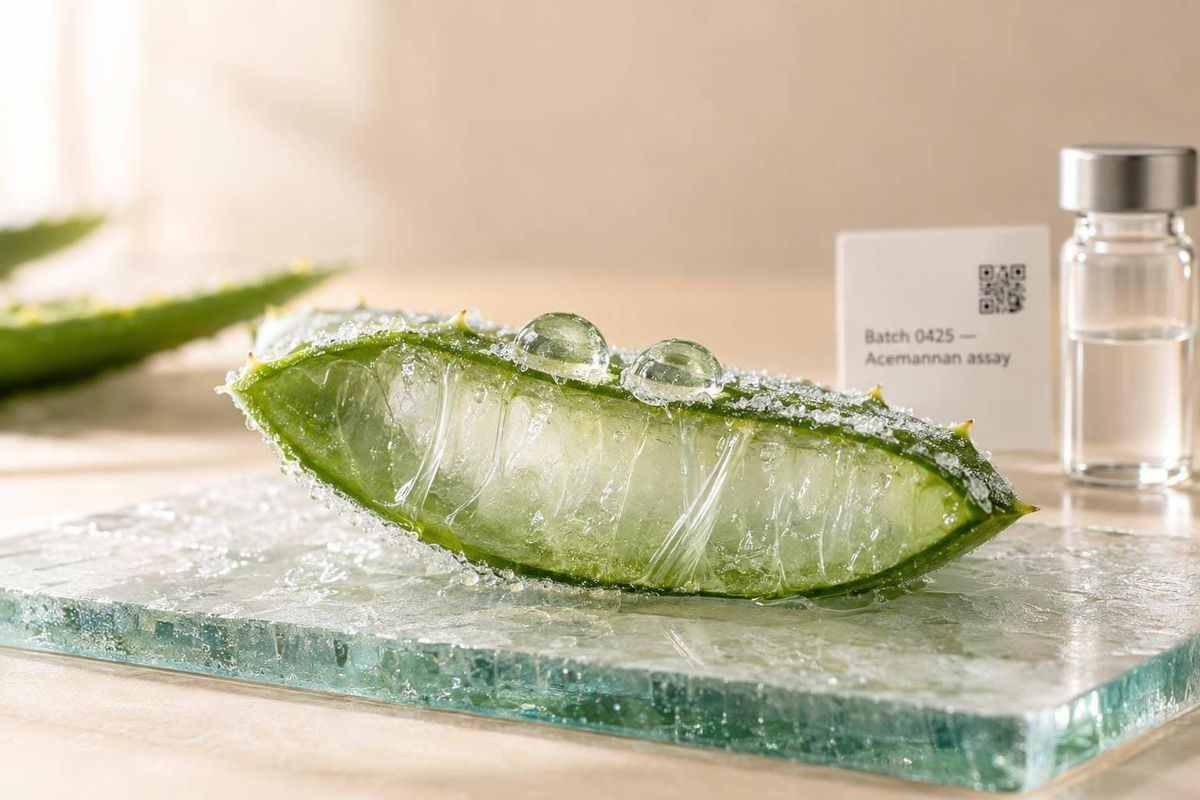
Cold processing may help protect acemannan, but I wouldn’t judge aloe vera by that label alone. I’d check the full processing history and batch-specific tests showing how much acemannan remains, how many acetyl groups it retains, and its chain sizes.
Here’s what I’d look for:
- Heat exposure: One study reported about 14% loss of acetyl groups at 140°F (60°C), versus 46–58% at 176–212°F (80–100°C), under its specific test conditions. Time matters, too.
- Steps beyond heating: Drying, pH, enzymes, oxygen, and storage can also change acemannan - even after cold processing.
- The right tests: Total polysaccharides aren’t the same as acemannan. I’d request lot-matched results, test methods, a suitable baseline for comparison, and shelf-life data.
- Separate safety checks: Low temperatures alone don’t control microbes. Heating can reduce them, but the process still needs validation.
My rule: <u>check what remains, not just how it was processed</u>. Preserved structure does not prove safety or health effects; those claims need separate testing and human studies.
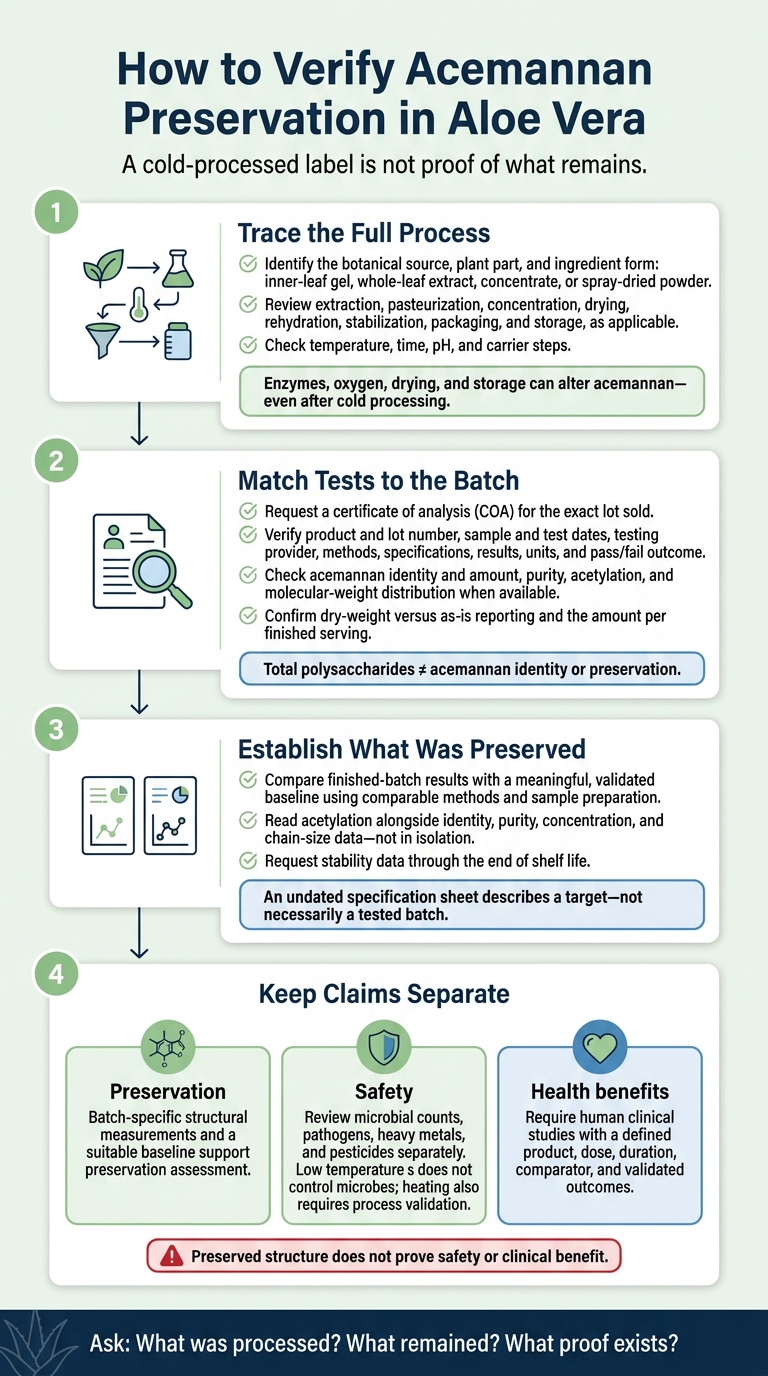
How to Verify Acemannan Preservation in Aloe Vera
Acemannan Structure and Quality
To assess preservation, look at acetylation, chain structure, and concentration. Acemannan is a partially acetylated polysaccharide found in aloe’s inner-leaf gel. Its mannose-rich chain and side groups vary by source, extraction process, and test method.
Acetylation, Chain Structure, and Concentration
The degree of acetylation describes how extensively acetyl groups occupy sites on the polymer. That’s separate from concentration: even a concentrated sample can be partly deacetylated. Total polysaccharide tests measure carbohydrate content - not acemannan identity or preservation. Fragmented chains can still register after deacetylation. Check whether a result measures acemannan specifically or broader aloe solids, and whether it’s reported on a wet or dry basis.
Molecular weight describes polymer size. Its distribution shows the mix of shorter and longer chains, which an average can hide. Chain-linkage analysis and sugar composition help describe the structure, while solubility and viscosity add context. Compare results only when the test methods and sample preparation are clearly identified. Use these markers when comparing cold-processed and heat-processed aloe.
Preserved Structure Does Not Prove Health Benefits
Laboratory research links changes in acetylation to changes in biological activity. In deacetylation experiments, fully deacetylated material did not reproduce some acemannan effects seen in lab studies. That supports measuring structure - it does not prove that a commercial product works better. Claims about human benefits require clinical studies with a defined product, dose, duration, comparator, and validated outcomes.
sbb-itb-b88dd21
Cold Processing vs. Heat Processing
Cold and heat processing affect acemannan’s structure and acetylation differently. The key isn’t whether aloe was cooled. It’s whether every step that followed preserved acemannan.
| Processing aspect | Lower-temperature or “cold” processing | Heat-based processing |
|---|---|---|
| Preservation goal | Limit heat-related deacetylation and structural changes | Reduce microbes, improve stability, or remove moisture while limiting structural changes |
| Structural risk | Enzymes, oxygen, pH, and storage can alter acemannan | Depending on conditions, risks include deacetylation, side-chain loss, backbone changes, aggregation, or molecular-weight shifts |
| Microbial control | Low temperature alone does not control microbes; sanitation, handling, and microbial testing still matter | Heating may reduce microbes, but the process needs validation and protection against recontamination |
| Finished-batch testing | Test acemannan content, acetylation, and molecular-weight distribution to assess preservation; moisture and microbial results measure separate quality factors | Use the same tests after heating and downstream processing |
Track extraction, pasteurization, concentration, drying, and storage separately. A temperature that preserves acemannan in wet gel may not preserve it after dehydration. Even lower-temperature processing can fall short if later handling, storage, or drying changes the batch.
Cold Processing: Less Heat, Other Risks
Lower temperatures may slow deacetylation. But enzymes, oxygen, pH, storage, and drying can still alter acemannan, and freeze–thaw cycles add another risk. Ask how sanitation, handling, and microbial testing are validated. Microbial safety and structural preservation need separate validation.
Heat Processing: Microbial Control and Structural Changes
Controlled heating can reduce microbes and improve shelf stability. Results depend on the product, equipment, packaging, target organisms, and time–temperature profile. A common pasteurization condition is about 149°F (65°C) for 15 minutes, but it is not a universal standard.
A peer-reviewed study of dry and humid thermal processing reported approximately 14% deacetylation at 140°F (60°C) and roughly 46–58% at 176–212°F (80–100°C). Those results came from specific treatment conditions - not temperature alone.
What Processing Research Shows
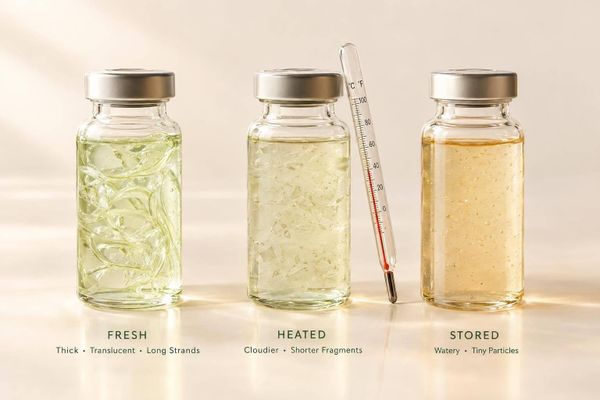
Research shows no single outcome: the processing method and later steps shape the result. Heating and drying can increase or decrease measured molecular weight, depending on the method.
One processing review reported an increase from approximately 45 kDa to 75–81 kDa. That change may reflect altered chain interactions rather than better preservation. Other drying research reported a decrease from approximately 49 kDa to 23–26 kDa, alongside a 40–70% reduction in acetylation. Use the same test methods to assess finished batches rather than treating “cold” or “heat” as a quality verdict.
How to Check Acemannan Preservation Claims
After comparing processing methods, check the records for the specific batch behind the label.
Review Every Processing Step
Ask for the full process record. It should identify the botanical source, plant part, and ingredient form: inner-leaf gel, whole-leaf extract, concentrate, or spray-dried powder.
Review temperature, time, pH, stabilization, packaging, and storage. Also check any pasteurization, concentration, drying, rehydration, or carrier steps. These details help you assess whether processing protected or changed acemannan in the finished product.
Check Batch-Specific Lab Results
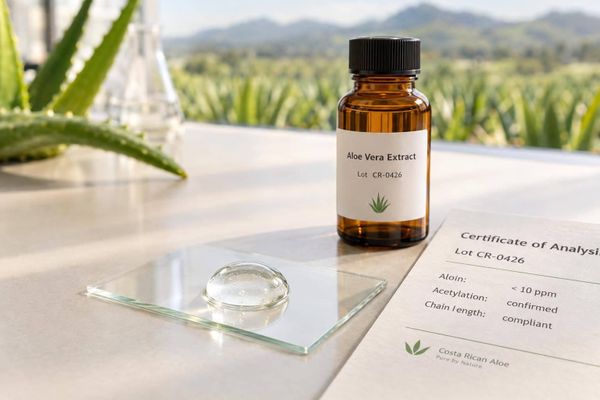
Match the process record to lab results for the exact lot sold. Request a certificate of analysis (COA) that lists the product, lot number, sample and test dates, testing provider, methods, specifications, results, units, and pass/fail outcome. An undated specification sheet describes a target - not necessarily what the batch test found.
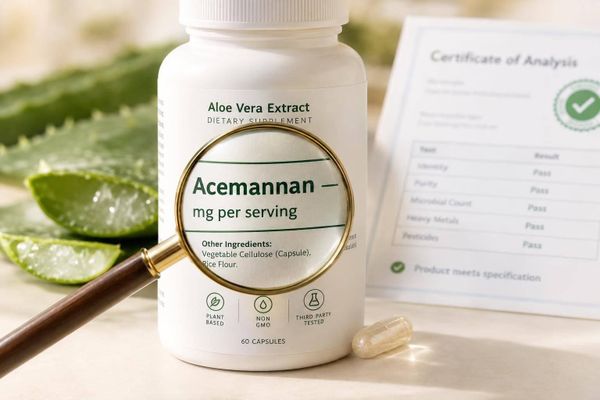
Check each preservation marker separately: acemannan identity and amount, purity, acetylation, and, when available, molecular-weight distribution. Confirm whether the concentration uses a dry-weight or as-is basis, and ask for the amount per finished serving. Total polysaccharides do not necessarily measure acemannan specifically. Review microbial counts, pathogens, heavy metals, and pesticides separately; an acemannan assay cannot establish safety.
Understand What the Records Cannot Prove
A preservation claim is only as strong as the batch data behind it. Processing records can support a cold-processing claim, but they cannot establish preservation on their own. Missing methods, unmatched lot numbers, or nonspecific polysaccharide results do not support preservation claims.
Read acetylation results alongside identity, purity, concentration, and chain-size data - not in isolation. The International Aloe Science Council’s 5% acetylated mannan minimum by dry weight applies to aloe raw materials, not finished products.
Even a detailed COA supports only the tested batch’s results against defined specifications. Showing preservation also requires a meaningful comparison, such as a validated baseline measured with comparable methods. Neither processing records nor a COA proves absorption or clinical benefit.
Conclusion: Look Beyond the Cold-Processed Label
Cold processing may limit heat-related changes to acemannan structure. But drying, stabilization, and storage still affect its final quality. Heat can control microbes, though the result depends on both time and temperature.
Check the full process, not just the label. Ask for batch-specific test results after processing and stability data through the end of shelf life. These records help separate processing claims from measured preservation - and show whether quality held up during storage.
Keep three questions separate: What was processed? What remained? What proof exists? A cold-processing label does not prove acemannan content. Preserved structure alone does not prove safety, efficacy, or clinical benefit. Each claim needs its own evidence.
FAQs
How should I store aloe to protect acemannan?
Store aloe products in a cool, dry place out of direct sunlight, and keep the container tightly sealed to limit exposure to moisture and oxygen. Avoid humid spots and places with temperature swings, such as bathrooms or countertops near heat sources. These conditions can break down acemannan’s molecular structure and acetyl groups.
Follow the manufacturer’s storage instructions, and use the product within the recommended time after opening.
What if a brand won’t share acemannan test results?
If a manufacturer won’t share batch-specific test results, its cold-processed claims remain unverified. Consider waiting to buy. A label alone doesn’t guarantee product integrity or acemannan stability.
Ask for a Certificate of Analysis that matches your lot number. It should include numerical acemannan results, the laboratory’s name, ISO/IEC 17025 accreditation, and the test method. Without that information, you can’t confirm how processing affected acemannan’s structure.
Is there a clinically proven acemannan dose?
There’s no universally established, clinically proven dose for acemannan. Research points to possible effects on immune function or gut health, but it hasn’t established a clinically validated dosage.
Processing records and lab tests can verify acemannan’s quality and structural integrity - not its health benefits or clinical efficacy. Look for batch-specific Certificates of Analysis that confirm acemannan quantity, molecular weight, and acetylation. Don’t rely on assumed clinical dosage standards.
Related Blog Posts
- Why Cold Processing Matters: Preserving Acemannan Integrity in Aloe Vera
- Protecting Acemannan: The Role of Cold Processing in Aloe Vera Quality
- From Harvest to Finished Product: How Cold Processing Helps Preserve Acemannan in Aloe Vera
- Preserving What Matters: Why Processing Temperature Is Critical to Acemannan Integrity