5 Antioxidant Benefits of Acemannan Aloe Vera
Preclinical evidence shows acemannan scavenges radicals, supports antioxidant enzymes, and reduces membrane damage; human trials are limited.

Acemannan may help fight oxidative stress in five main ways: it can scavenge free radicals, support the body’s own antioxidant enzymes, lower membrane damage, help cells recover under stress, and support immune balance. But here’s the key point: most of the research is still from lab and animal studies, not human trials.
If you want the short version, here it is:
- Direct antioxidant action: acemannan showed 45% radical clearance in a DPPH lab test
- Enzyme support: research links it with Nrf2, SOD, catalase, and glutathione-related activity
- Lower oxidative damage: animal studies found lower MDA, a marker tied to lipid peroxidation
- Cell support: cell studies found better viability after H₂O₂-induced stress
- Immune link: it may help shift immune activity toward repair and lower signals like IL-6 and TNF-alpha
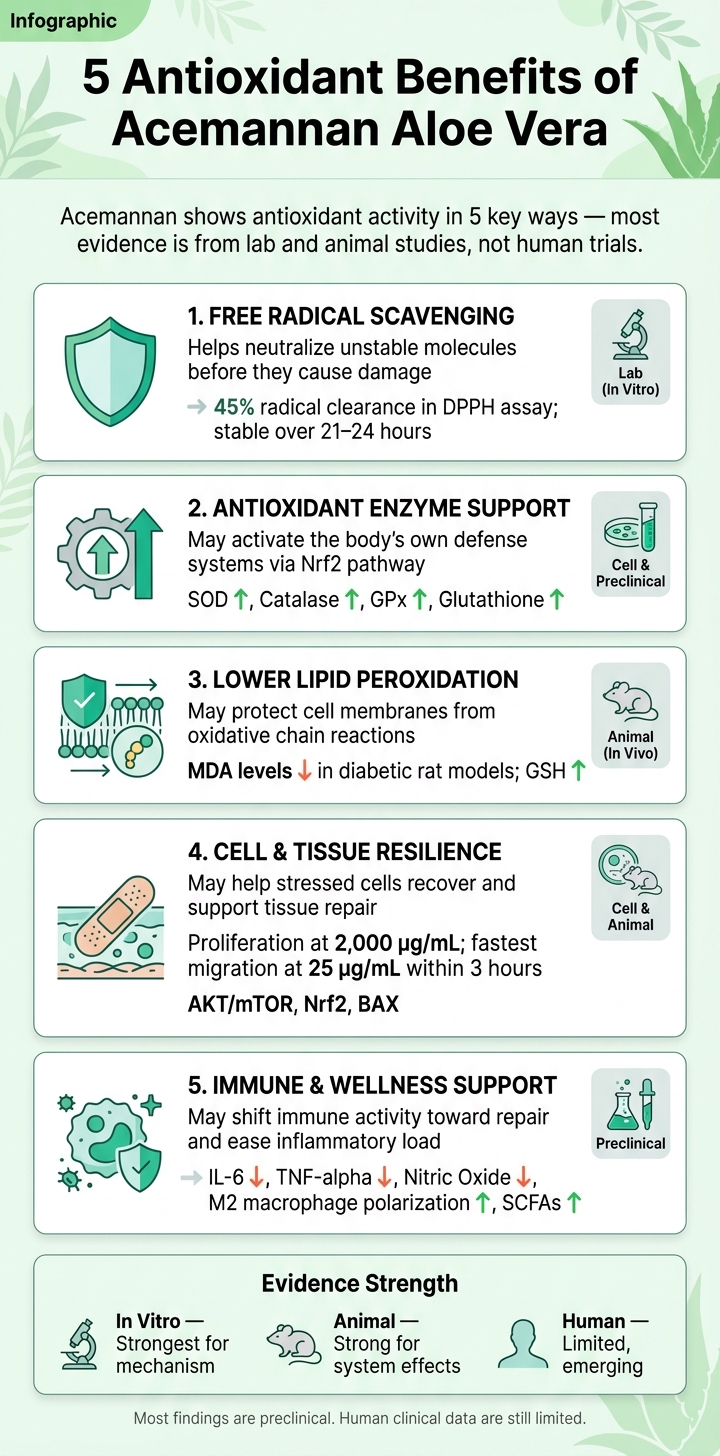
5 Antioxidant Benefits of Acemannan: Evidence Summary
Quick Comparison
| Benefit | What it means in plain English | Main support |
|---|---|---|
| Free radical scavenging | Helps neutralize unstable molecules | Lab assays |
| Antioxidant enzyme support | May help the body switch on its own antioxidant systems | Cell and preclinical studies |
| Lower lipid peroxidation | May help protect cell membranes from oxidative damage | Animal studies |
| Cell and tissue support | May help stressed cells recover and move toward repair | Cell and animal studies |
| Immune wellness support | May help lower inflammatory stress and support gut-immune balance | Preclinical studies |
My takeaway: the acemannan research is promising, especially at the mechanism level, but it does not yet prove the same effects in people. So if you’re reading this for wellness use, the article is best seen as a research snapshot, not a medical claim.
sbb-itb-b88dd21
How Acemannan Fits Into Antioxidant Research
Researchers study acemannan in two main ways: how it handles free radicals directly, and how it may help the body's own defense systems under oxidative stress. To test that, they use chemical assays like DPPH and cell-based assays like MTT.
On the direct side, acemannan works as a free radical scavenger. In DPPH assays, it cleared 45% of radicals and stayed more stable over 21–24 hours than malvidin and CoQ10. In MTT assays, acemannan helped restore viability in hydrogen peroxide-damaged mouse fibroblasts.
There’s also an indirect side to the research. Studies suggest acemannan may support internal antioxidant defenses by activating the Nrf2 signaling pathway and helping stimulate glutathione, superoxide dismutase (SOD), and catalase. Put simply, it may do more than mop up radicals on its own - it may also help the body switch on some of its built-in protective systems. Research also links higher acetylation with stronger antioxidant activity.
"The acetyl group is a prominent part of the structure of acemannan and is responsible for its biological properties, including antioxidant effects." - BMC Complementary Medicine and Therapies
Taken together, these findings set up the five benefits below.
1. Enhanced Free Radical Scavenging
Primary Antioxidant Mechanism
The first benefit is direct radical scavenging. In plain English, that means acemannan may help neutralize free radicals before they cause more damage.
Acemannan’s main antioxidant effect appears to come from this direct scavenging action, which is tied to its acetyl groups. Studies also show that its scavenging activity increases as acetylation goes up.
Type of Supporting Evidence
The support here comes from DPPH assays and FTIR analysis. These lab methods connect acemannan’s scavenging activity to its functional groups.
Key Biomarkers and Endpoints
In DPPH assays, acemannan cleared 45% of radicals. That result puts it on the radar as a candidate for sustained antioxidant support.
Wellness Relevance
For wellness readers, the main point is pretty simple: acemannan shows sustained antioxidant potential in lab tests, but that does not prove it works the same way inside the human body.
Next: how acemannan may support the body’s own antioxidant enzymes.
2. Support for the Body's Own Antioxidant Enzymes
Primary Antioxidant Mechanism
Acemannan may support the body's antioxidant defenses through the Nrf2 (Nuclear factor erythroid 2-related factor 2) signaling pathway, which helps control how the body responds to oxidative stress.
That matters because this is less about direct free-radical cleanup and more about helping the body turn on its own protective systems.
When Nrf2 is activated, it can increase enzymes such as Superoxide Dismutase (SOD), Catalase (CAT), and Glutathione Peroxidase (GPx). These enzymes help lower ROS and limit oxidative damage.
Type of Supporting Evidence
The support here comes from preclinical research, not human trials. In L929 mouse fibroblasts exposed to 0.8 mM hydrogen peroxide, 9 µM acemannan helped restore cell viability and reduce oxidative damage.
So the signal is interesting, but it's still from cell-based work.
Key Biomarkers and Endpoints
Researchers looked at a few markers to see how acemannan may support the body's internal antioxidant response:
| Endpoint | What It Measures |
|---|---|
| Nrf2/HO-1 Pathway Activation | A key molecular marker of the body's antioxidant response |
| Intracellular ROS Levels | Direct measure of oxidative burden inside the cell |
| MTT Cell Viability Assay | Shows whether acemannan can protect or help recover cells from oxidative damage |
Wellness Relevance
By supporting SOD, CAT, and GPx, acemannan may help cells deal with oxidative stress tied to aging and tissue repair. But human data are still missing, so these findings do not show the same effect in people.
That cell-level protection sets up the next area: defense against oxidative damage and lipid peroxidation.
3. Protection Against Oxidative Damage and Lipid Peroxidation
Primary Antioxidant Mechanism
When free radicals hit the fatty acids in your cell membranes, they can trigger lipid peroxidation. That sets off a chain reaction that weakens the membrane and can harm nearby proteins and DNA.
Acemannan may help slow this process in two main ways: by scavenging radicals and by binding iron, a metal that can speed up oxidation. In plain terms, part of acemannan’s antioxidant activity seems to come from helping protect the membrane itself.
Type of Supporting Evidence
The support for this comes from animal research. In diabetic rat models, acemannan-containing Aloe vera treatment reduced lipid peroxidation and increased antioxidant enzyme activity in the liver and kidneys.
Key Biomarkers and Endpoints
One marker matters a lot here: malondialdehyde (MDA). MDA forms when free radicals break down polyunsaturated fatty acids in cell membranes. So when MDA levels go down, that’s a direct sign that lipid peroxidation is also dropping.
| Biomarker / Endpoint | What It Indicates | Study Type |
|---|---|---|
| MDA (Malondialdehyde) | Degree of lipid peroxidation and membrane damage | Animal (in vivo) |
| MTT Cell Viability | Cell survival after oxidative stress | Cell (in vitro) |
| Glutathione (GSH) | Restoration of internal antioxidant defenses | Animal (in vivo) |
Wellness Relevance
Lower lipid peroxidation helps cells keep their membranes working the way they should. That matters for signaling, repair, and day-to-day cell function.
Animal studies found lower MDA levels and higher glutathione after acemannan treatment. Taken together, that points to better membrane protection during periods of oxidative stress.
4. Cell and Tissue Resilience Under Oxidative Stress
Primary Antioxidant Mechanism
Acemannan does more than mop up radicals and help protect cell membranes. It also seems to help stressed cells bounce back. In lab studies, acemannan reduced H₂O₂-related damage, improved cell viability, and turned on pathways tied to repair.
Two pathways matter most here. AKT/mTOR signaling helps support protein synthesis and tissue repair. Nrf2 turns on the body’s own antioxidant defense system.
Type of Supporting Evidence
Most of the evidence comes from in vitro and animal research. In these studies, acemannan increased fibroblast proliferation and cell migration. At 2,000 µg/mL, it supported proliferation, while 25 µg/mL produced the fastest migration within 3 hours.
It also appears to affect apoptosis-related pathways, including BAX, which may help cells stay alive during oxidative stress.
Key Biomarkers and Endpoints
| Biomarker / Endpoint | What It Indicates | Study Type |
|---|---|---|
| Cell Viability | Recovery from H₂O₂-induced oxidative damage | Cell (in vitro) |
| Cell Migration | Speed of wound closure and epithelial repair | Cell (in vitro) |
| BAX Pathway Activity | Regulation of apoptosis under oxidative stress | Cell (in vitro) |
| AKT/mTOR Signaling | Protein synthesis for tissue repair | Cell (in vitro) |
Wellness Relevance
Put simply, these findings suggest better tissue recovery when oxidative stress is in play. In topical studies, acemannan plus chitosan has been linked to faster re-epithelialization and less inflammation.
That matters because oxidative stress doesn’t just wear down cells on paper. It can slow repair when tissue is under strain, so support in these pathways may have a role in recovery and immune wellness.
5. Immune and Wellness Support Tied to Antioxidant Activity
Primary Antioxidant Mechanism
Acemannan does more than neutralize free radicals directly. It may also help immune cells deal with oxidative stress in a steadier way. Research shows that acemannan interacts with immune cells like macrophages and dendritic cells without pushing the immune system into overdrive.
That matters because acemannan works more like an immune modulator than a simple stimulant. In plain terms, it may help keep immune activity in balance. And that balance is a big deal, since oxidative stress and inflammation often move together.
Type of Supporting Evidence
Research also connects acemannan with M2 macrophage polarization. That shift points immune activity away from inflammation and toward tissue repair. In inflammatory animal models, acemannan-linked aloe vera treatment lowered IL-6, TNF-alpha, and nitric oxide.
There’s also a gut angle here. Humans can’t digest acemannan, so it passes to the colon intact, where gut microbes ferment it into short-chain fatty acids (SCFAs). Those SCFAs help support gut barrier stability and immune homeostasis.
Key Biomarkers and Endpoints
| Biomarker / Endpoint | What It Indicates | Supporting Context |
|---|---|---|
| IL-6, TNF-alpha | Reduction in systemic inflammation | Experimental colitis model |
| Nitric Oxide (NO) | Decreased oxidative and inflammatory signaling | Experimental colitis model |
| M2 Macrophage Polarization (CD206) | Shift from inflammation to tissue repair | Immune-shift evidence |
| Short-Chain Fatty Acids (SCFAs) | Gut barrier stability and immune homeostasis | Prebiotic fermentation in the colon |
Wellness Relevance
From a wellness point of view, acemannan may help immune cells handle oxidative stress by easing inflammatory load and supporting gut-derived SCFAs. That’s one reason it draws interest for long-term immune support, not just short bursts of use.
For longer-term wellness, steady use over 3 or more months is generally needed to see cumulative shifts in immune resilience. The evidence summary below shows how these findings break down by study type.
Evidence at a Glance
Across the five benefits above, the strongest support comes from lab and animal research. Most of the antioxidant data on acemannan comes from preclinical work, especially lab assays and animal models.
DPPH assays show that acemannan can scavenge free radicals directly. In a 24-hour test, it reached 45% clearance and showed more stable antioxidant activity than CoQ10 and malvidin. That’s a strong mechanistic signal. But controlled human trials are still limited.
Animal studies push the picture further. They point to effects tied to radioprotection, wound healing, and immune modulation. Human research, by contrast, is still early. So far, the main signals are around gut health, tissue repair, and fatigue, not antioxidant endpoints.
The table below shows how the evidence stacks up.
| Evidence Type | Strength | What It Shows |
|---|---|---|
| In Vitro | Strongest for mechanism | Direct radical scavenging; 45% DPPH clearance; cell recovery from H₂O₂ damage |
| Animal | Strong for system effects | Radioprotection; wound healing; immune modulation |
| Human | Limited, emerging | Gut health, tissue repair, early cognition/fatigue insights; fewer controlled antioxidant trials |
One more thing matters here: potency can shift based on molecular weight and acetylation. That helps explain why study results don’t always line up neatly, and why crude aloe vera and purified acemannan shouldn’t be treated as the same thing.
Research Summary Tables
The earlier findings point in the same direction. Across acemannan studies, two themes keep showing up: higher antioxidant defenses and lower oxidative damage.
Table 1: Antioxidant Enzyme Trends
| Enzyme / Molecule | Model Type | Trend with Acemannan | What It Means |
|---|---|---|---|
| Superoxide Dismutase (SOD) | Animal / Cell | Higher / Restored | Better neutralization of superoxide radicals |
| Catalase (CAT) | Animal / Cell | Higher / Restored | Improved breakdown of hydrogen peroxide |
| Glutathione Peroxidase (GPx) | Animal / Cell | Higher / Restored | Stronger protection against hydroperoxides |
| Reduced Glutathione (GSH) | Animal / Cell | Higher / Restored | Bolstered primary intracellular antioxidant |
In stressed models, "restored" means acemannan moved levels back toward baseline. Nrf2 likely plays a role in these increases.
That same trend shows up in oxidative stress markers.
Table 2: Oxidative Stress Marker Trends
| Stress Marker | Model Type | Trend with Acemannan | What It Means |
|---|---|---|---|
| Malondialdehyde (MDA) | Animal / Cell | Lower | Reduced end-product of lipid peroxidation |
| Lipid Peroxidation Index | Animal / Cell | Lower | Decreased oxidative degradation of cell membranes |
| Intracellular ROS | Cell | Lower | Mitigation of reactive oxygen species levels |
Put simply, the tables show a steady shift toward stronger antioxidant defense and less oxidative damage.
Conclusion
Acemannan’s antioxidant profile comes down to five main takeaways: radical scavenging, support for antioxidant enzymes, less oxidative damage, stronger cell resilience, and a connection to immune wellness.
That’s a promising pattern. But right now, most of the evidence is still preclinical.
Human clinical data are still limited. And that’s exactly why the lab findings matter so much, even if strong human confirmation isn’t here yet.
If you want the full science overview, see the Acemannan Supplement resource. Further research will show how far these effects carry over to human wellness.
FAQs
Is acemannan proven to work in people?
Research suggests acemannan has biological activity in humans, with studies pointing to possible support for the immune system, wound healing, and oral health.
For example, a 2023 triple-blind study in 50 adults found that daily supplementation increased influenza B-specific IgG levels. That said, the bigger picture is still mixed, and researchers say more research is needed to confirm these clinical effects.
What is oxidative stress, exactly?
Oxidative stress happens when the body makes more reactive oxygen species (ROS) than its antioxidant defenses can handle. Once that balance slips, cells can take a hit.
Acemannan, a bioactive polysaccharide found in aloe vera, may help push back on this process by lowering intracellular ROS levels and supporting the body’s antioxidant defense systems.
How is acemannan different from regular aloe vera?
Acemannan is the main bioactive polysaccharide found in Aloe vera gel and skin. Aloe vera is the whole plant. Acemannan is one specific soluble compound inside it.
That distinction matters. When people talk about the wellness effects of Aloe vera, they’re often talking about a mix of plant compounds. Acemannan is one of the key parts tied to many of those effects, including immune support, antioxidant activity, and wound healing.
Put simply: Aloe vera contains many natural compounds, and acemannan is one of its main functional components.