Acemannan Checklist: What to Look for in Aloe Products
Quick checklist to evaluate aloe products: plant part, processing, verified acemannan levels, COA, aloin safety, and packaging.

Most aloe labels do not tell you how much acemannan you’re getting. If I wanted a fast screen, I’d check five things first: the plant part, the processing method, the listed acemannan amount, the COA and safety data, and the packaging.
Here’s the short version:
- Inner leaf gel is the best starting point because acemannan is tied most closely to the clear inner gel.
- Cold-processed and not from concentrate are better label signs than heat-treated or reconstituted forms.
- I’d look for a number I can verify:
- Liquids: at least 0.25 mg/mL
- Powders: at least 5% D-acemannan by dry weight
- For drinkable aloe, I’d want low aloin or decolorized on the label, since the IASC oral limit is under 10 ppm of aloins A + B.
- A batch-specific COA matters more than words like “pure,” “premium,” or “high acemannan.”
- Opaque or airless packaging is a plus because light and oxygen can wear acemannan down over time.
If a product is vague about the aloe part, skips processing details, and gives no lab data, I’d pass.
Quick comparison
| Check | Better sign | Weaker sign |
|---|---|---|
| Aloe source | Inner leaf gel / fillet | Aloe blend, complex, or extract |
| Processing | Cold-processed, stabilized, not from concentrate | Spray-dried, reconstituted, heat-treated |
| Potency | % acemannan or mg per serving listed | “Rich in polysaccharides” with no number |
| Safety | Lot-matched COA with aloin, microbes, metals, pesticides | No batch data |
| Packaging | Opaque or airless | Clear bottle |
That’s the core of the article: don’t judge aloe by front-label claims - judge it by source, handling, measured content, and batch proof.
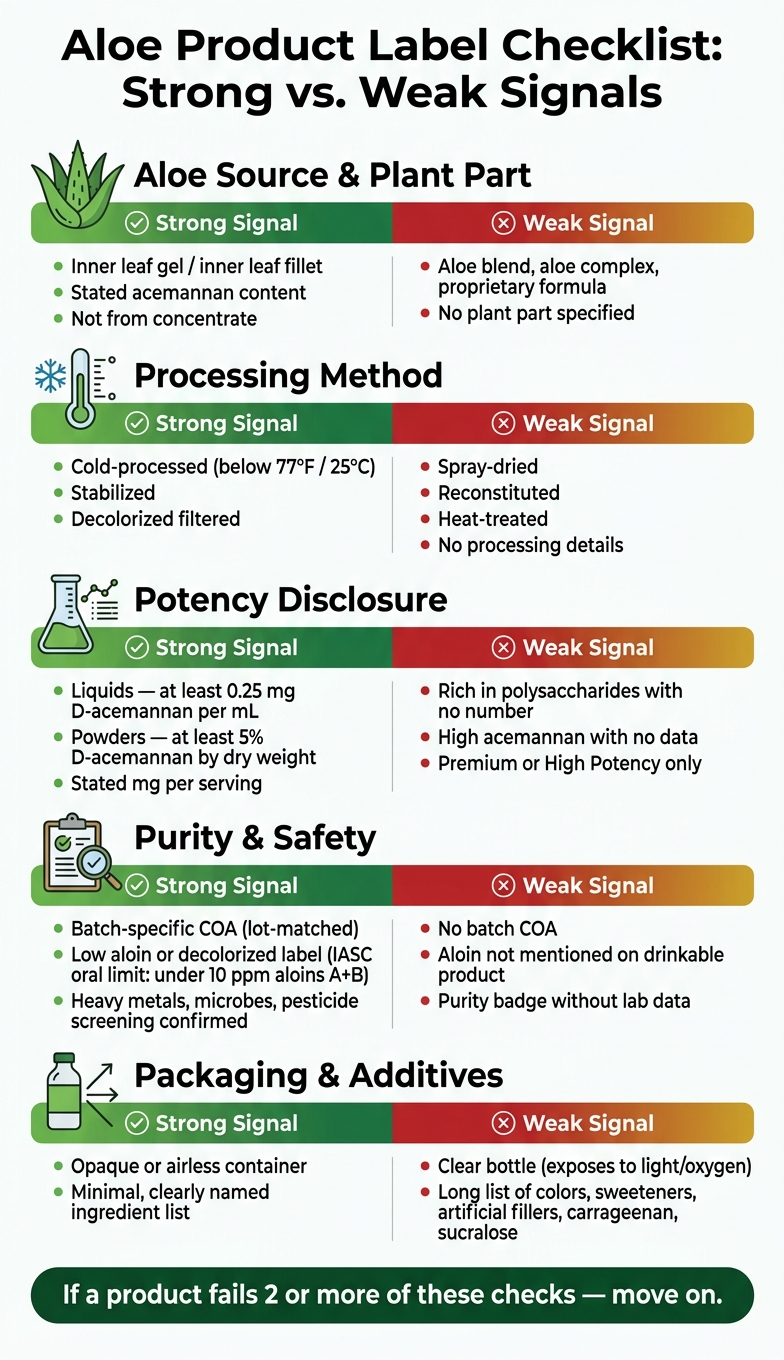
Aloe Product Label Checklist: Strong vs. Weak Signals
What Aloe Vera Is The Best Source of Acemannan?
sbb-itb-b88dd21
1. Check the aloe source and plant part first
Start with the ingredient list. The plant part on the label is your fastest clue to how much acemannan the product is likely to have.
Identify whether the label says inner leaf gel, whole leaf, or decolorized filtered leaf juice
These terms point to different types of aloe.
Inner leaf gel - sometimes shown as inner leaf fillet - comes from the clear inner gel center. That’s the main source of acemannan.
Whole leaf products use the entire leaf, including the outer rind and latex. That can bring in latex compounds such as aloin, which may cause abdominal pain and cramping.
Decolorized filtered leaf juice begins with whole-leaf material, then goes through charcoal filtration to remove those latex compounds.
Here’s the quick read:
| Label Term | Plant Part Used | Acemannan Signal |
|---|---|---|
| Inner Leaf Gel / Fillet | Clear inner gel only | Strong - acemannan-rich and generally low in aloin |
| Whole Leaf | Entire leaf, including rind and latex | Moderate - requires strict aloin control |
| Decolorized Filtered Leaf Juice | Filtered whole-leaf material | Moderate - depends on filtration efficacy |
| Aloe blend / complex | Unspecified plant part | Weak signal |
If the label uses vague names, you can’t tell which plant part was used or what the acemannan level might be.
Once you know the plant part, the next step is processing.
Look for explicit Aloe vera naming and any stated standardized acemannan content
Look for Aloe vera listed as Aloe vera (Aloe barbadensis Miller), not just “aloe” or “aloe extract.” Generic wording like “aloe complex,” “aloe blend,” or “proprietary aloe formula” is a weaker sign. It can hide a low amount of aloe or leave the plant part unclear.
Then check for a potency marker. For powders, look for at least 5% D-acemannan by dry weight. For liquids, look for at least 0.25 mg/mL. A label that gives a specific acemannan percentage or total polysaccharide content tells you a lot more than one that stays fuzzy.
One more clue helps here: products labeled “not from concentrate” are a stronger sign than products made from concentrate.
After source and processing, move on to potency, purity, and safety. Understanding these factors is key to realizing the health benefits of acemannan.
Note farming and harvest details when disclosed
USDA Organic, named farm regions, and harvest timing can help, but they don’t prove quality on their own. Premium brands often process leaves within about 12 hours of harvest to help preserve bioactivity. If the brand doesn’t share sourcing details, skip ahead to processing and testing.
2. Check how the aloe was processed
After source, processing is the next thing to check because it shapes how much acemannan is still there.
Look for cold-processed, stabilized, purified, filtered, or decolorized on the label
These label terms point to different levels of acemannan protection.
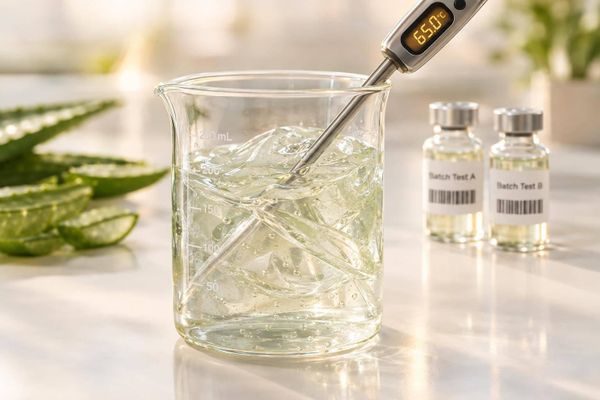
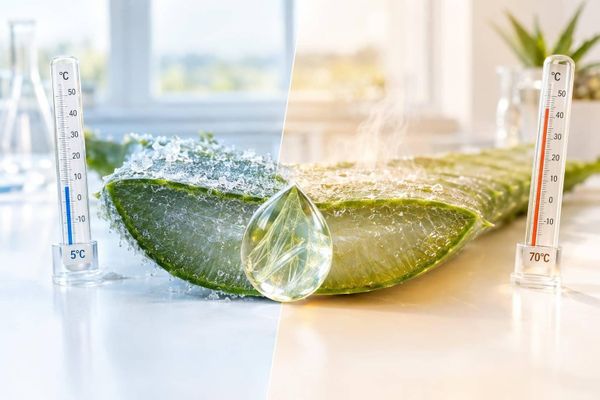
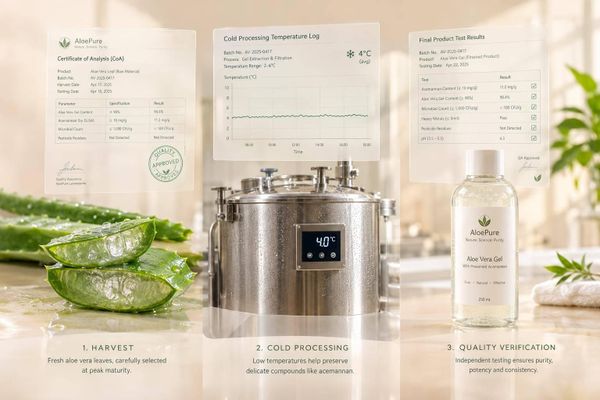
Cold-processed - sometimes called cold-pressed - means the gel stayed below 77°F (25°C) during processing. Once temperatures go above 104°F (40°C), acemannan’s molecular chains can start to break apart through depolymerization, which leads to major polysaccharide loss.
Stabilized means the brand used steps such as freeze-drying or natural antioxidants to help preserve acemannan’s structure during storage.
Decolorized points to aloin reduction.
Filtered and purified suggest extra refining, but on their own, they don’t tell you much unless the brand adds details.
Be more cautious with spray-dried or reconstituted aloe. Those forms can point to high-heat exposure, which may damage bioactive polysaccharides.
Check whether the brand explains how it limits heat and enzyme breakdown
Label claims are a start. What matters more is whether the brand explains how it handles processing.
Look for a clear statement that the brand avoids enzyme treatments that break down polysaccharides. Then check the brand’s website for details like:
- A stated processing temperature
- A harvest-to-stabilization window under 24 hours
- A direct note about enzyme handling
That kind of detail is a stronger signal than vague marketing copy.
Look for quality-control or batch-testing references tied to aloe content
A batch-specific COA is the best proof of acemannan content. It should confirm acemannan or total polysaccharide content and tie those results to a specific lot number.
You may also see technical markers like Degree of Acetylation and molecular weight. If a brand shares those numbers, it usually means it has tested what’s actually in the product.
If you can’t find these figures on the label, the COA, or the brand’s site, that’s a gap worth noting.
If the processing details look strong, move next to serving amount, purity, and safety markers.
3. Verify potency, purity, and safety markers
Confirm the amount per serving and the product form
Once the processing checks out, the next step is simple: make sure the product still delivers a useful amount of acemannan per serving. Look at the serving size and the product form, then compare that with the benchmark for that form.
- Liquids: at least 0.25 mg D-acemannan per mL
- Powders: at least 5% D-acemannan by dry weight
If the label doesn't give you a number you can compare with those benchmarks, that's a gap worth flagging.
Look for a stated acemannan percentage or total polysaccharide content
Look for a stated acemannan percentage, mg per serving, or total polysaccharide content.
If a brand says “high acemannan,” treat that as unproven unless the label, assay, or lot-specific COA gives an actual number. Otherwise, you're left guessing.
Labels that only say “contains aloe” or “rich in polysaccharides” don't give you usable potency data. A label that means something will list a specific figure, such as a percentage, a milligram amount per serving, or a note that points to a standardized assay.
Diluted flavored aloe drinks usually deliver less acemannan than higher-aloe formulas.
If the label claims the product is concentrated, check the COA before you buy it. That's the easiest way to see whether the claim holds up.
Check for third-party testing, low aloin positioning, and additive load
After potency, move to purity markers. This is where you rule out formulas that look fine on the front but fall apart under a closer look.
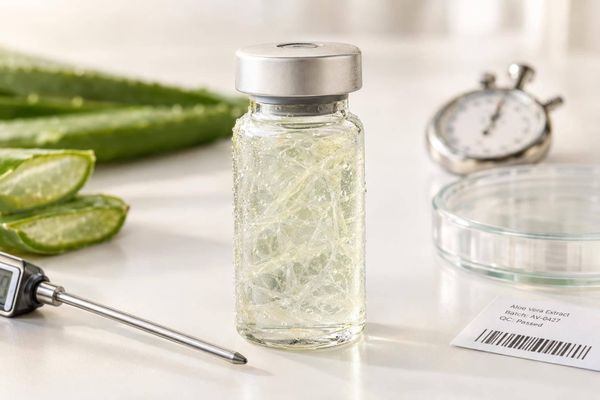
Match the lot number first. Then check for acemannan or polysaccharides, heavy metals, microbes, and pesticide screening. The batch or lot number on the product should match the one on the COA. If it doesn't, the document isn't tied to the item in your hand.
For products meant for internal use, the label should say “low aloin”, “decolorized,” or list a specific aloin amount. The International Aloe Science Council (IASC) standard for oral products is less than 10 ppm of aloins A + B. If aloin isn't mentioned at all on a product made for drinking or supplementation, that's a red flag.
Then scan the ingredient list. A long list of colors, sweeteners, or thickeners often points to diluted aloe. A shorter list usually points to less dilution.
4. Use a simple strong-vs-weak label checklist before you buy
Strong, moderate, and weak product signals at a glance
Use this table for a last side-by-side scan before you buy.
| Feature | Strong Signal | Moderate Signal | Weak Signal |
|---|---|---|---|
| Source & Plant Part | Inner leaf gel/fillet with stated acemannan content | Whole leaf or filtered leaf juice with aloin control disclosed | "Aloe extract" or "proprietary blend" |
| Processing | Cold-processed; not from concentrate | Batch-tested; COA linked | Heat-treated; no processing details |
| Potency Disclosure | Stated acemannan % or mg per serving | "Rich in polysaccharides" with no numbers | Vague terms like "Premium" or "High Potency" |
| Purity Markers | IASC seal; batch-specific COA showing low aloin and pass results for heavy metals and pesticides | Organic certification only; no safety labs | Purity badge without a batch COA |
| Packaging | Opaque or airless container | Some light protection, but not clearly opaque or airless | Clear packaging that exposes product to light |
| Additives | Minimal list; clearly named preservatives | Some additives, but not a long filler list | Carrageenan, sucralose, artificial colors, or "proprietary" fillers |
One more thing to check: packaging. Acemannan breaks down when it's exposed to light and oxygen, so opaque or airless packaging is a smart plus.
Conclusion: The shortest checklist to remember
If you're in a store aisle or scanning a product page, go through these five checks in order:
- Identify the aloe part - inner leaf gel is the best place to start.
- Check processing - cold-processed and not from concentrate beats heat-treated products.
- Confirm measurable potency - look for a listed acemannan percentage or mg per serving, not marketing words.
- Review purity and safety - a batch-matched COA with microbial, heavy metal, pesticide, and low-aloin results is the bar to meet.
- Treat vague claims with caution - "proprietary blend", "purity guaranteed", and similar phrases don't mean much without lab data behind them.
If a product clears all five, it's worth a closer look. If it fails two or more, move on.
FAQs
How can I verify a COA is real?
Make sure the COA matches your product’s exact batch number, not some generic file that could apply to anything. It should also come from a third-party lab you can identify by name, ideally one with ISO/IEC 17025 accreditation.
A solid COA should show the test methods used, include specific numeric results instead of vague “pass” claims, and reflect recent testing, ideally from the last 6 to 12 months.
Does whole leaf aloe always mean lower quality?
Generally, yes. Whole leaf aloe is often tied to lower quality and more risk than inner leaf products.
Here’s why: acemannan is concentrated in the inner leaf gel. The outer rind, which is used in whole leaf processing, contains anthraquinones like aloin. Removing those compounds can call for harsh filtration, and that process may also strip away acemannan.
So in most cases, inner leaf fillet products are preferred for purity and potency.
How much does packaging affect acemannan?
Packaging isn’t the main thing that affects acemannan levels, but it still plays a part in keeping the product intact. That matters even more for water-based aloe products, which can be more open to microbial growth when the packaging or preservation system falls short.
There’s another layer to this too. Because aloe comes from a plant, contamination can happen through the packaging supply chain as well. In plain terms, the bottle, cap, seal, and handling process all matter.
High-quality packaging can be a sign of more consistent manufacturing and better protection for stability and purity.