Why Costa Rica? Investigating How Growing Environment, Volcanic Soil, Water Quality, and Harvesting Practices Affect Acemannan-Rich Aloe Vera
Country of origin doesn't prove acemannan quality—lot-specific COAs, soil, water, and processing records determine content and preservation.

Costa Rican origin does not prove higher acemannan content - or better preservation. I’d check the Certificate of Analysis (COA) for the lot number on your bottle before paying more for its origin.
The supplier describes 350 hectares (about 865 acres) of aloe, but the supplied sources do not establish a Costa Rican growing advantage. I compare Costa Rica with other growing locations across four factors:
- Growing conditions: Climate and sunlight records linked to tested leaves.
- Soil: Measured soil properties - not just a “volcanic” label.
- Water: Test results for irrigation and processing water.
- Harvesting and processing: Leaf maturity, time to processing, and temperature records.
My bottom line: <u>compare records and test results, not country labels</u>. Ask how much acemannan the finished product contains and whether its molecular structure remains intact. Neither result, by itself, proves health effects.
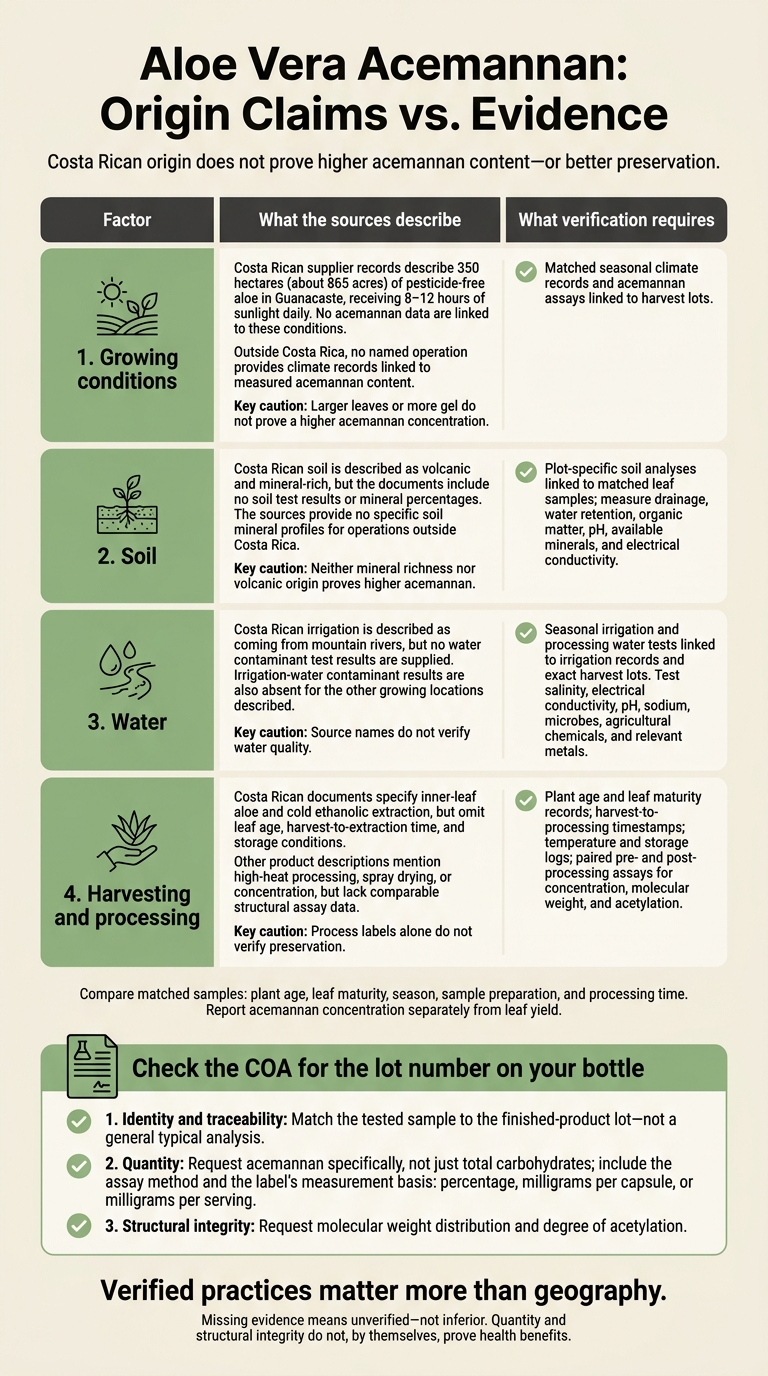
Aloe Vera Acemannan: Origin Claims vs. Evidence
Aloe Vera Farming: Complete Step-by-Step Cultivation Guide
sbb-itb-b88dd21
1. Documented Aloe Growing and Handling in Costa Rica
The records describe how the aloe is grown and handled. The question is whether they show how those conditions affect acemannan and its health benefits.
Growing environment
The records name Natural Aloe Costa Rica as the supplier and describe 350 hectares (about 865 acres) of pesticide-free aloe in Guanacaste, receiving 8–12 hours of sunlight daily. They provide no acemannan data linked to those conditions.
Soil characteristics
Supplier descriptions call the soil volcanic and mineral-rich. The documents include no soil test results or mineral percentages.
Water quality
The records describe irrigation from mountain rivers but include no water contaminant test results.
Harvesting and preservation
The documents specify inner-leaf aloe and cold ethanolic extraction intended to preserve acemannan structure. However, they omit leaf age, harvest-to-extraction time, and storage conditions - details needed to assess preservation before extraction.
Aloe grown elsewhere must be assessed against the same evidence standard.
2. Comparable Aloe Growing and Handling Outside Costa Rica
The same documentation gaps appear outside Costa Rica. The sources describe products in general terms but don’t name farms or suppliers. That limits farm-level comparisons of climate, soil, water, and harvest timing. The comparison depends on records - not origin labels.
Growing environment
No named operation provides climate records linked to measured acemannan content. Claims based on origin therefore remain unverified.
Soil characteristics
The sources provide no specific soil mineral profiles for operations outside Costa Rica. Without those measurements, there’s no basis for comparison with Costa Rica’s volcanic-soil claims.
Water quality
The sources supply no irrigation-water contaminant test results, leaving water quality unverified.
Harvesting and preservation
The sources don’t report farm-specific leaf maturity or harvest-to-processing times. Available descriptions mention high-heat processing, spray drying, or concentration steps that can damage acemannan’s acetylated structure. But they lack comparable data on acetylation and molecular weight distribution, so preservation cannot be verified.
Comparing Four Factors That May Affect Acemannan
Costa Rican sourcing matters only if cultivation and processing data show an acemannan advantage. Compare matched samples by plant age, leaf maturity, season, sample preparation, and processing time. Report acemannan concentration separately from leaf yield.
The supplied sources do not identify controlled primary studies that establish a Costa Rican growing advantage. Claims about growing conditions therefore remain plausible or unverified. Each factor below needs measurements from matched samples linked to lot-specific acemannan results.
| Factor | Evidence status in the supplied sources | What would support a fair comparison? |
|---|---|---|
| Growing conditions | Claimed sunlight level remains unverified. | Matched seasonal climate records and acemannan assays |
| Volcanic soil | Soil effects on acemannan remain unverified. | Soil analyses linked to matched leaf samples |
| Water quality | Water quality remains unverified. | Seasonal water tests linked to irrigation and harvest records |
| Harvesting and processing | Processing claims lack a matched time–temperature comparison. | Paired pre- and post-processing assays for concentration, molecular weight, and acetylation |
Use these criteria to separate possible growing effects from unproven claims about origin.
Growing Conditions: Climate, Seasons, and Plant Stress
Compare wet- and dry-season samples instead of assuming either season produces better aloe. Request records for location, elevation, planting density, temperature, rainfall, irrigation, humidity, sunlight, and shade.
Larger leaves or more gel do not prove a higher acemannan concentration. Use matched seasonal samples and measured acemannan assays. Link season, elevation, and irrigation records to those samples, using the same assay method.
Volcanic Soil: Measured Properties Matter More Than Origin
Ask for measurements of drainage, water retention, organic matter, pH, available minerals, and electrical conductivity - not just a description of the soil as volcanic. Require sampling locations, dates, and methods.
Neither mineral richness nor volcanic origin proves higher acemannan. Soil chemistry can support a comparison only when it is tied to the same leaf sample set and assay method.
Water Quality: Irrigation and Processing Controls
Compare irrigation and wash water through testing, not source names. Request seasonal results for salinity, electrical conductivity, pH, sodium, microbes, agricultural chemicals, and relevant metals. Also request records for irrigation, washing, treatment, and processing water.
Report irrigation water results alongside acemannan assays and processing logs. Link water tests to the exact harvest lots they support, using matched sample types and assay methods.
Harvesting: Leaf Maturity and Time to Processing
Keep plant age separate from leaf maturity and position. The supplied sources do not establish a universal optimum age. Record planting dates, season, sample basis, and processing conditions.
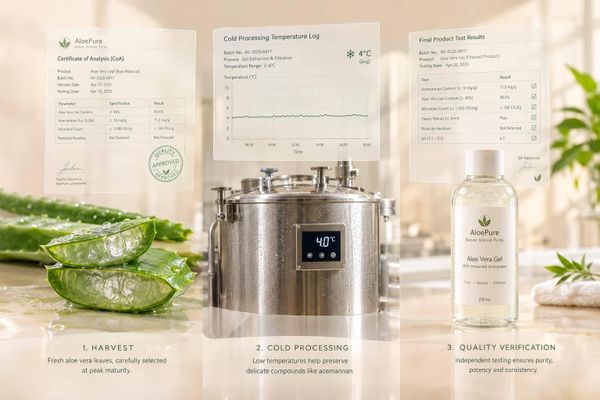
Compare immediate processing, temperature-controlled storage, and processing delays using logged temperatures. Require paired pre- and post-processing assays for concentration, molecular weight, and acetylation, with reported units, matched sample preparation, and the same assay methods. Verify preservation through assay results, not process labels alone.
Sourcing Claims: Advantages, Limits, and Evidence
After comparing climate, soil, water, and harvest timing, check the records behind each sourcing claim. Origin tells you where a product comes from - not how good it is.
| Origin and stage | Verification step | Limits | Supporting evidence needed |
|---|---|---|---|
| Costa Rica: cultivation | Check claims about volcanic soils, mountain water, and high daily sunlight. | These descriptions do not prove higher acemannan in a given lot. | Farm-level soil and water reports linked to the tested harvest lot |
| Outside Costa Rica: cultivation | Check growing conditions using equivalent records. | The sources do not establish regional rankings or poorer soils. | Cultivation records and matched acemannan testing |
| Either origin: handling | Check extraction and storage controls intended to preserve harvested material. | A cold-extracted label does not prove preservation. | Traceable processing records and finished-lot results for quantity and structural integrity |
Use the table below to turn claims into specific document requests. Without those records, a claim remains unverified. Labels cannot replace lot-specific testing.
| Claim | Evidence to request | Remaining uncertainty |
|---|---|---|
| Climate supports higher acemannan | Farm location, seasonal weather records, and measured sunlight exposure linked to harvest lots. | Whether sunlight explains any measured acemannan difference |
| Volcanic soil improves quality | Plot-specific soil mineral assays and pesticide-free certification for the relevant fields. | Mineral composition alone does not establish acemannan enrichment |
| Mountain water is low-contaminant | Source identification, sampling dates, contaminant panels, and irrigation and processing water results. | Untested contaminants and changes between sampling dates |
| Mature inner leaves are used | Planting and harvest records, plus documents showing how inner-leaf gel is separated from outer-leaf material. | Inner-leaf identity does not establish acemannan quantity or exact harvest maturity |
| Fast, cold processing preserves acemannan | Harvest, transport, receipt, and extraction timestamps; temperature logs; extraction details; and storage records through shipment. | Process names do not verify retained molecular weight or acetylation |
| The finished product is acemannan-rich | A lot-specific Certificate of Analysis (COA), acemannan quantity, assay method, molecular weight distribution, and degree of acetylation. Use lot traceability records to match the tested sample to the finished-product lot. | Method differences, shelf-life changes, and whether testing covers the finished product or only its raw ingredient |
Request the COA that matches the lot number on the bottle, not a general typical analysis. Check that the results report acemannan specifically - not just total carbohydrates - and use the label’s measurement basis: percentage, milligrams per capsule, or milligrams per serving. Independent testing is useful only when its scope and sample identity are clear.
Read contaminant results within their limits: “not detected” applies only to the substances tested. A COA supports chemical identity, quantity, and structural integrity; it does not prove biological effects.
Conclusion: Verified Practices Matter More Than Geography
The comparison of climate, volcanic soil, water quality, and harvesting practices points to a cautious conclusion: Costa Rica may be suitable for growing aloe, but the evidence here does not separate out how these factors affect acemannan.
Sourcing claims need lot-by-lot verification - not just a country of origin. Look for linked cultivation records, soil and water tests, documented leaf maturity, harvest-to-processing logs, and lot-specific analysis. Before paying more for origin, compare equivalent records and assays rather than geographic descriptions. These records support sourcing quality, not health outcomes.
The remaining question is whether growing conditions explain measured differences when leaf maturity and processing are comparable. Until that evidence is available, Costa Rican origin remains a sourcing detail, not proof of superior acemannan. Composition data alone do not prove health benefits; those claims require clinical evidence.
FAQs
How do I interpret acemannan test results?
Check the Certificate of Analysis (COA) for numerical results - not “pass” or “conforms.” Look for dry-weight acemannan content: 5% is a common industry benchmark, while 10% is often considered satisfactory. Verify that aloin A and B are below 10 ppm and that the testing methods include NMR, HPLC, or AOAC Official Method 2018.14. Also confirm that the laboratory holds ISO/IEC 17025 accreditation.
Check the molecular weight distribution and degree of acetylation. Both affect biological activity and can point to degradation caused by processing.
Can acemannan degrade after I open the bottle?
Yes, acemannan can degrade after opening when exposed to heat, moisture, or poor storage conditions. Its structure - particularly its acetyl groups - is sensitive to heat and processing. Protecting it from moisture and other storage-related stresses helps keep that structure intact.
After opening, keep the bottle tightly sealed and store it away from heat and humidity to limit degradation.
What if my COA lacks structural testing?
Without structural testing, your Certificate of Analysis (COA) cannot verify whether acemannan remains bioactive or whether processing damaged its molecular structure. A total polysaccharide percentage alone doesn’t tell you enough: acemannan’s functional properties depend on acetylation, molecular weight, and an intact backbone.
Look for a COA that names its testing methods, such as NMR or HPLC, and reports numerical results for acemannan concentration, molecular weight distribution, and degree of acetylation.