What Makes an Aloe Supplement Worth Adding to Your Wellness Routine?
How to pick an effective aloe supplement: inner-leaf source, standardized acemannan, low aloin, and gentle processing.

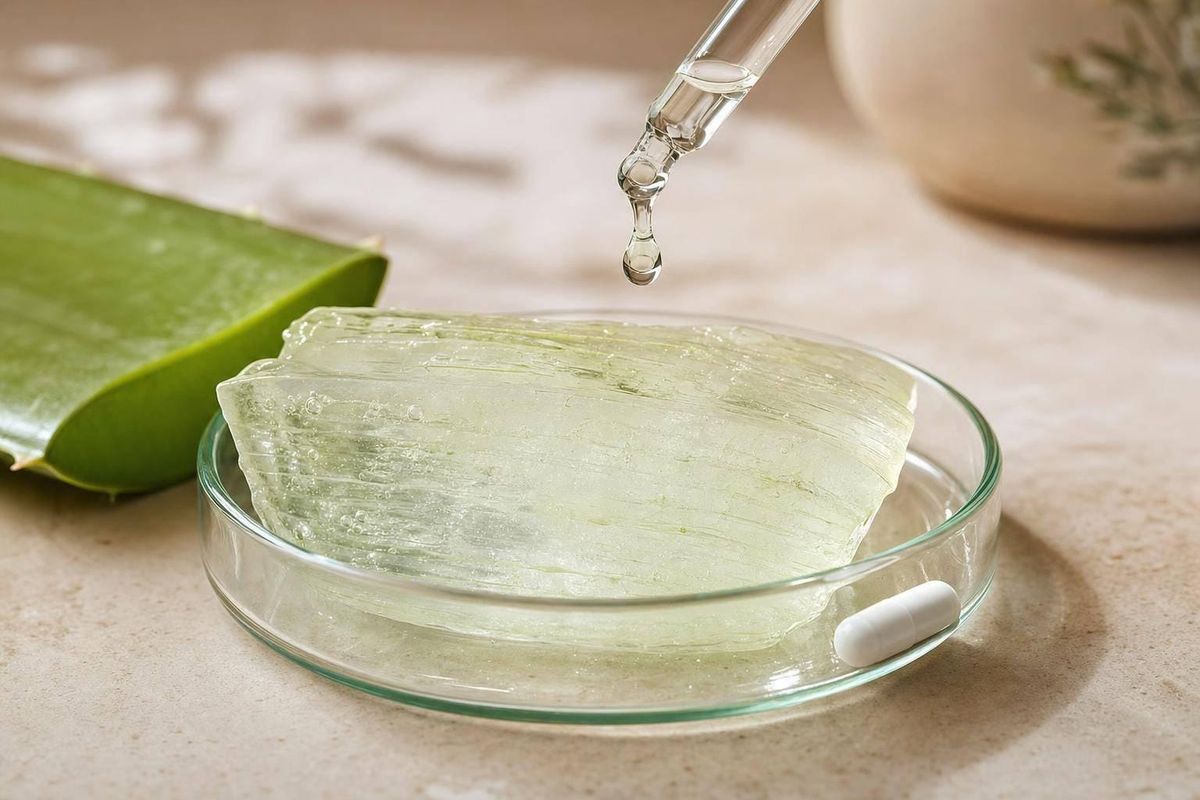
Most aloe supplements are easy to compare once I look at four things: inner-leaf source, acemannan amount, aloin level, and processing. If a product does not show its acemannan content, uses whole-leaf material, or says nothing about aloin removal, I treat that as a warning sign.
Here’s the short version:
- Pick purified inner-leaf aloe
- Look for standardized acemannan on the label
- Check for low-aloin or aloin-free processing
- Use third-party testing and clear sourcing as backup proof
- Choose a format you will take daily: capsules, gels, or drinks
Why does this matter? Because aloe quality can swing a lot based on plant part and processing. The article points out that acemannan may support gut bacteria and short-chain fatty acid output, with one figure showing up to 145% more SCFA production. It also notes that acemannan can hold up to 1,000 times its weight in water, which helps explain why many people look to aloe for gut and hydration support.
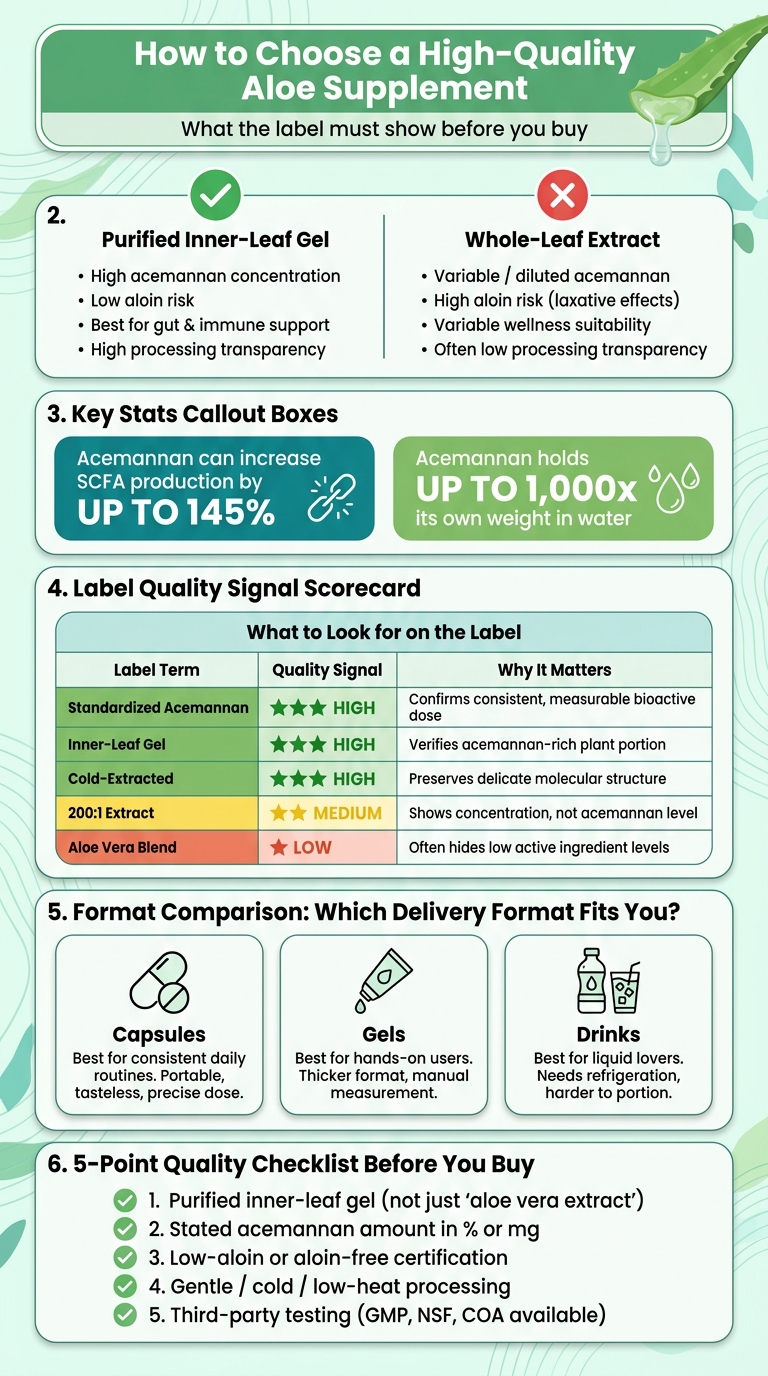
Aloe Supplement Quality: Inner-Leaf vs. Whole-Leaf & Key Label Markers
Quick comparison
| What I check | What I want to see | What I avoid |
|---|---|---|
| Plant part | Purified inner-leaf gel | Whole-leaf with no clear aloin removal |
| Active compound | Standardized acemannan in % or mg | Blend names or extract ratios only |
| Aloin | Low-aloin / aloin-free | No disclosure |
| Processing | Low-heat or cold-extracted | High-heat processing |
| Format | Capsule, gel, or drink that fits my day | Any format I won’t use often |
So if I want an aloe supplement that has a fair shot at working, I start with the label - not the front-of-bottle claims.
sbb-itb-b88dd21
Why aloe supplements differ so much in quality
Aloe quality comes down to which part of the plant is used and how it’s processed - not the promise on the front label. The biggest differences usually show up in acemannan content and aloin level.
Inner-leaf gel, whole-leaf extract, and latex are not the same thing
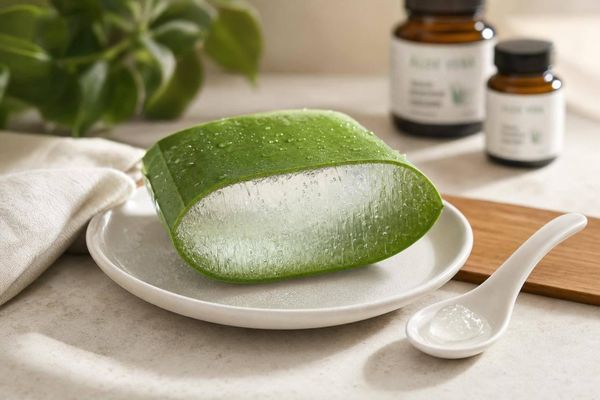
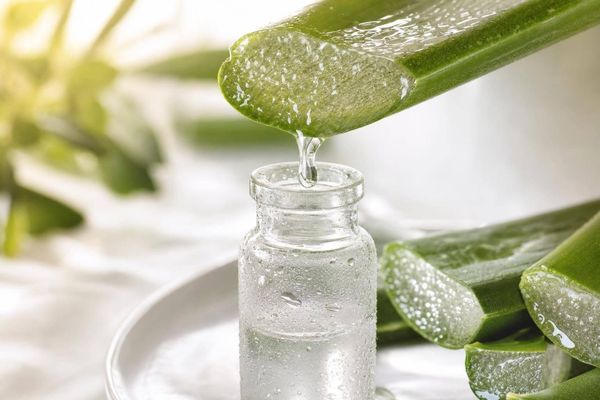
The inner-leaf gel is the clear, jelly-like center of the aloe leaf. It’s the main source of acemannan, the compound linked to digestive and immune support. Just under the rind sits aloe latex, a yellow sap that contains aloin, a compound with strong laxative effects.
Whole-leaf extract combines the rind, latex, and gel. That means it often has more aloin and less acemannan than purified inner-leaf aloe.
For daily use, purified inner-leaf gel is usually the better pick. That’s why the plant part matters before almost any other claim on the label.
How low acemannan and high aloin can make a product underperform
The two big quality issues are low acemannan and too much aloin. Many formulas use diluted whole-leaf powder and don’t disclose a standardized acemannan amount. If there’s no standardization, the dose may be too low to do much. High-heat processing, including spray drying, can also weaken acemannan.
Too much aloin can lead to digestive upset and laxative effects. If you want a better-tolerated product, aloin-free certification is a strong sign to look for.
| Quality Factor | What It Affects | Red Flag to Watch For |
|---|---|---|
| Plant part used | Acemannan concentration | Whole-leaf, no aloin removal |
| Aloin content | Digestive tolerability | No aloin-free certification |
| Processing method | Bioactive potency | High-heat processed |
| Acemannan disclosure | Consistent, measurable dosing | No acemannan standardization on label |
These differences shape whether an aloe product gives people the kind of support they’re usually after. With those markers in mind, the next step is looking at what aloe can realistically support.
What benefits can make aloe worth adding to your routine
Once the label checks out, the next step is simple: what does aloe actually do? A good aloe supplement earns a spot in your routine when it delivers enough acemannan to support digestion, immune balance, hydration, and antioxidant defense.
Digestive comfort and gut lining support
Aloe inner-leaf gel can help support digestive comfort and the lining of the gut. One big reason is acemannan, which works like a prebiotic. In plain English, it helps feed the good bacteria already living in your gut.
When those bacteria break down acemannan, they produce short-chain fatty acids (SCFAs) such as butyrate and acetate. Butyrate matters a lot here because it serves as a main fuel source for the cells that line your colon, which helps support a strong gut barrier.
That’s why acemannan content isn’t just a nice detail on the label. It has a direct link to how well aloe may support the gut. Studies have shown that acemannan can increase total SCFA production by up to 145%.
Immune modulation, hydration support, and antioxidant value
The story doesn’t stop at digestion. Acemannan has also been studied for immune balance. It acts as an immunomodulator, which means it supports balance instead of pushing the immune system too far in one direction.
Aloe may also help with hydration support. Its gel matrix holds water, which can support hydration and mucosal comfort.
On top of that, aloe contains phytonutrients that provide antioxidant support.
Why acemannan content is the clearest quality marker
When you’re judging an aloe supplement, acemannan is the first thing to check. It’s a polysaccharide found mostly in the inner-leaf gel, and when a brand lists a standardized amount on the label, that’s one of the best signs you’re looking at a product with a meaningful bioactive dose.
That matters because acemannan is fragile. Heat and moisture can break it down, so a stated standardized amount often points to gentler processing methods. Put simply: if you want a fast way to screen an aloe label, start here.
How acemannan connects to the benefits readers care about
Acemannan does more than one job. As a prebiotic fiber, it helps feed gut bacteria such as Bifidobacterium and supports short-chain fatty acid production. As a polysaccharide, it can bind and hold water - up to 1,000 times its own weight. It also acts as an immunomodulator, interacting with immune receptors to help the system return to balance.
That’s why a meaningful acemannan level often tells you more about likely results than the total amount of aloe extract listed on the bottle. A big number can look impressive, but without acemannan disclosure, it doesn’t say much.
Why standardized label disclosure matters more than vague terms
A lot of aloe products tell you what plant material is inside, but not how much of the active compound you’re getting. For example, a 200:1 extract ratio tells you the material is concentrated, but it does not tell you the acemannan content. Terms like "aloe blend", "whole-leaf," and "proprietary formula" can make a label sound good while hiding the dose you need to judge.
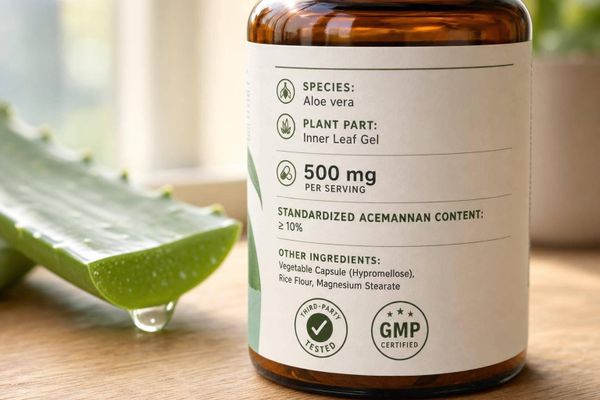
What should you look for instead? Standardized acemannan listed as either a percentage or a milligram amount in Supplement Facts.
Here’s a simple way to sort useful label language from fuzzy marketing:
| Label Term | Quality Signal | Why It Matters |
|---|---|---|
| Standardized Acemannan | High | Confirms a consistent, measurable dose of the primary bioactive |
| Inner-Leaf Gel | High | Verifies the acemannan-rich portion of the plant was used |
| Cold-Extracted | High | Indicates the delicate molecular structure was preserved |
| Aloe Vera Blend | Low | Often hides low concentrations of active ingredients |
| 200:1 Extract | Medium | Shows concentration of plant material, not acemannan level |
Once acemannan is clear, the next thing to check is whether the product format fits your routine.
How to judge quality and pick the right format for your routine
Once you know to watch acemannan and aloin, label reading gets a lot easier.
Quality markers that signal a high-quality aloe supplement
Use this checklist to find products that keep acemannan in place and steer clear of unwanted aloin.
- Purified inner-leaf gel: Look for that exact wording, not just “aloe vera extract”.
- Stated acemannan amount: You want a listed acemannan amount, not only an extract ratio.
- Gentle processing: Go with gentle, low-heat processing to help protect acemannan.
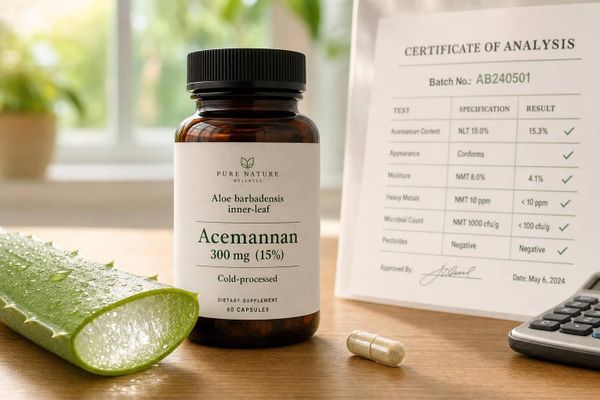
- Third-party verification: Check for GMP and NSF certifications, plus batch-specific Certificates of Analysis (COA) you can access through scannable QR codes.
- Transparent sourcing: If a brand tells you where the aloe was grown, you get a better sense of the raw material. Aloe grown in mineral-rich volcanic soil has been linked to higher natural polysaccharide density.
| Feature | Inner-Leaf Aloe | Whole-Leaf Aloe |
|---|---|---|
| Acemannan Relevance | High; primary source of bioactive gel | Variable; often diluted; may include aloin from outer leaf |
| Aloin Risk | Low (if purified) | High (contains outer leaf) |
| Wellness Suitability | Best for gut and immune support | Variable; often diluted |
| Processing Transparency | Usually high | Often low or generic |
After the label passes the test, the next step is simple: pick the format you’ll stick with.
Capsules, gels, and drinks: picking the format that fits your day
The best format is the one you can use every day without turning it into a chore.
Capsules make daily dosing simple. They’re portable, tasteless, and don’t need measuring, which makes them the easiest fit for a steady routine.
Gels are a better match if you prefer a thicker, more hands-on option. The downside is that you have to measure each serving yourself.
Drinks and juices can work well if you like liquids, but they often need refrigeration and can be tougher to portion with accuracy.
| Format | Convenience | Serving Control | Everyday Fit |
|---|---|---|---|
| Capsules | High; portable, no fridge | Precise; standardized dose | Best for consistent daily routines |
| Gels | Medium; may need fridge | Manual measurement | Best for a thicker, more hands-on format |
| Drinks | Low; requires refrigeration | Harder to measure | Best for people who want a liquid format |
That leaves one last rule: match the product to the way you live.
Conclusion: the traits that make an aloe supplement worth taking
Aloe supplements worth taking tend to share the same core traits: purified inner-leaf aloe, a disclosed and standardized acemannan level, low-aloin or aloin-free processing, and verifiable quality standards such as third-party testing and transparent sourcing. Those are the baseline markers to look for. Format comes after that, but it still counts. When product quality and day-to-day fit line up, aloe is much easier to use as part of your wellness routine.
FAQs
How much acemannan should I look for?
Look for a clear, standardized acemannan amount. Skip fuzzy claims like 100X or 200X. Those numbers sound impressive, but they don’t tell you much.
A solid benchmark for raw materials is at least 5% acemannan by dry weight. Some research also points to 10% (w/w) as a satisfactory level.
Also, make sure the percentage is stated on a dry-weight basis. Then verify it with a Certificate of Analysis (COA) instead of taking marketing copy at face value.
Is aloe safe to take every day?
Yes, a high-quality aloe supplement can be safe for daily use if it’s processed the right way to remove anthraquinones such as aloin.
When you’re shopping, look for labels like purified, decolorized, or aloin-removed. It also helps to check for a Certificate of Analysis that shows aloin levels at 10 parts per million or less.
There isn’t one standard dose that works for everyone, so it’s smart to talk with a healthcare professional before taking aloe every day, especially if you have an autoimmune condition or take medications.
What’s the difference between aloe capsules, gels, and drinks?
Aloe supplements mainly vary in concentration, stability, and delivery method.
Capsules are often the top pick because they can deliver a standardized acemannan dose. They also help shield sensitive polysaccharides from moisture and other outside exposure.
Gels and drinks can be less predictable, especially if they aren’t processed or stabilized well. In some cases, they also don’t clearly state how much of the active ingredient is inside.
No matter the format, check for standardized acemannan levels and purity.