How to Choose an Aloe Product That Prioritizes Purity and Potency
Batch-specific CoAs and acemannan tests reveal whether 'pure aloe' claims are true.
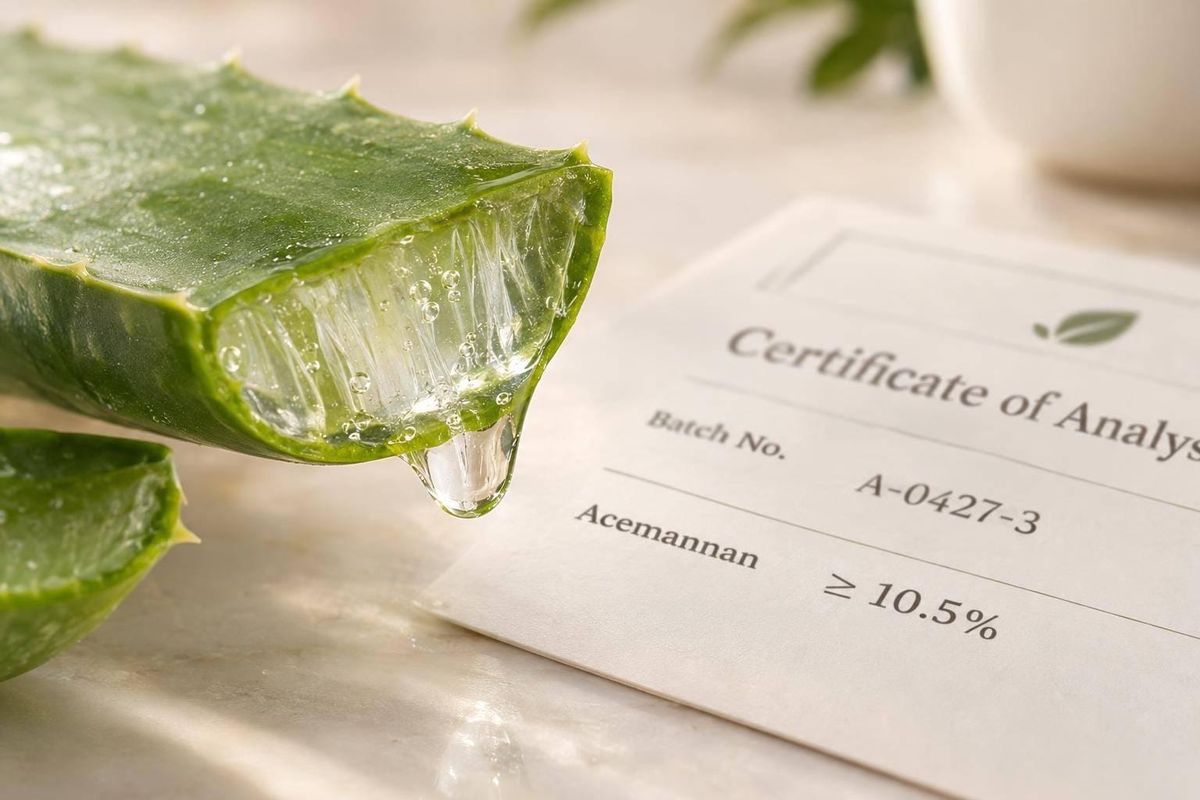
I start with the batch test report - not the “pure aloe” claim. Before buying oral aloe, I check that the Certificate of Analysis (CoA) matches the package’s lot number and tests the finished product.
Here’s my checklist:
- Label: Plant part, aloe form, serving size, acemannan amount, and all added ingredients.
- Processing: Evidence that production and storage preserve acemannan, plus shelf-life and after-opening data.
- Testing: Aloe identity, acemannan-specific results - not just total polysaccharides - and aloin and contaminant results with units and limits.
For aloin, the article cites an IASC limit of 10 ppm for products containing 0.5% aloe solids. I also check the test’s detection limit: <u>“not detected” does not mean zero</u>.
My rule: accept matching records, ask about gaps, and skip claims I can’t verify. These checks address documented composition and quality - not proof of acemannan's health benefits. I’d consult a healthcare professional before starting an aloe supplement.
How to Verify Aloe Product Purity and Potency
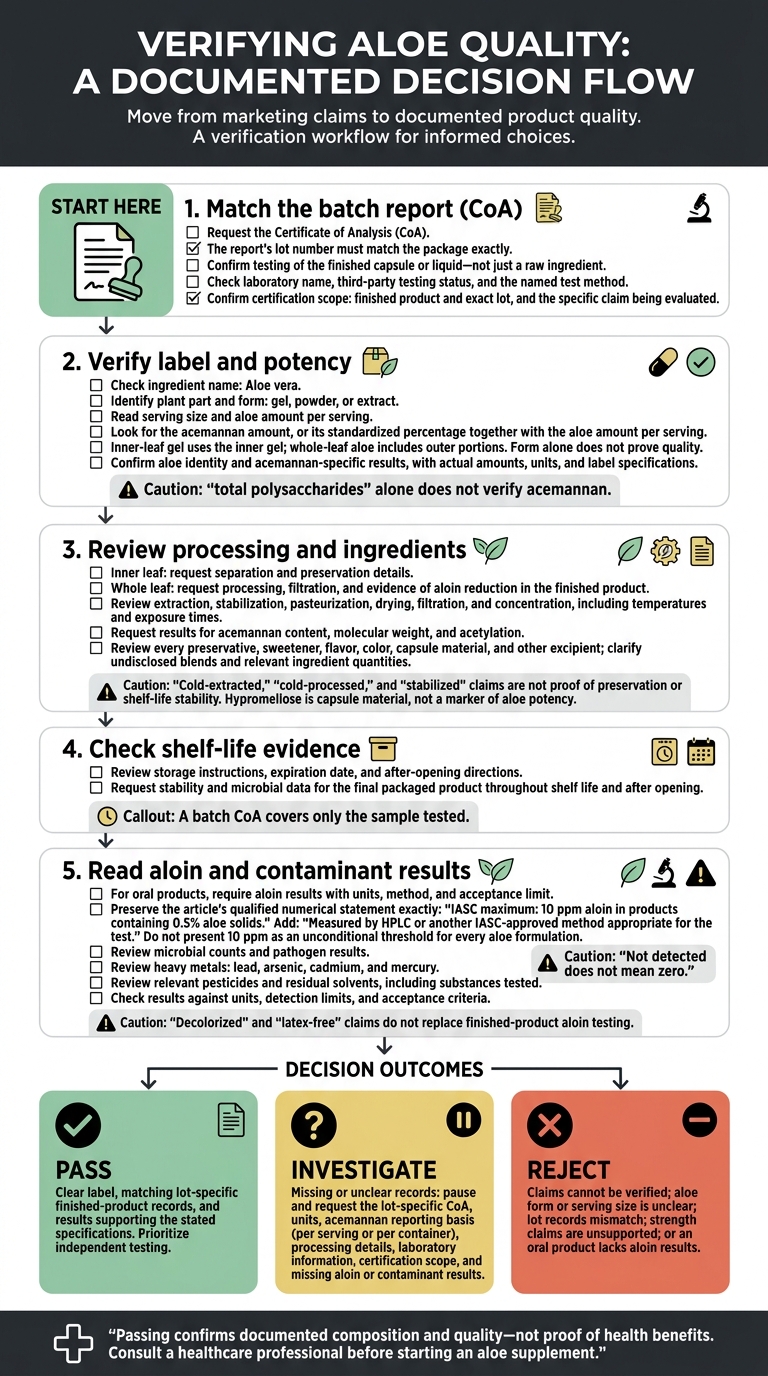
Step 1: Check Aloe Form and Acemannan Content
Identify the Plant Part and Serving Amount
Read the ingredient list alongside the serving instructions. Look for Aloe vera, the plant part used, and its form: gel, powder, or extract.
Label checklist: ingredient name; plant part and form; serving size; and either the acemannan amount or its standardized percentage with the aloe amount per serving.
These details help you decide whether the stated potency is specific enough to verify.
Compare Inner-Leaf and Whole-Leaf Aloe
Inner leaf is usually preferred for oral products, but form alone doesn’t prove quality. The plant part tells you what’s used; processing helps determine whether the product meets its claims.
| What to check | Inner-leaf gel | Whole-leaf aloe |
|---|---|---|
| Plant material | Inner gel | Whole leaf, including outer portions |
| Processing details | How the gel was separated and preserved | How the leaf was processed and filtered |
| What to ask for | Aloe amount, acemannan specification, and separation/preservation details | Aloe amount, acemannan specification, and processing/filtration details |
| Quality question | Does the certificate of analysis (CoA) confirm retained acemannan? | Does the CoA support purity and potency claims? |
Use the form as an initial screening step. The assay is what confirms the claim.
Read Acemannan Test Results
Once you’ve checked the form, make sure the test measures the right compound.
Acemannan, or beta-1,4-acetylated glucomannans, is a defining component of Aloe vera. “total polysaccharides” alone does not verify acemannan. Ask whether the assay measures acemannan specifically rather than total polysaccharides.
Read the result alongside the serving size, product form, and assay method. Treat “standardized” as a specification backed by testing - not just a marketing term.
sbb-itb-b88dd21
Step 2: Review Processing and Added Ingredients
Once you’ve confirmed the aloe form and acemannan, check whether processing and added ingredients have kept them intact.
Check Processing, Storage, and Shelf Life
For inner-leaf products, ask how the gel is separated and purified. For whole-leaf aloe, ask how aloin is reduced and how its level is verified in the finished product. Separation and filtration claims alone don’t tell you how much aloin remains.
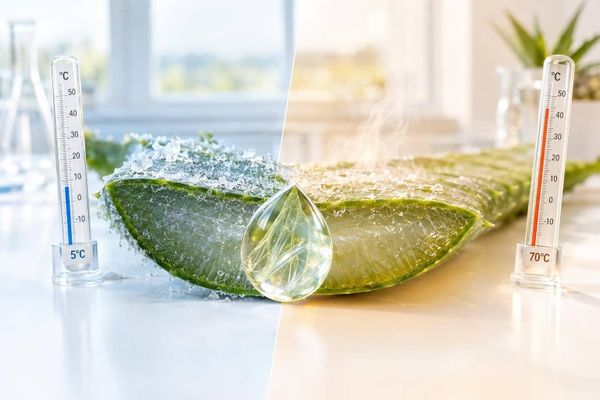
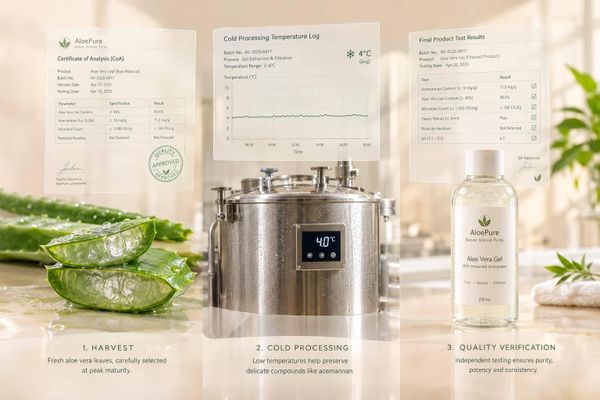
Ask for details about extraction, stabilization, pasteurization, drying, filtration, and concentration, including temperatures and exposure times. Heat and harsh processing can change acemannan’s molecular weight and acetylation. “Cold-extracted” tells you something about the process, but it isn’t proof of preservation. Request lab results for acemannan content, molecular weight, and acetylation.
Review storage instructions, the expiration date, and directions for use after opening. Ask for stability and microbial data showing that the product in its final package meets label claims throughout its shelf life and after opening. A batch CoA covers only the sample tested.
Then separate how the aloe was processed from which ingredients were used to package or stabilize the product.
Review Each Added Ingredient
Additives affect stability and delivery - not aloe potency. Read each preservative, sweetener, flavor, color, capsule material, and other excipient by name. Hypromellose, for example, is a capsule material, not a marker of aloe potency.
| Label claim | What it does not prove |
|---|---|
| “Cold-processed” | Temperatures reached throughout production. |
| “Stabilized” | Stability through expiration and after opening. |
| Hypromellose capsule | Capsule material grade and purity. |
| “Natural flavors” | Specific components and quantities. |
| “Proprietary blend” | Amounts and proportions of aloe and other ingredients. |
Ask for clarification when blends aren’t disclosed or flavor descriptions are vague. Request ingredient roles and quantities that matter for your dietary needs or serving size. Preservatives and excipients can help with preservation, stability, or delivery. Judge those roles by ingredient disclosure and supporting tests - not by how long the ingredient list is.
Step 3: Verify Batch-Specific Test Results
Check the claims against the finished batch you plan to buy. Use its certificate of analysis (CoA) to confirm aloe identity, acemannan content, and contaminants of concern.
Match the CoA to the Product Lot
The report’s lot number should match your packaging exactly. Also confirm that the lab tested the finished capsule or liquid - not just a raw ingredient. A manufacturer’s statement alone does not prove what’s in the finished product.
| CoA item | What to check | What you cannot conclude without this check |
|---|---|---|
| Lot number | Exact match to the product packaging | The report applies to your batch |
| Laboratory | Lab name and third-party testing status | The results have third-party verification |
| Method | Named method appropriate for the test | The test supports the reported claim |
| Aloe identity | Result confirming the stated aloe identity | The aloe matches the label |
| Acemannan or polysaccharides | Actual amount, units, and label specification | The results support the claimed content |
| Aloin | Result, units, and acceptance limit | The product meets the stated aloin limit |
| Microbial limits | Counts, pathogen results, units, and acceptance limits | The product meets microbial specifications |
| Heavy metals | Lead, arsenic, cadmium, and mercury results, with units and limits | The product meets stated limits |
| Pesticides and residual solvents | Substances tested, results, and detection limits | The screening coverage and amounts that could go undetected |
Check Aloin and Contaminant Results for Oral Use
Confirming aloe identity is only part of the check. Oral aloe also needs testing for aloin and contaminants.
Aloin comes from aloe latex and acts as a laxative. The International Aloe Science Council (IASC) set a maximum limit of 10 ppm aloin in products containing 0.5% aloe solids, measured by HPLC or another IASC-approved method appropriate for the test. Claims such as “decolorized” or “latex-free” are not enough on their own.
Review microbial results, along with relevant heavy-metal, pesticide, and residual-solvent screening. Check each result against its units, detection limit, and acceptance criterion. Not detected does not mean zero. Without a detection limit, you cannot tell how sensitive the test was.
What the Certification Covers
Check that the certification applies to the finished product and the exact lot. Then check its scope: does it cover the claim you’re evaluating, or only a narrower ingredient or process claim?
Acemannan measurements support composition claims. Aloin and contaminant results address separate quality and safety concerns.
If the records cover only raw ingredients, request finished-product verification.
Conclusion: Decide Whether to Pass, Investigate, or Reject
Pass Products with Clear Labels and Matching Results
After reviewing labels and certificates of analysis (CoAs), place each product into one of three groups. A pass applies to the label and records - not to health benefits. Require the plant part, serving amount, standardized acemannan, processing details, full ingredient list, aloin results for oral products, and contaminant screening. Prioritize lot-specific CoAs and independent testing that matches the stated acemannan content.
Investigate Missing or Unclear Records
If records are incomplete, pause the decision. Ask for the lot-specific CoA and confirm whether acemannan is reported per serving or per container. Check the units, processing details, laboratory name, and any third-party certification. Request any missing aloin results and contaminant screening.
Reject Claims That Cannot Be Verified
If you can't verify the label or records, stop there. Reject unverified claims, unclear aloe form or serving size, mismatched lot records, unsupported strength claims, and oral products without aloin results. Passing confirms documented composition and quality only. Consult a healthcare professional before starting a supplement.
FAQs
How do I calculate acemannan per serving?
Check the product’s label or Certificate of Analysis (COA) for acemannan content, listed in milligrams per serving or as a standardized percentage by weight [3].
Confirm whether the amount is reported as-is or by dry weight - that distinction changes how you read the result. Aloe gel is about 99% water, so raw materials are often tested and reported on a dry-weight basis. Also, check that the COA matches your bottle’s lot number and uses validated testing methods, such as NMR or HPLC [3].
How can I verify a testing lab’s independence?
Check that the certificate of analysis (COA) matches your bottle’s lot number. It should give numeric results for acemannan and aloin - not just “pass” or “conforms” - and name the testing methods, such as NMR, HPLC, or AOAC Official Method 2018.14.
Other details that support independent testing include ISO/IEC 17025 laboratory accreditation, separate dates for sample collection and testing, and confirmation that the lab tested the finished product. [3]
Does higher acemannan content mean better health benefits?
Not necessarily. Acemannan content is a key indicator, but more doesn’t guarantee better health benefits. Its biological activity depends on its structure: the degree of acetylation, molecular weight distribution, and an intact backbone.
High heat or harsh drying methods can damage that structure. This may reduce effectiveness even when the total polysaccharide concentration stays high.
Look for lot-specific testing of these structural markers, rather than relying only on the total acemannan percentage.