Why Cold Processing Matters: Preserving Acemannan Integrity in Aloe Vera
Explains why cold processing better preserves acemannan structure and which finished-product tests verify preservation.

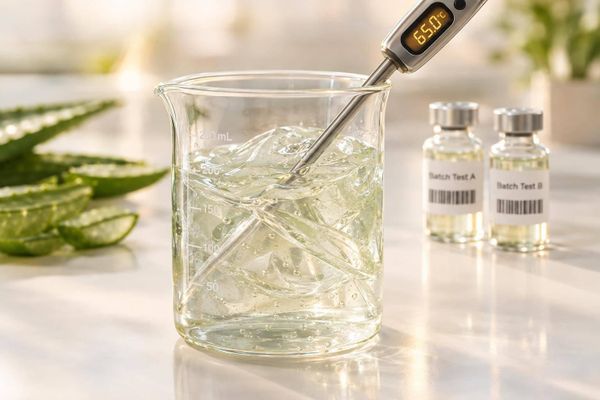
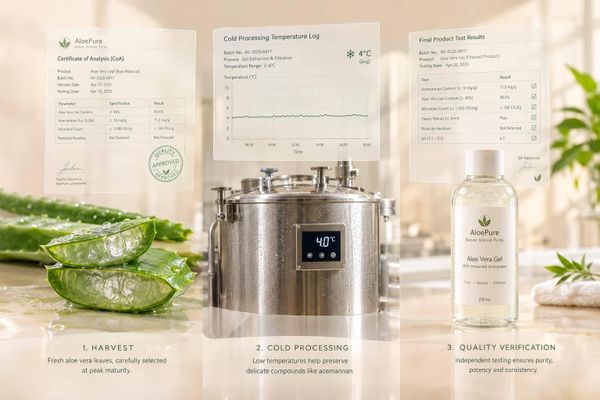
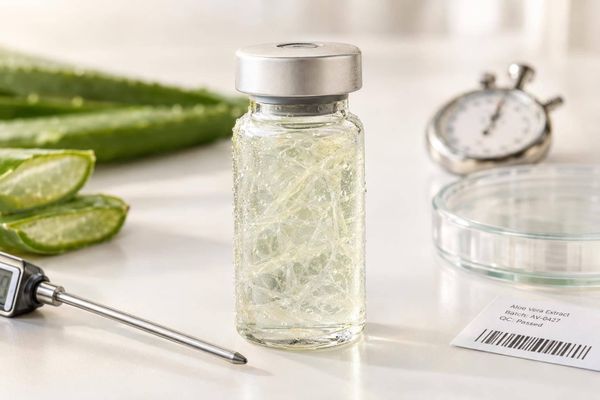
I look for finished-product tests - not just a “cold-processed” label. To check whether acemannan survived processing, I ask for 3 measurements: acetylation, molecular-weight distribution, and acemannan content, plus batch temperature and exposure-time records.
Here’s how I compare the methods:
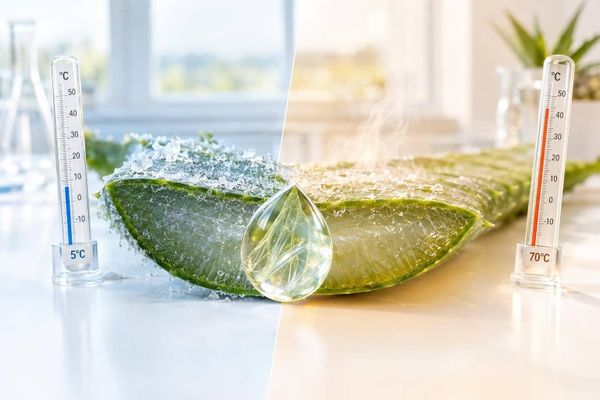
- Cold processing: Limits heat exposure, but later heating and storage still matter.
- Pasteurization: Uses heat to control microbes; microbial safety tests don’t show whether acemannan stayed intact.
- Thermal dehydration: Removes water through heated concentration or drying; drying-air temperatures alone don’t show the product’s heat exposure.
Quick Comparison
| Method | Main goal | What I check |
|---|---|---|
| Cold processing | Limit heat exposure | Records for every processing step |
| Pasteurization | Control microbes | Product temperature, hold time, and microbial results |
| Thermal dehydration | Remove water | Concentration and drying temperatures and exposure times |
For all three, I also request lot-specific structural tests and shelf-life data. More acemannan doesn’t necessarily mean more intact acemannan. There’s no established universal heat-damage threshold, and <u>preserved structure does not prove health effects in humans</u>.
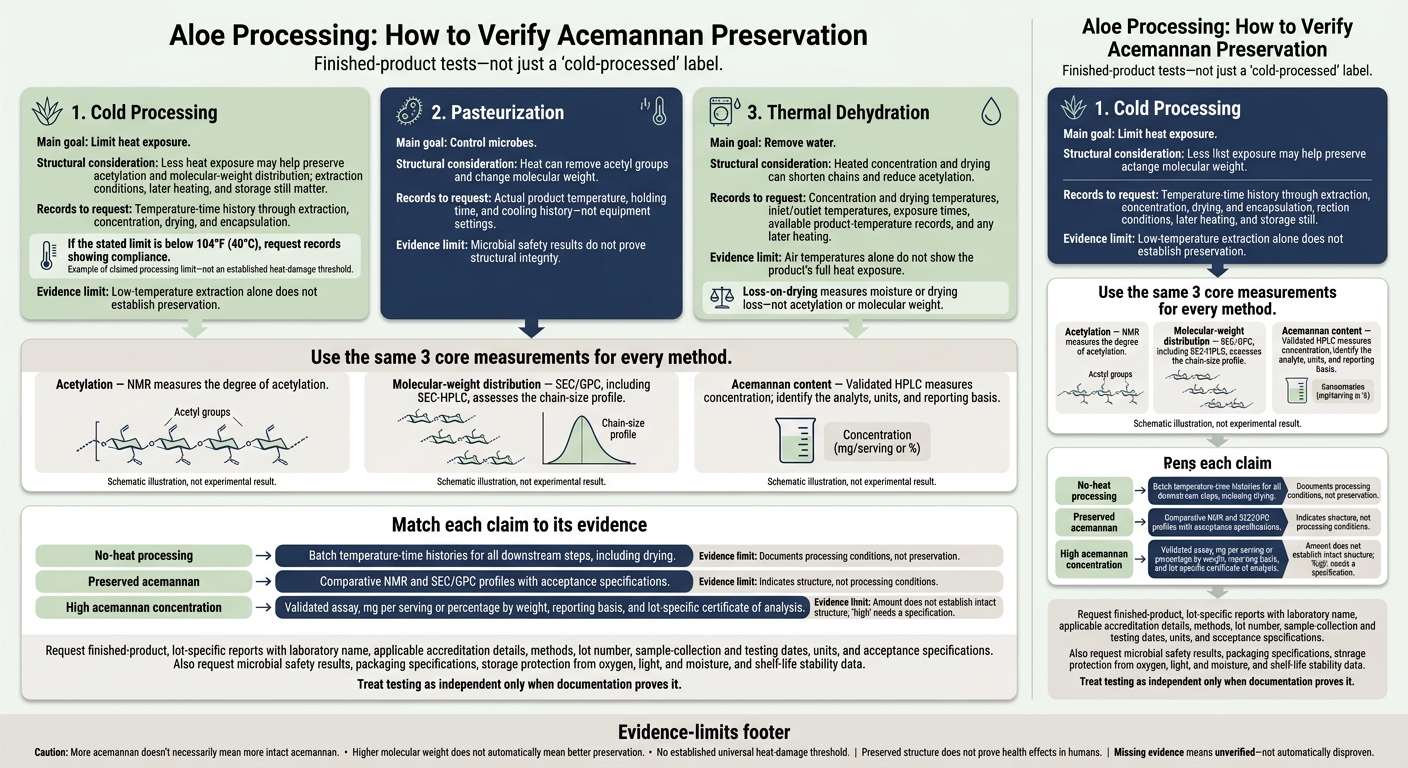
Aloe Processing: How to Verify Acemannan Preservation
1. Cold Processing
Temperature and Exposure Time
Cold ethanolic extraction limits heat exposure to help preserve acemannan structure. Ask for the temperatures used in °F and °C, along with exposure times. Later heating steps can still damage that structure.
Acemannan Structure
Less heat exposure may help preserve acemannan’s acetylation and molecular weight distribution. Heat isn’t the only factor, though. Extraction conditions and storage can also change its structure. Finished-product testing matters more than the process label.
What Preservation Research Shows
Cold extraction is presented as a way to preserve acemannan. Standardized acemannan content helps indicate preservation, but it doesn’t confirm purity or safety. Ask for third-party testing that reports purity, potency, and safety.
Structural preservation and safety are separate requirements. Next, compare those preservation goals with pasteurization and how heat-based processing can affect both.
sbb-itb-b88dd21
2. Pasteurization
Temperature and Exposure Time
Unlike cold processing, pasteurization adds heat after extraction to control microbes. But that heat can also damage acemannan. None of the temperature-time profiles in the sources shows both microbial control and intact acemannan.
Acemannan Structure
Heat can remove acetyl groups and change molecular weight. A higher polysaccharide yield doesn’t necessarily mean better preservation: it may still include degraded chains.
What Preservation Research Shows
The sources point to heat-related risks, but they don’t report a controlled comparison of temperatures, hold times, and retention rates. That leaves the exact threshold unclear.
Microbial-control data and structural testing answer different questions, so both are needed. Look for post-pasteurization tests of acetylation, molecular weight, and polysaccharide profiles.
Thermal dehydration involves the same tradeoff, but with longer heat exposure.
3. Thermal Dehydration
Temperature and Exposure Time
Spray drying and heated concentration remove water to make aloe vera powder. Ask for product temperatures and exposure times, including concentration before drying - not just the drying-air temperature. These details matter because acemannan’s structure depends on how heat affects the molecule itself.
Acemannan Structure
Heated drying can shorten acemannan chains and reduce acetylation. Cold processing limits heat exposure, but the finished powder still needs testing. Chain length and acetylation are the same preservation markers that cold processing aims to protect.
What Preservation Research Shows
The supplied sources do not report product temperatures, drying times, or retention rates. They cannot establish a safe drying threshold or prove that every spray-dried powder has lost its structural integrity.
For powder products, put measured preservation ahead of processing labels. Request finished-product tests for acetylation, molecular weight distribution, and polysaccharide profile. Standardized content tells you the quantity - not whether the structure remains intact. The next structural question is what acetylation, molecular weight distribution, and polysaccharide composition remain after drying.
Acemannan Structure: Acetylation, Molecular Weight, and Composition
Acemannan is an acetylated, mannose-rich polysaccharide. Beyond its structure, researchers have identified several science-backed health benefits associated with this molecule. Cold processing aims to keep its acetyl groups and molecular-weight distribution intact. Heat can remove those groups or shorten the chains. Finished-product testing should measure both markers, rather than rely on the processing method alone.
| Structural feature | Cold-processing aim | Potential thermal change | Measurement and interpretation |
|---|---|---|---|
| Acetylation | Preserve acetyl groups | Reduced acetylation | NMR measures the degree of acetylation. |
| Molecular-weight distribution | Maintain the native chain-size profile | Shorter chains or a shifted size distribution | Size-exclusion chromatography assesses molecular-weight distribution. |
| Mannose-rich backbone | Retain the original polymer structure | Possible backbone cleavage | Carbohydrate composition analysis identifies constituent sugars. |
| Galactose-containing side chains | Limit side-chain changes | Possible side-chain cleavage | Composition analysis shows sugar makeup, but not structural integrity. |
A processing claim describes how a product was made. A preservation claim needs evidence that its structure survived. Moisture, heat, duration, pH, oxygen exposure, and the aloe matrix all affect that outcome.
Yield alone doesn't confirm preservation of acetylation or chain-size distribution. Higher molecular weight doesn't automatically mean better preservation, either. Finished-product testing should check acetylation, molecular-weight distribution, and overall structure to show whether these markers remain intact.
Checking Preservation Claims With Finished-Product Tests
After comparing how processing affects acemannan, check preservation claims against lot-specific process records and finished-product tests. Temperature records document exposure; lab results show how much structure remains.
Use the same tests for every processing method: NMR for acetylation, SEC/GPC (including SEC-HPLC) for molecular-weight distribution, and validated HPLC for concentration.
| Processing method | Process records to request | Finished-product tests to request | Evidence limits |
|---|---|---|---|
| Cold processing | Temperature-time history through extraction, concentration, drying, and encapsulation. If the stated limit is below 104°F (40°C), request records showing compliance. | NMR, SEC/GPC, and HPLC. | Low-temperature extraction alone does not establish preservation. |
| Pasteurization | Actual product temperature, holding time, and cooling history - not equipment settings. | NMR, SEC/GPC, and HPLC. | Microbial safety results do not prove structural integrity. |
| Thermal dehydration | Inlet/outlet temperatures, exposure time, and available product-temperature records, including any later heating. | NMR, SEC/GPC, HPLC, and loss-on-drying. | Air temperatures alone do not show the product’s full heat exposure. |
Supporting tests answer different questions. FT-IR adds a fingerprint, while GC or GC-MS supports composition analysis. Neither replaces intact-chain testing. HPLC reports should identify the measured analyte, units, and reporting basis. Loss-on-drying measures moisture or drying loss - not acetylation or molecular weight. Ask for sample-preparation details and interpretation limits, too. Instrument names alone do not make a complete report.
| Claim | Support to request | Limit of that support |
|---|---|---|
| No-heat processing | Batch temperature-time histories for all downstream steps, including drying. | Documents processing conditions, not preservation. |
| Preserved acemannan | Comparative NMR and SEC/GPC profiles with acceptance specifications. | Indicates structure, not processing conditions. |
| High acemannan concentration | Validated assay, mg per serving or percentage by weight, reporting basis, and lot-specific certificate of analysis. | Amount does not establish intact structure; “high” needs a specification. |
For product pages and lot reports, request the laboratory’s name, applicable accreditation details, methods, lot number, and confirmation that tests used the finished product. List sample-collection and testing dates separately. Results should include units and acceptance specifications for acetylation, molecular-weight distribution, and concentration. Treat testing as independent only when the documentation proves it.
Storage also affects preservation. Request records showing protection from oxygen, light, and moisture, along with packaging specifications and stability data. Without matching process records and finished-product reports, claims remain unverified - not automatically disproven.
Conclusion: Choose Documented Preservation Over Labels
Lower heat may help preserve acemannan’s acetyl groups and chain length, but documented results - not labels - must support that claim. Any preservation benefit must also be weighed against microbial safety, formulation, and shelf-life stability.
Product format matters, too. Aloe gel, powder, extract, and finished supplements use different starting materials, solvents, and additives. Results for one format don’t automatically apply to another.
Use documented preservation as the standard: temperature-time histories paired with consistent finished-product testing. Research has not established a universal heat-damage threshold.
When checking a claim, read the original study first. Marketing summaries are not proof.
FAQs
How do I interpret acemannan test results?
Look for numeric potency values in lab results or a certificate of analysis (COA), such as dry-weight percentage or milligrams (mg) per serving. Check whether the results are reported “as-is” or on a “dry basis.”
Also check molecular weight distribution and degree of acetylation. Heat or harsh processing can affect both. To verify aloin safety, look for numeric aloin A/B results, not just “pass,” and note the test method used (e.g., NMR, HPLC, AOAC 2018.14).
Can cold processing preserve acemannan without compromising safety?
Yes, cold processing can preserve acemannan while maintaining safety. Methods such as cold ethanolic extraction avoid heat stress, helping protect acemannan’s molecular structure and native acetylation.
Safety measures include using only inner-leaf gel and purifying it to remove unwanted compounds, such as aloin, found in the outer rind and latex [5]. Acemannan itself has shown no lethal toxicity in research [6].
How can I protect acemannan after opening?
After opening, keep the product tightly sealed in a cool, dry place away from sunlight to protect acemannan from heat, moisture, and breakdown over time. Don’t leave it on countertops or in humid bathrooms. Heat and moisture can break down or change acemannan’s acetylated structure, so keep capsules dry, too. Follow the label’s storage instructions and use the product within the stated timeframe after opening.