10 Foods That Boost Acemannan's Gut Benefits
Pair acemannan with oats, barley, berries, yogurt, salmon, ginger and green tea to support the gut barrier, microbes, and reduce inflammation.

If you want acemannan to do more for your gut, pair it with foods that feed gut bacteria, support the gut lining, and help calm gut stress. The best matches here are oats, barley, blueberries, raspberries, spinach, broccoli, yogurt with live cultures, salmon, ginger, and green tea.
I’d group them like this:
- For fiber and SCFAs: oats, barley, broccoli, spinach
- For polyphenols: blueberries, raspberries, green tea
- For live cultures: yogurt
- For inflammation support: salmon, ginger, green tea
- For gut lining support: many of the above, especially oats, berries, broccoli, yogurt, and ginger
A few points stand out fast:
- Gut microbes can shift in 24 to 48 hours
- Barley intake for 4 weeks was linked with changes in gut bacteria in cited research
- Changes tied to the gut barrier and inflammation may take 8 to 12 weeks of steady intake
- Diets with 30+ plant foods per week are linked with more microbial diversity
So the main idea is simple: acemannan helps on the gut-lining side, and these foods add fiber, plant compounds, probiotics, or omega-3 fats. That mix gives you more than acemannan alone.
8 Foods That Actually Fix Your Gut (Not Probiotics)
sbb-itb-b88dd21
Quick Comparison
| Food | Main Role | Best Use With Acemannan |
|---|---|---|
| Oats | Beta-glucan fiber | Helps SCFA production |
| Barley | Beta-glucan + arabinoxylan | Adds fermentable fiber |
| Blueberries | Anthocyanins + fiber | Supports microbes and gut lining |
| Raspberries | Fiber + ellagitannins | Adds butyrate support |
| Spinach | Fiber + sulfoquinovose | Feeds gut bacteria |
| Broccoli | Fiber + glucosinolates | Supports barrier and gut compounds |
| Yogurt with live cultures | Probiotics | Adds live microbes |
| Salmon | Omega-3 fats | Helps calm gut stress |
| Ginger | Gingerols and shogaols | Supports digestion and gut comfort |
| Green tea | Catechins like EGCG | Adds polyphenols for gut support |
What I like about this list is that it’s practical. You can build a simple routine with oatmeal and berries, yogurt as a snack, salmon or greens at dinner, and green tea or ginger tea during the day.
How Food and Acemannan Work Better Together
Acemannan tends to work best when it’s paired with foods that support the gut from a few angles at once: fiber, polyphenols, probiotics, and foods that help cool inflammation.
Take oats and barley. They provide fermentable fiber, which works alongside acemannan to support short-chain fatty acid production. That pairing matters because acemannan can also help buffer fermentation, so the gut gets support from both sides.
Blueberries and green tea bring polyphenols to the mix. Those compounds help feed beneficial microbes, while acemannan helps reinforce the gut barrier. It’s a simple combo: one side helps shape the microbiome, and the other helps support the gut lining.
Yogurt with live cultures adds probiotics, which pair well with acemannan’s support for Bifidobacterium and Lactobacillus.
Ginger and salmon add anti-inflammatory support, while acemannan helps calm gut inflammatory signaling.
Use this framework to see why each food in the list below pairs well with acemannan.
Here’s the quick breakdown:
| Food Category | Example Foods | What It Does With Acemannan |
|---|---|---|
| Prebiotic Fibers | Oats, Barley | Boosts SCFA production; acemannan helps buffer fermentation |
| Polyphenols | Blueberries, Green Tea | Feeds beneficial microbes; acemannan reinforces the gut barrier |
| Probiotics | Yogurt with live cultures | Supports beneficial bacteria growth |
| Anti-inflammatories | Ginger, Salmon | Adds anti-inflammatory support; acemannan helps reduce gut inflammatory markers |
1. Oats
Oats pair well with acemannan for a simple reason: they bring in beta-glucan, resistant starch, and antioxidants that help with fermentation, gut barrier support, and inflammation control. So if you're looking for a clear example of how acemannan works with fermentable foods, oats are a strong place to start.
Prebiotic Fiber and SCFA Support
Oat beta-glucan adds another fermentable substrate alongside acemannan, which helps support short-chain fatty acid production. Cooked oats can also form more resistant starch after they cool, giving gut microbes another fuel source. That fermentation support can also help the gut lining.
Barrier Integrity and Gut Lining Support
Fermentation from oats supports the gut barrier, while acemannan helps reinforce tight junctions such as ZO-1 and occludin.
Anti-Inflammatory Compounds
Oats also contain avenanthramides. These oat antioxidants may help dial down inflammatory signals such as TNF-α and IL-6.
Microbiome Synergy With Acemannan
Oats are linked with higher populations of Lactobacilli and Bifidobacterium. Both help support SCFA production, which makes oats and acemannan a good match for gut microbiome health.
Barley offers a similar beta-glucan effect.
2. Barley
Like oats, barley brings beta-glucan. But it doesn't stop there. It also contains arabinoxylan and a stronger polyphenol profile. That matters because beta-glucan and arabinoxylan are fermentable fibers that make it to the colon and help support SCFA production alongside acemannan.
Prebiotic Fiber and SCFA Support
Barley contains 2%–11% beta-glucan by dry weight. As these fibers ferment, they help support bacteria like Bifidobacterium, Butyricicoccus, and Anaerostipes - all linked to SCFA production that helps fuel the cells lining your colon.
Barrier Integrity and Gut Lining Support
Barley beta-glucan helps preserve the mucus barrier and support gut integrity.
Anti-Inflammatory Compounds
Barley contains phenolic acids, flavonoids, tocols, lignans, and phytosterols - compounds with anti-inflammatory and antioxidant effects. Up to 90% of barley polyphenols are converted by gut microbes into more active compounds that help reduce low-grade inflammation.
Microbiome Synergy With Acemannan
Clinical trials have shown that 4 weeks of barley consumption significantly increased the abundance of Blautia. In plain terms, barley pairs well with acemannan by helping with fermentation, gut barrier support, and inflammation control.
Barley does contain gluten, so it's not a fit for people with celiac disease or non-celiac gluten sensitivity. A simple starting point is a 5%–10% barley-to-rice mix, then increase as tolerated.
Next, berry polyphenols support the gut-immune axis in a different way.
3. Blueberries
Blueberries bring two big things to the table: fiber and anthocyanins. Gut microbes can break those anthocyanins down into smaller compounds.
Prebiotic Fiber and SCFA Support
Blueberries supply fiber and anthocyanins, while acemannan adds its own fermentable substrate. That combo helps support short-chain fatty acid production and gut barrier health.
Barrier Integrity and Gut Lining Support
Acemannan supports tight junctions such as ZO-1 and claudin. Blueberry anthocyanins add another layer by shaping the microbial ecosystem along the gut lining, which helps support digestion and immune balance. Put simply, this pairing supports both the structure of the gut barrier and the microbes that live around it.
Anti-Inflammatory Compounds
Blueberries are rich in anthocyanins, including cyanidin, delphinidin, and malvidin. These compounds work alongside acemannan, which helps calm gut immune signaling.
Microbiome Synergy With Acemannan
Anthocyanin-rich foods can shift the microbiome fast, so blueberries tend to work best when you eat them on a regular basis.
Raspberries follow a similar fiber-plus-polyphenol pattern, with more seed fiber mixed in.
4. Raspberries
Raspberries bring fiber, anthocyanins, and ellagitannins to the table. Gut microbes can break these compounds down into byproducts that help support gut health. Compared with blueberries, raspberries add more seed fiber and a stronger ellagitannin profile.
Prebiotic Fiber and SCFA Support
Raspberries can help support acetate and butyrate production, giving gut microbes another fiber source to work with. That makes them a good fit alongside acemannan and its fermentable fiber effects.
Barrier Integrity and Gut Lining Support
Acemannan helps support epithelial repair. Red raspberry extract also helps strengthen the gut barrier by increasing claudin-1 and reducing permeability. Put those together, and you get barrier support alongside polyphenol-linked inflammation control.
Anti-Inflammatory Compounds
Raspberry polyphenols can also be converted by gut microbes into urolithins, which have anti-inflammatory properties.
Microbiome Synergy With Acemannan
Raspberries may shift the microbiome in ways that work well with acemannan. Raspberry supplementation has reduced Ruminococcus gnavus and, when combined with fructo-oligosaccharides, increased Bifidobacterium fourfold.
Spinach shifts the focus from berries to leafy greens with a different fiber profile.
5. Spinach
Spinach takes this in a different direction. Instead of berry polyphenols, it brings leafy-green fiber and antioxidants to the table. One cooked cup has about 4 grams of fiber, which gives gut bacteria more to feed on alongside acemannan.
Prebiotic Fiber and SCFA Support
Spinach also contains sulfoquinovose, a compound that feeds helpful gut bacteria. That fiber helps drive short-chain fatty acid production, which can calm inflammation and help keep the gut lining in better shape. It also pairs well with acemannan's support for butyrate production, helping fuel colon cells and support the gut barrier.
That same support shows up at the gut lining level too.
Barrier Integrity and Gut Lining Support
Spinach provides vitamin C, which works alongside acemannan's barrier support to help maintain gut lining function. Acemannan also upregulates tight junction proteins like ZO-1 and occludin to help repair the intestinal wall.
Anti-Inflammatory Compounds
Spinach is rich in antioxidants. Those antioxidants help protect the intestinal lining from oxidative stress.
Microbiome Synergy With Acemannan
Spinach and acemannan both support the growth of Lactobacillus and Bifidobacterium. Spinach's fiber profile also helps support microbial diversity.
That makes spinach a strong, low-sugar match for acemannan.
6. Broccoli
Broccoli brings two things to the table: glucosinolates and fiber. Gut microbes can turn those into compounds like sulforaphane, indole-3-carbinol, and short-chain fatty acids. That makes broccoli a good fit with acemannan, which also supports fermentation.
Prebiotic Fiber and SCFA Support
Broccoli supplies fermentable fiber, and acemannan adds another prebiotic substrate. Together, they can help support acetate production during fermentation.
Barrier Integrity and Gut Lining Support
Broccoli compounds may help support tight junction proteins such as occludin and ZO-1, which lines up well with acemannan’s barrier support. It also brings an anti-inflammatory effect that adds another layer here.
Anti-Inflammatory Compounds
Sulforaphane and acemannan both support a more repair-focused immune response. For a simple tweak, lightly cook broccoli or add mustard seeds to help improve sulforaphane availability.
Microbiome Synergy With Acemannan
Broccoli may help support helpful bacteria like Bifidobacterium and Akkermansia muciniphila, while acemannan adds prebiotic support of its own.
If broccoli expands the fiber-and-compound side of the picture, yogurt brings live microbes in directly.
7. Yogurt with Live Cultures
Broccoli brings plant compounds to the table. Yogurt does something different: it adds live cultures directly. That makes yogurt acemannan’s clearest probiotic match - a synbiotic combo that helps support both the microbiome and the gut lining.
Microbiome Synergy With Acemannan
Yogurt provides the microbes, while acemannan helps support them. One study in Food Production, Processing and Nutrition found that adding 5% aloe vera gel helped probiotic yogurt maintain Lacticaseibacillus rhamnosus viability over 28 days.
Prebiotic Fiber and SCFA Support
Acemannan also works a bit differently from faster-fermenting prebiotics like inulin or FOS. It tends to ferment more slowly, which may make it easier on sensitive stomachs when used with probiotic foods like yogurt.
Barrier Integrity and Gut Lining Support
Yogurt’s live cultures add another layer of gut lining support. That pairs well with acemannan’s barrier support, coming at the same goal from a different side.
Anti-Inflammatory Compounds
Go with plain, unsweetened yogurt that lists live and active cultures on the label, then pair it with acemannan on a regular basis.
8. Salmon
Salmon brings omega-3s to the table, which makes it a smart match for acemannan’s gut-support role. After yogurt’s live cultures, salmon shifts the focus to healthy fats that help calm irritation in the gut.
Anti-Inflammatory Compounds
Those fats matter because gut inflammation often goes hand in hand with immune stress. Acemannan can reduce pro-inflammatory IL-1β to basal levels in salmon studies. In fish studies, aloe extract lowered intestinal inflammation and helped protect the gut lining.
Barrier Integrity and Gut Lining Support
This combo also matters for the gut barrier itself. Acemannan promotes repair of the intestinal lining in the small intestine and colon. In a 28-day Atlantic salmon study, aloe extract lowered enteritis scores and supported the intestinal lining.
Acemannan Supplies the Fiber
Salmon doesn’t provide fiber, but acemannan does. It acts as a prebiotic polysaccharide that gut microbes can ferment into butyrate and other SCFAs, which help fuel gut lining cells and reduce inflammation. It also supports gut-immune signaling.
9. Ginger
If salmon brings omega-3s to the table, ginger brings a plant-based way to support digestion and help cool inflammatory activity. It contains gingerol, shogaol, and zingerone, compounds linked to digestive support and a calmer inflammatory response. When you pair it with acemannan, the combo can help support gut-immune balance.
Digestive Comfort
Acemannan helps support short-chain fatty acid production. Ginger can help ease bloating and support gastric emptying, which may make this pairing gentler on the gut.
Barrier Integrity and Gut Lining Support
Acemannan helps support the gut barrier by upregulating tight junction proteins such as ZO-1 and occludin and by promoting mucosal regeneration. Ginger’s bioactive compounds also help manage oxidative stress that might otherwise harm the intestinal lining. Put them together, and they can help shield the gut lining from daily stress.
A more protected lining also creates a better setting for helpful microbes.
Microbiome Synergy with Acemannan
Ginger adds antimicrobial support that may help limit unwanted microbes, while acemannan helps feed helpful strains such as Bifidobacterium and Lactobacillus.
You can use ginger in tea, smoothies, or mixed with aloe gel for a simple daily pairing.
10. Green Tea
Green tea is a catechin-rich option that pairs well with acemannan for gut support. It’s especially high in EGCG, and its polyphenols make their way to the colon, where gut microbes turn them into bioactive compounds.
Anti-Inflammatory Compounds
Green tea polyphenols help calm inflammatory signaling. At the same time, acemannan supports the mucosal layer and may help lower TNF-α and IL-6.
Barrier Integrity and Gut Lining Support
Acemannan supports tight junction proteins such as ZO-1 and occludin. Green tea helps protect that same barrier by easing oxidative stress and inflammation.
Prebiotic Fiber and SCFA Support
Green tea polyphenols and acemannan both support short-chain fatty acid production. The difference is that acemannan tends to ferment more slowly, which may make it gentler on the gut.
Microbiome Synergy with Acemannan
Green tea catechins may help inhibit harmful bacteria such as E. coli and Clostridium while generally leaving beneficial species alone. Acemannan adds low-fermenting prebiotic support that helps feed beneficial bacteria.
Put simply, green tea is a clean, easy daily match for acemannan.
How These 10 Foods Compare as Acemannan Partners
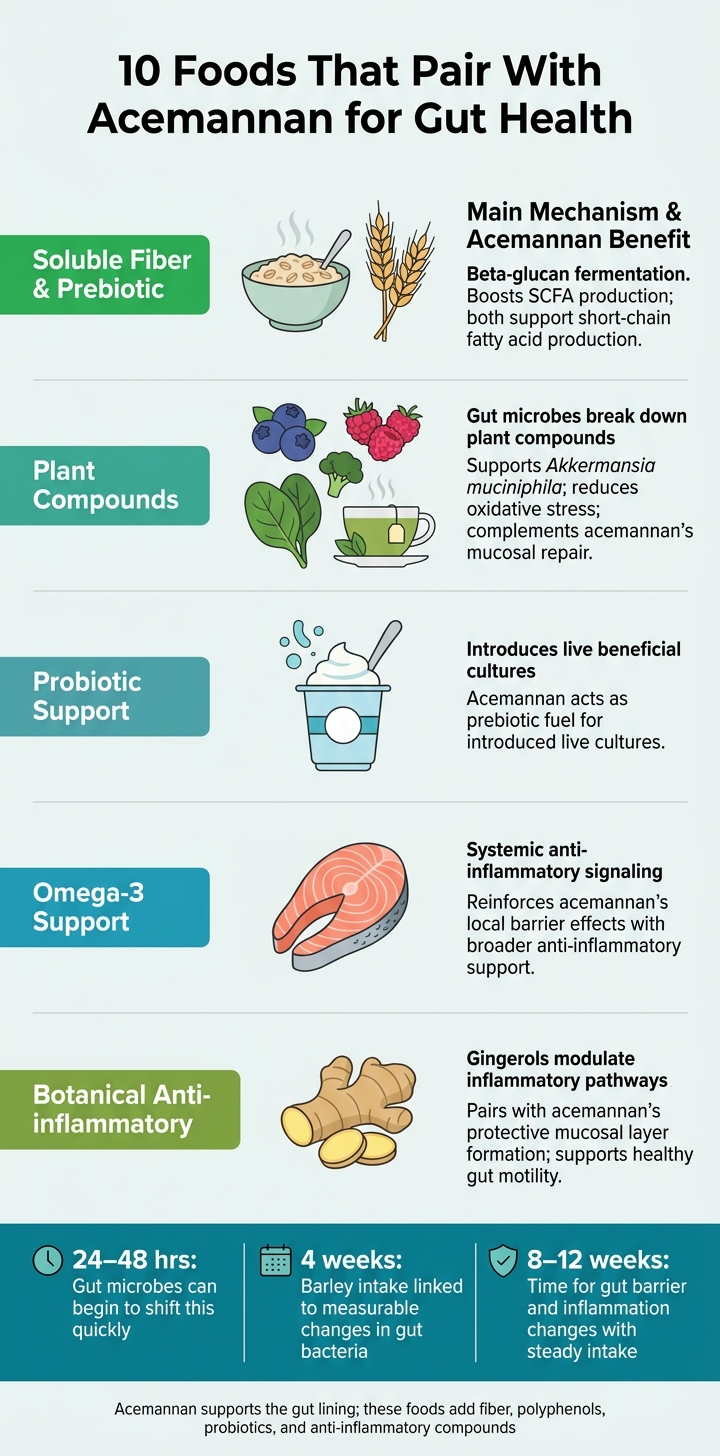
10 Foods That Pair With Acemannan for Gut Health
These foods support acemannan in five main ways: fermentable fiber, polyphenols, probiotics, omega-3s, and anti-inflammatory botanicals.
Here’s the simple way to think about it: acemannan helps on the gut lining side, while these foods can add fuel for gut microbes, bring in live cultures, or help calm inflammation. Grouping them by their strongest role makes pairing a lot easier.
| Category | Foods | Main Gut Mechanism | Effect on SCFAs / Barrier | Acemannan Alignment |
|---|---|---|---|---|
| Soluble Fiber & Prebiotic | Oats, Barley | Beta-glucan fermentation | Boosts SCFA production | Both support SCFA production |
| Plant Compounds | Blueberries, Raspberries, Spinach, Broccoli, Green Tea | Gut microbes break down plant compounds | Supports Akkermansia muciniphila and reduces oxidative stress | Complements acemannan's mucosal repair with antioxidant defense |
| Probiotic Support | Yogurt with Live Cultures | Introduces live beneficial cultures | Adds live beneficial microbes | Acemannan provides prebiotic support for these introduced cultures |
| Omega-3 Support | Salmon | Systemic anti-inflammatory signaling | Helps lower inflammation and oxidative stress | Reinforces acemannan's local barrier effects with broader anti-inflammatory support |
| Botanical Anti-inflammatory | Ginger | Gingerols modulate inflammatory pathways | Calms the gut lining and supports healthy motility | Pairs with acemannan's protective mucosal layer formation |
In practice, oats and barley are your go-to picks for fermentation support. Yogurt helps when you want live cultures in the mix. Then berries, greens, Green Tea, ginger, and salmon round things out by helping with inflammation, oxidative stress, or both.
Easy Ways to Add These Foods to Your Daily Routine
You don’t need to overhaul your whole diet to make these foods part of your day. The easiest move is to work them into meals you already eat and take acemannan with a meal so it becomes part of the same routine.
Breakfast: Cook 1/2 cup dry oats and top with 1/2 cup blueberries. If you want to switch up your grains later in the day, try barley in soups or grain bowls instead of refined grains.
Snack: Mix 1/2 cup raspberries into 6 oz plain yogurt with live cultures. It’s simple, filling, and easy to keep on repeat.
Lunch or dinner: Bake a 4–6 oz salmon fillet and serve it with 1 cup steamed broccoli. Or keep it even simpler and add 1–2 cups raw spinach on the side. If prep is what slows you down, frozen broccoli helps cut that step.
Drinks: Go with 8 fl oz unsweetened green tea or make ginger tea with 1–2 tsp freshly grated ginger.
Use the table below for quick portions and meal timing.
| Food | U.S. Serving Size | Best Meal Fit |
|---|---|---|
| Oats | 1/2 cup (dry) | Breakfast |
| Barley | 1/4–1/2 cup (cooked) | Lunch or dinner |
| Blueberries / Raspberries | 1/2 cup | Breakfast or snack |
| Yogurt (plain, live cultures) | 6 oz | Breakfast or snack |
| Salmon | 4–6 oz | Lunch or dinner |
| Broccoli | 1 cup (chopped) | Lunch or dinner side |
| Spinach | 1–2 cups (raw) | Lunch or dinner side |
| Green tea / Ginger tea | 8 fl oz | Afternoon or after dinner |
As you add more oats, barley, or broccoli, drink more water too. Starting with smaller portions and building up over time gives your gut time to adjust.
Conclusion
No single food can do all the heavy lifting. Oats, berries, leafy greens, yogurt, salmon, ginger, and green tea each bring something different to the table. Some add fiber. Some help feed gut microbes. Others supply compounds that help calm inflammation. Alongside acemannan’s barrier support, they help round out a gut-friendly eating pattern.
That’s why consistency matters more than any one serving. The best results come from what you do day after day, not from one “superfood” meal. Gut microbes can shift within 24 to 48 hours, but those shifts can fade if your routine isn’t steady. Research also ties greater microbial diversity to diets with 30 or more plant varieties per week. Changes tied to the gut barrier and inflammation often take 8 to 12 weeks of regular intake.
A simple way to make this stick is to pair acemannan with a small daily base:
- One breakfast with whole grains
- One snack built around berries or yogurt
- One drink like green tea
Leafy greens, berries, and whole grains are an easy place to start. Put together, these foods can make acemannan easier to keep using and more effective for gut-immune support.
FAQs
How should I take acemannan with these foods?
Take acemannan with water or a light meal as part of a gut-healthy routine. That simple habit can help support steady absorption. And when you take it with meals, it may also help lower triglycerides and inflammatory markers after high-fat foods.
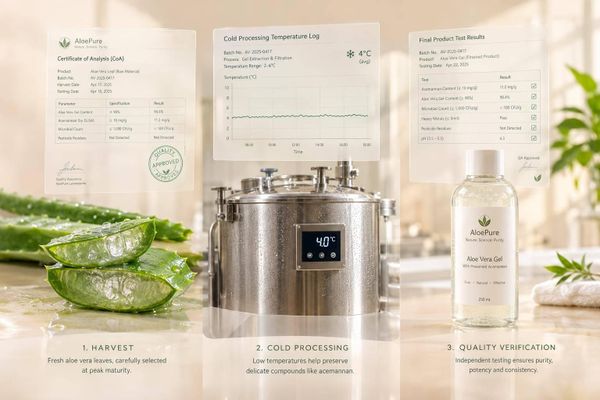
For digestive wellness, consistency matters most. Many people notice benefits within 10 days to 8 weeks. When choosing a product, look for high-quality, cold-processed, inner-leaf acemannan. That helps preserve its activity and avoids the harsh laxative compounds found in the outer rind.
Which foods should I start with first?
Start with a wide mix of plant foods and work toward 30 or more plant types each week. That kind of variety can help support a more resilient microbiome.
It also helps to include:
- Fiber-rich foods
- Fermented foods
- Lean proteins
Because acemannan is a gentle, low-fermenting prebiotic, it fits well alongside plant-based foods. That can be a good match for people who have a harder time with other prebiotic fibers.
How long until I notice gut benefits?
Most people start to notice gut health changes within 10 days to 8 weeks when they take aloe supplements on a steady schedule, usually with water or a light meal.
The key is consistency. Aloe’s compounds tend to work gradually, helping support the digestive system over time, including beneficial bacteria and the gut’s mucosal lining.