What Sets Science-Backed Aloe Supplements Apart?
How to identify science-backed aloe supplements by checking acemannan dose, inner-leaf source, third-party COAs, and extraction methods.
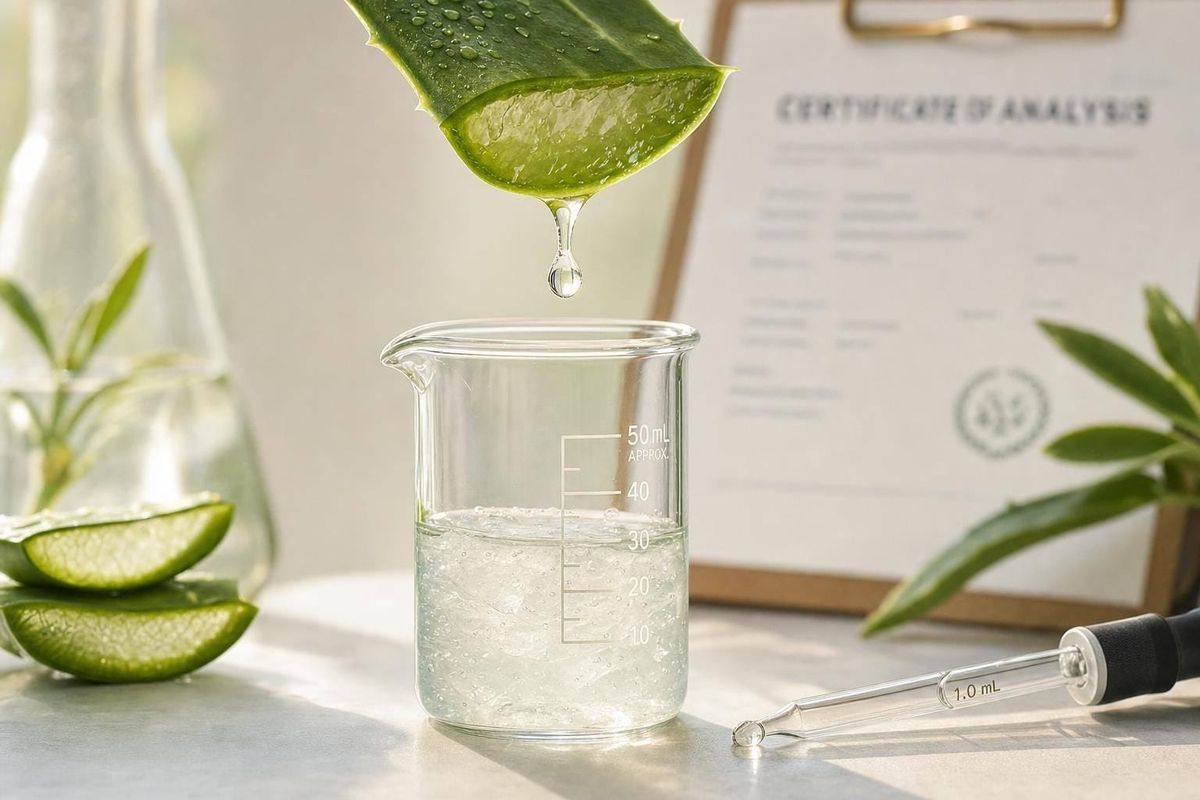
The short answer: aloe supplements are not equal. If I want a science-backed product, I look for four things right away: acemannan amount, inner-leaf source, third-party testing, and how the extract was processed.
Here’s the simple version:
- Best tier: inner-leaf aloe with a stated acemannan percentage or mg amount
- Next tier: a formula that matches the aloe form used in studies
- Lower tier: vague aloe blends or proprietary complexes
- Lowest tier: products that just say “Aloe Vera” with almost no proof on the label
If a label shows 10% to 40% acemannan, says aloin-free, and includes batch-specific COAs, I have something I can check. If it only lists a 200:1 extract or a generic whole-leaf powder, I still don’t know how much acemannan is inside.
Quick Comparison
| Product type | Acemannan listed? | Aloe source | Testing shown? | Processing details? |
|---|---|---|---|---|
| Standardized inner-leaf extract | Yes | Inner-leaf gel | Yes | Usually yes |
| Clinically aligned aloe formula | Yes | Inner-leaf gel | Yes | Yes |
| Generic aloe blend | Often no | May include whole leaf | Sometimes limited | Often vague |
| Low-verification aloe product | No | Unclear | Usually no | Usually no |
So when I read an aloe label, I don’t stop at the word aloe. I check whether the product names the active compound and its science-backed health benefits, shows the dose, and proves the batch was tested.
sbb-itb-b88dd21
1. High-Acemannan Inner-Leaf Aloe Extract
Acemannan Standardization
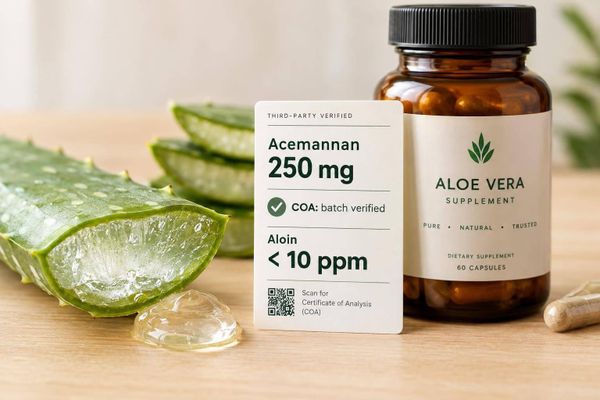
The clearest quality marker is a label that shows acemannan content in a percentage or milligram amount, not just an extract ratio. That gives you a direct read on bioactive strength. Verified products disclose standardized acemannan content, so you’re not left trying to fill in the blanks.
As Stephanie Thomas of Aelius Naturals puts it:
"If a label doesn't tell you how much acemannan you're actually getting, you're guessing."
Research Relevance
Once the label confirms acemannan, the next step is simple: does the formula have real research behind it?
Standardized acemannan has a long research history, including studies involving the U.S. Army and NASA. That matters. But it only means something when the label also tells you the ingredient amount and where it comes from. Without that, the research doesn’t map cleanly to the product in your hand.
It helps regulate immune activity, which generic aloe products lack the research base to claim.
Sourcing and Purity Verification
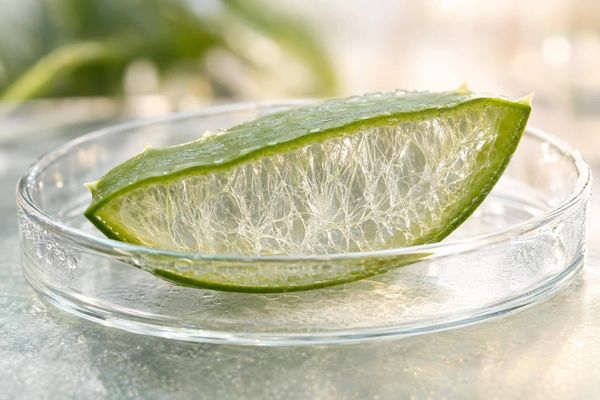
High-acemannan extracts use only the inner-leaf gel. That part is key. The outer rind contains aloin, a compound with laxative effects that has no place in a clean supplement.
Look for labels that clearly state:
- aloin-free
- third-party testing
- batch-specific COAs
Formulation and Stability
Processing can make or break aloe quality. Heat processing and spray drying may reduce potency. Cold ethanolic extraction does a better job of preserving structure, so it’s worth checking the label for that detail.
HPMC capsules also help protect moisture-sensitive polysaccharides over the product’s shelf life.
Standardization and handling are the first filters; the next is whether the formulation has clinical validation.
2. Clinically Studied Standardized Aloe Formulation
Acemannan Standardization
A clinically studied formula does more than mention acemannan on the label. It gives you a measured acemannan percentage, such as 15%, instead of relying on an extract ratio.
That distinction matters. A ratio like 200:1 tells you how much raw plant material went into the process, but it does not tell you how much of the bioactive compound ends up in the capsule. And that only matters when the ingredient studied is the same one you're actually taking.
True standardization also depends on how the ingredient is handled during processing. The acetyl groups and molecular size of the acemannan molecule need to stay intact, because both are linked to its immune and prebiotic effects.
Research Relevance
Having studies is one thing. Having studies that match the formula is another.
For research to apply to a product, four parts need to line up:
- the aloe part used
- the extraction method
- the acemannan concentration
- the molecular size integrity
High heat can change acemannan's structure, which weakens the connection between the study and the finished product. So a heat-processed whole-leaf powder is not the same as the compound studied in the lab. Once that match is gone, the research no longer describes the product.
Sourcing and Purity Verification
Source details matter when they back up the studied formula. One thing to check is Botanical ID testing. That confirms the product contains 100% pure inner-leaf Aloe vera and is free from fillers or whole-leaf dilution.
Formulation and Stability
Acemannan is moisture-sensitive, so the capsule shell isn't just packaging. It helps protect what's inside.
Hypromellose (HPMC) veggie capsules usually keep moisture low, around 3% to 8%. That low-moisture range helps protect delicate polysaccharides from breakdown during storage.
If a label stays this exact, it belongs in the science-backed tier. If the wording gets vague, it slips into the next category.
3. Generic Aloe Blend or Proprietary Aloe Complex
Acemannan Standardization
Once a label stops naming acemannan in plain terms, it starts drifting away from the science-backed group. These products often hide the acemannan amount behind vague wording or a proprietary blend. And that matters, because clinical research looks at intact acemannan, not a loosely described aloe powder.
Research Relevance
The research listed on the label may not match the product if the formula uses a different part of the aloe plant, a different extraction process, or a different acemannan level. If the plant part, extraction method, and dose don’t line up, the cited research doesn’t describe what’s actually in the bottle. That disconnect usually carries over to sourcing and testing as well.
Sourcing and Purity Verification
Whole-leaf aloe can water down acemannan, even when aloin has been removed. Batch-specific Certificates of Analysis with HPLC or FTIR testing tell you much more than GMP claims by themselves. GMP only shows that the facility meets compliance standards - it does not confirm a meaningful level of active compounds.
Formulation and Stability
Generic labels also tend to skip stability details. Fillers can dilute what’s left even further. That missing disclosure is often what separates a generic blend from a product with weak verification.
4. Low-Verification Aloe Products
At the bottom of the scale, the label tells you very little.
Acemannan Standardization and Research Relevance
Low-verification products often list only "Aloe Vera" and leave out any standardized acemannan amount. That makes side-by-side comparison tough, especially if you're trying to line the product up with clinical research. Those studies were done on stabilized acemannan, not a loosely defined whole-leaf powder.
So what does that usually mean in practice? In many cases, the product contains an unstandardized whole-leaf blend with only a small amount of active acemannan.
Sourcing and Purity Verification
These products also tend to skip batch-specific third-party testing for potency, aloin, and botanical identity.
Formulation and Stability
Processing matters here. Heat processing and spray drying can damage acemannan, and poor moisture control can shorten shelf life. That’s the line between verified formulas and weakly labeled aloe products.
Pros and Cons: Verified Aloe Formulations vs. Low-Verification Blends
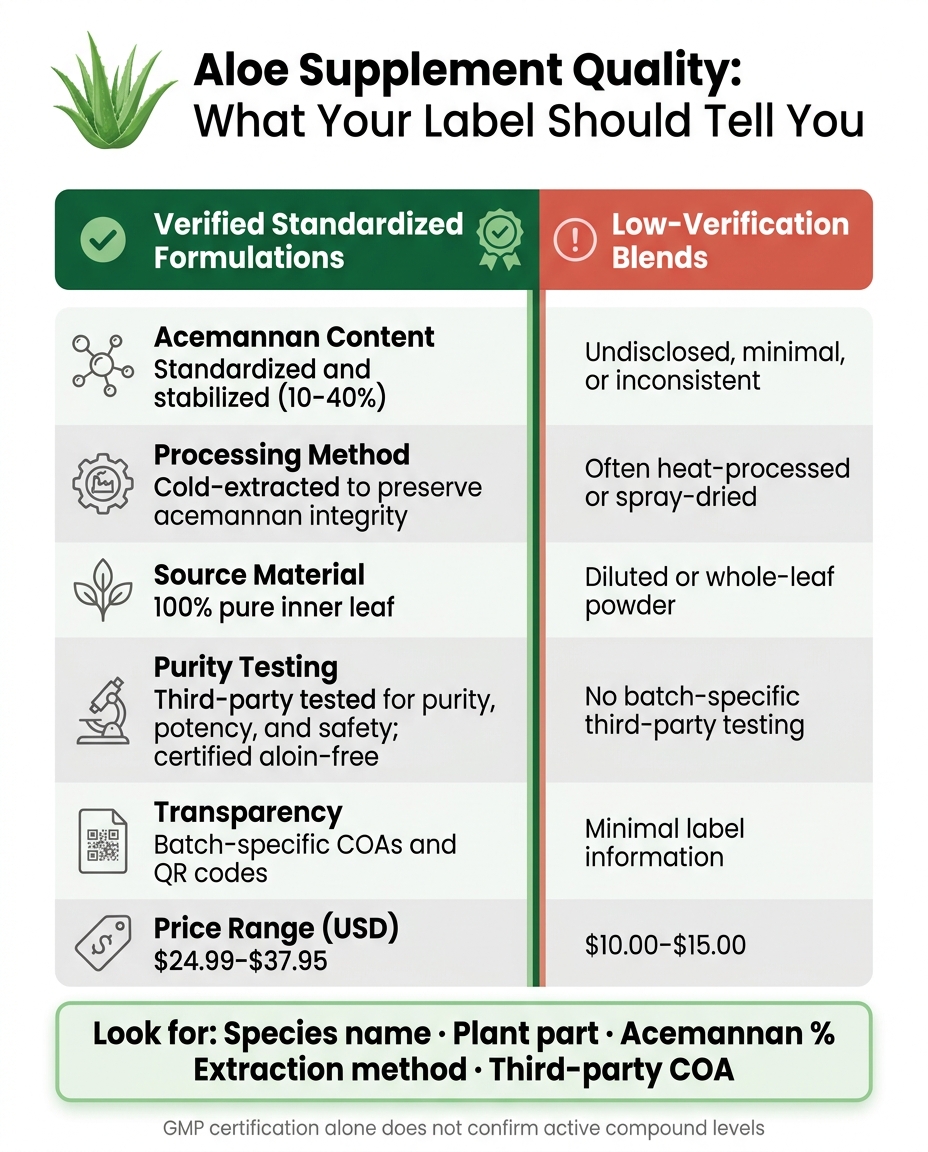
Aloe Supplement Quality Tiers: Verified vs. Low-Verification Labels
The gap here is easy to spot. Verified aloe formulations tell you what’s in the bottle. Low-verification blends usually don’t.
A verified formula lists things like standardized acemannan, the extraction method, and third-party testing. Low-verification blends often skip those details. And that matters, because if a label doesn’t show the basics, you’re left guessing.
Here’s the side-by-side view:
| Feature | Verified Standardized Formulations | Low-Verification Blends |
|---|---|---|
| Acemannan Content | Standardized and stabilized (e.g., 10–40%) | Undisclosed, minimal, or inconsistent |
| Processing Method | Cold-extracted to preserve acemannan integrity | Often heat-processed or spray-dried |
| Source Material | 100% pure inner leaf | Diluted or whole-leaf powder |
| Purity Testing | Third-party tested for purity, potency, and safety; certified aloin-free | No batch-specific third-party testing |
| Transparency | Batch-specific COAs and QR codes | Minimal label information |
| Price Range (USD) | $24.99–$37.95 | $10.00–$15.00 |
Yes, verified formulations cost more upfront. But you’re paying for something you can check: a stated acemannan percentage, a disclosed extraction method, and independent lab results you can look up.
Without standardization data, there’s no solid way to tell if the acemannan is intact, broken down, or present in any meaningful amount.
Conclusion: What Actually Signals Real Aloe Supplement Value
After the comparison above, the buying test is pretty simple: read the label for the species, plant part, acemannan amount, and processing method.
Use the checklist below to tell the difference between a label that says something and a label that just sounds nice.
| Label Marker | What to Look For | Why It Matters |
|---|---|---|
| Species / Plant Part | Aloe barbadensis Miller, inner-leaf gel | Confirms the right aloe source and helps avoid aloin |
| Acemannan Quantity | A standardized mg amount or percentage per serving | Shows how much of the active compound you're actually getting |
| Serving Size | Standardized amount per serving | Lets you compare the dose directly |
| Processing / Research Match | Cold-extracted and aligned with studied acemannan handling | Helps preserve the active structure the research is based on |
| Finished-Product Testing | Third-party batch testing; GMP-certified or NSF-certified facility | Supports potency and purity claims |
| Contaminant Controls | Aloin-free and heavy metal tested | Lowers the risk of laxative effects and contamination |
| Lot & Expiration | Lot number and expiration date on the label | Improves freshness and traceability |
These markers support informed immune and antioxidant wellness choices, not disease claims.
If those markers are missing, the label is making promises without the details to support them. You’re left guessing about the species, the dose, and whether the batch was tested. That’s the difference between science-backed aloe and empty labeling.
FAQs
How do I verify a batch-specific COA?
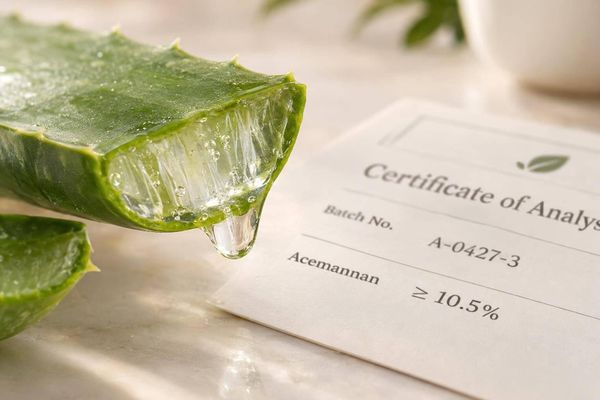
Check for numerical results, not vague terms like “conforms” or “pass.” A solid COA should name the testing lab, ideally ISO/IEC 17025-accredited, and list the test method used, such as NMR, HPLC, or AOAC Official Method 2018.14.
It should also include a numerical acemannan result, a specific aloin A and B result under 10 ppm for oral products, disclose any added carriers like maltodextrin, and confirm Aloe barbadensis Miller. If there’s a QR code, scan it and pull up the document for your batch.
Why is inner-leaf aloe preferred over whole-leaf aloe?
Inner-leaf aloe is the better pick because it’s the natural source of acemannan, the bioactive polysaccharide tied to immune and digestive support.
Whole-leaf aloe includes the outer rind and latex. Inner-leaf gel does not. And that matters because inner-leaf gel is naturally low in aloin, a potent laxative.
The upside is simple: it needs less heavy processing, which helps keep more intact, functional acemannan in the final material.
Does a 200:1 extract ratio prove potency?
No. A 200:1 extract ratio does not prove potency.
Most of the time, that number points to liquid equivalency, not the actual amount of active acemannan.
That matters because a concentration claim is not the same as confirmed bioactive content. It doesn’t tell you the dose. And it doesn’t tell you how well the product may work.
If you want a clearer sign of potency, look for:
- a standardized dry-weight percentage
- a clearly stated milligram amount per serving
- proof backed by a certificate of analysis
Without that, “200:1” is mostly a concentration label, not solid proof of active strength.