Checklist for Using Acemannan to Support Gut Health
Practical checklist for choosing and testing inner-leaf, aloin-free acemannan to support gut comfort, regularity, and safe dosing.


If I want to use acemannan for gut support, I keep it simple: pick a quality inner-leaf, aloin-free product, start with the lowest label dose, and track how I feel for 4 to 8 weeks. This timeframe allows you to monitor the science-backed health benefits of the compound. That covers the big risks and the main use steps in one pass.
Here’s the short version of what matters most:
- Buy the right form: I look for inner-leaf gel only, not whole-leaf aloe.
- Check aloin status: The label should say “aloin-free” or “decolorized.”
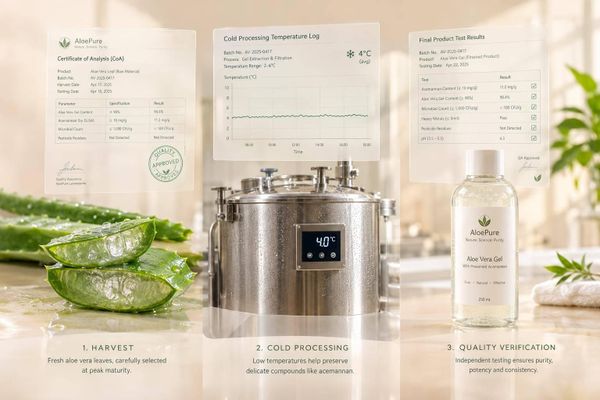
- Check processing: I prefer cold-processed or raw-stabilized products because high heat above 140°F (60°C) can break down acemannan.
- Check the label details: I look for a listed polysaccharide standard, often around 10% to 30%, plus third-party testing.
- Start low: A common starting point is 1 capsule (about 100 to 300 mg) or 1 fl oz (30 mL) of purified inner-leaf juice.
- Take it daily: I stick with one time each day, often with breakfast or before a meal.
- Watch for side effects: Loose stools, cramping, bloating, or diarrhea can mean poor tolerance or a low-quality product.
- Know when to avoid it: I’d check with a clinician first if I’m pregnant, nursing, taking diuretics or laxatives, or if I have kidney or electrolyte issues.
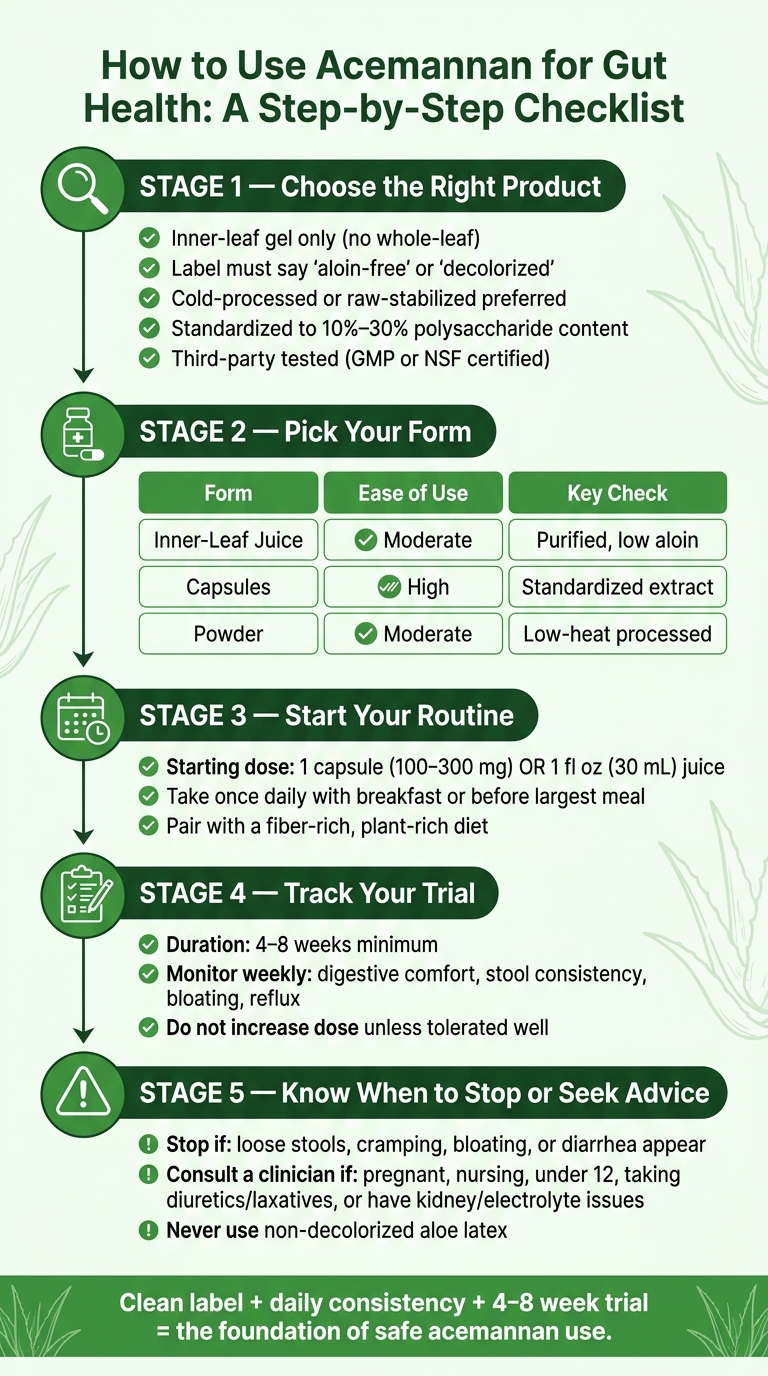
How to Use Acemannan for Gut Health: A Step-by-Step Checklist
Quick comparison
| Form | Best starting use | Main check | Main drawback |
|---|---|---|---|
| Inner-leaf juice | Daily liquid routine | Purified and low aloin | Often needs refrigeration |
| Capsules | Easy daily dosing | Standardized extract | Label quality varies |
| Powder | Mixing into drinks | Low-heat processing | Quality can swing a lot |
Bottom line: I’d only use acemannan if the product is clean, clearly labeled, and easy to take every day. From there, I’d give it a fair trial, keep notes, and stop if my gut feels worse instead of better.
sbb-itb-b88dd21
Checklist for Choosing a Safe Acemannan Product
Before you buy, check the label for three things: source, purity, and testing. Those details usually tell you whether the product is worth your money.
Check Source, Purity, and Aloin Content
Start with the basics. Source, purity, and aloin content do most of the heavy lifting here.
- Choose inner leaf gel only. Skip whole-leaf products.
- Look for purified, low-aloin, or cold-extracted products.
- Check for "aloin-free" or "decolorized" on the label.
- High heat or harsh drying can lower acemannan quality. Cold-extracted or minimally processed products are a better bet.
- Read the "Other Ingredients" section for fillers or starch.
Check Standardization, Testing, and Educational Transparency
“Aloe vera extract” sounds nice, but it doesn’t tell you much. You want a product that says exactly how much acemannan it contains and backs that up with outside testing.
- Look for a clear potency percentage. For example, a product standardized to 18% acemannan gives you a concrete benchmark.
- Check for GMP or NSF certification. Third-party testing helps confirm purity and potency.
Comparison Table: Common Acemannan Forms
Once a product passes the label check, compare the format. The best option is often the one you’ll actually use every day.
| Form | Source Part | Aloin Content | Ease of Use for Gut Health |
|---|---|---|---|
| Inner-Leaf Juice | Inner leaf gel | Low (if purified) | Moderate; requires refrigeration |
| Standardized Capsules | Concentrated inner leaf | Very low / trace | High; shelf-stable and portable |
| Concentrated Powders | Dehydrated inner leaf | Very low | Moderate; must be mixed with liquid |
Capsules are often the easiest pick for daily gut support. They’re shelf-stable, simple to dose, and they sidestep the taste issue that turns some people off juice.
Powders can pack a lot into a small serving and blend well into smoothies. You can also pair them with foods that boost acemannan's benefits to maximize the effect. That said, quality can swing quite a bit depending on how the product was extracted and dried.
Checklist for Building a Daily Acemannan Routine
If the label looks good, use this routine to test tolerance and see how your body responds. Give acemannan 4 to 8 weeks of daily use before you decide whether it’s helping.
Start Low and Follow Label Guidance
Start with the lowest serving listed on the label. That’s often 1 fl oz (30 mL) of purified inner-leaf juice or 1 capsule of a standardized extract, usually around 100–300 mg.
If that goes smoothly, you can increase a little only if needed and do it slowly. More isn’t always better. In some people, higher amounts can lead to loose stools, diarrhea, or abdominal cramping.
Take It With Meals and Track Your Trial Period
Pick one time each day and stay consistent. A simple starting point is the lowest label dose: 1 fl oz (30 mL) of juice or 1 capsule (about 100–300 mg). Take it with breakfast or before your biggest meal. If needed, split the dose between morning and evening.
It also makes sense to pair it with a fiber-rich, plant-rich diet. That gives you a steadier base when you’re trying to notice changes.
Stay with the routine for at least 4 to 8 weeks before judging results.
Sample Routine Table for Different Starting Points
Use the table below to line up your dose, timing, and trial length with your starting point.
| Profile | Starting Dose Range | Timing With Meals | Suggested Trial Duration | Key Monitoring Points |
|---|---|---|---|---|
| Beginner / General Wellness | 1 capsule daily | Morning with water or breakfast | 4–8 weeks | Digestive comfort, energy levels |
| Digestive Support Focus | 1–2 fl oz (30–60 mL) daily | Morning on an empty stomach or 20–30 minutes before the largest meal | 4–8 weeks | Stool regularity, bloating, reflux |
| Structured Trial | 100–300 mg daily | Split: morning and evening | 8 weeks | Bloating, stool changes, tolerance |
Track things week by week in a simple phone note. Write down shifts in digestive comfort, stool consistency, bloating, and reflux so you can compare how you feel over time. If cramps, loose stools, or other signs of intolerance show up, stop sooner.
Checklist for Safety, Tolerance, and When to Stop
Once you've picked a product and started with a low dose, use this safety check to decide if it makes sense to keep going. Run through it before your first oral dose and again before any dose increase.
Check for Contraindications Before Use
Start by checking whether you fall into any of these groups before use.
| Group | Recommendation |
|---|---|
| Pregnant or nursing | Consult a healthcare professional before oral use |
| Children under 12 | Oral use not recommended |
| Kidney or electrolyte issues | Avoid use |
| Taking diuretics or laxatives | Consult a healthcare professional |
| A chronic or medical condition | Verify safety with a provider |
Never use non-decolorized aloe latex. Aloin can trigger strong laxative effects and digestive upset.
Watch for Signs of Intolerance and Product Quality Issues
During the first 2 to 4 weeks, pay close attention to any new or worse digestive symptoms. Loose stools, cramping, bloating, or diarrhea can point to poor tolerance or aloin contamination.
If symptoms show up, stop use and check the label. Then switch to inner-leaf, decolorized, purified, aloin-free products. It also helps to confirm third-party testing for microbes and heavy metals.
If the product causes symptoms, stop and reassess the label, dose, or whether you need to use it at all.
Conclusion: A Simple Checklist for Long-Term Gut Support
Acemannan tends to work best when you use it every day, not once in a while. It helps support resident microbes, short-chain fatty acid production, and barrier function.
To keep things simple, use this checklist before you start or as you continue.
Core Steps to Remember
Keep these five checks in mind before starting or sticking with a routine.
| Step | What to Check |
|---|---|
| Source | Inner-leaf only; avoid whole-leaf powders |
| Quality | Cold-extracted; standardized to 10%–30% polysaccharide content |
| Safety | Aloin-free or decolorized; third-party tested |
| Routine | Daily serving, morning or before meals, at 100–300 mg extract or 1–2 fl oz juice |
| Monitoring | Track comfort and regularity for 4–8 weeks before evaluating results |
If you want more background, Advanced Acemannan Supplement goes into the science behind acemannan sourcing, standardization, and best practices.
FAQs
How do I know if an acemannan product is truly aloin-free?
Look for supplements labeled 100 percent pure inner leaf gel and aloin-free. That usually means the product uses the part of the aloe plant people want, without much of the outer rind.
Skip whole-leaf powder when you can. It often includes more of the outer rind, which is where aloin is found.
It also helps to check for third-party testing for purity and potency. Standardization matters too, since it points to more consistent quality from one batch to the next.
What changes should I track during a 4- to 8-week trial?
Track changes in digestive comfort and overall consistency during a 4- to 8-week acemannan trial.
Pay attention to changes in bloating, abdominal comfort, and regularity. You may also notice shifts in your digestive system’s natural rhythm and balance over time.
Advanced Acemannan provides educational content on the science and best practices for using acemannan, so you can better understand what these changes may mean.
Should I stop right away if acemannan causes bloating or loose stools?
Not necessarily. Start by checking the product you’re taking. Digestive upset is often tied to anthraquinones found in the aloe leaf’s outer rind.
Look for a high-quality, cold-extracted supplement made only from the inner leaf gel. That kind of formula leaves out the harsh latex compounds that can trigger these side effects. If the symptoms keep going after you switch, talk to a healthcare provider.