Heat Effects on Acemannan Structure
Low-heat processing preserves acemannan acetyl groups: ~60°C limits deacetylation; 80°C+ and spray-drying cause major loss.

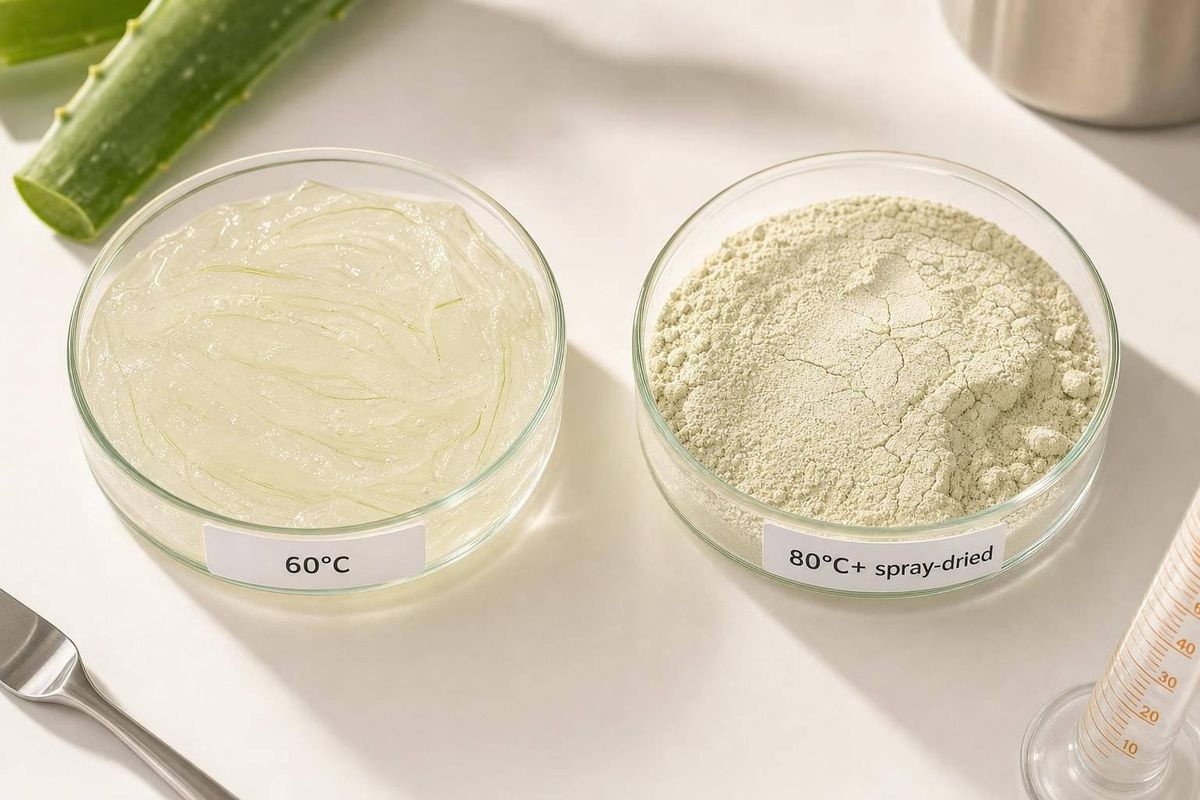
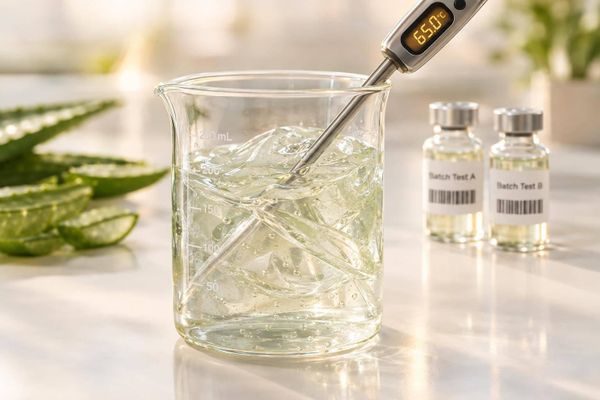
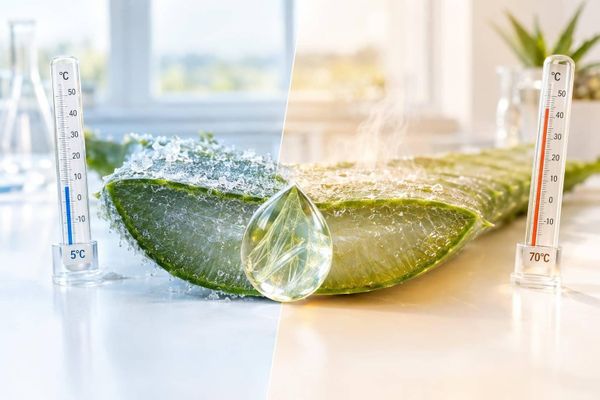
Heat can strip acemannan of the acetyl groups tied to its activity. If Aloe vera is processed around 140 °F (60 °C), damage stays lower. But at 176 °F (80 °C) and up, deacetylation can go past 46%, and some drying methods can cut acetylation by about 52% to 70%.
If I want acemannan for immune and gut support, the main takeaway is simple: processing temperature and drying method matter as much as the ingredient name on the label. Lower heat helps keep the structure closer to its original form, while harsher heat can lower viscosity, shift molecular size, and weaken how the compound works.
Here’s the short version:
- Best heat range: about 140–158 °F (60–70 °C)
- At 140 °F (60 °C): deacetylation is about 14%
- At 176 °F (80 °C)+: deacetylation goes above 46%
- Dry heat at 176 °F (80 °C): linked to more cell toxicity than humid heat
- Spray-drying: causes the biggest acetylation loss, at about 70%
- What changes with heat: acetyl groups, viscosity, chain arrangement, and measured molecular weight
- Why it matters: less intact acemannan may mean weaker immune signaling and less gut fermentation support
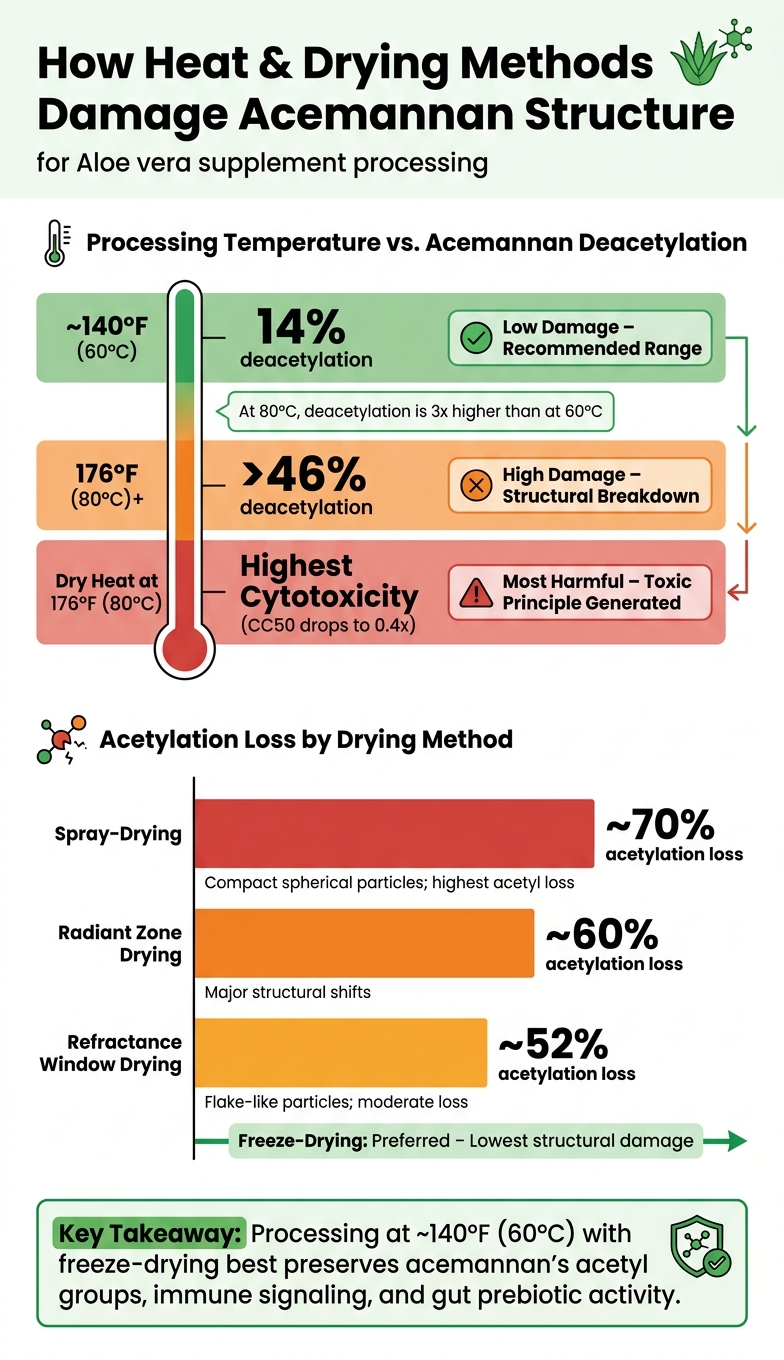
How Heat & Drying Methods Damage Acemannan Structure
Quick comparison
| Processing condition | What happens to acemannan | What it means |
|---|---|---|
| ~140 °F (60 °C) | About 14% deacetylation | More of the structure stays in place |
| 176 °F (80 °C)+ | >46% deacetylation | Bigger structural change |
| Dry heat at 176 °F (80 °C) | More cytotoxic than humid heat | Harsher processing outcome |
| Spray-drying | ~70% acetylation loss | Biggest drop in acetyl groups |
| Radiant zone drying | ~60% acetylation loss | Major structural shift |
| Refractance window drying | ~52% acetylation loss | Somewhat less damage, but still clear loss |
So if I’m judging how to choose a quality acemannan supplement, I’d look past the front label and ask a better question: Was the acemannan kept intact during processing?
sbb-itb-b88dd21
What Studies Show at Different Heat Levels
Research points to a clear pattern: processing temperature has a big effect on how much acemannan structure stays in place.
Moderate Heating Around 140–158 °F (60–70 °C)
Processing in the 140–158 °F (60–70 °C) range is recommended for preserving acemannan structure. At 140 °F (60 °C), deacetylation stays at 14%. That’s a fairly small shift, which means most of the structure still holds up.
One study recommends processing near 60 °C to preserve acemannan structure, bioactivity, and low cytotoxicity. At 60 °C, toxicity also stays low, with cell toxicity remaining low at CC50 1.1x. For supplement processing, this range offers a practical middle ground. You get enough heat to handle the gel, but without the steeper damage linked to harsher processing.
The next section shows what starts to happen when temperatures move higher.
Higher Heating at 176 °F (80 °C) and Above
Once temperatures reach 176 °F (80 °C), things shift fast. Deacetylation rises above 46%, which is more than three times the rate seen at 140 °F.
"At temperatures of 80 °C or higher, structural changes in acemannan, especially its deacetylation (>46%), are triggered, which does not happen at lower temperatures (14% at 60 °C)."
Dry heat at this level generates a toxic principle that increases cytotoxicity in human intestinal cells, dropping the CC50 to 0.4x. Humid heat at the same temperature does less damage, with a CC50 of 1.6x, but it still triggers clear changes. For supplements, that means less intact acemannan left for immune and gut support. (Certain foods can also boost these gut benefits).
Drying Methods and Extended Heat Exposure
Heat level isn’t the only issue. Drying method matters too. The way acemannan is dried affects acetylation loss and how well the structure holds together.
| Drying Method | Acetylation Loss | Structural Effect |
|---|---|---|
| Spray-Drying | ~70% | Compact spherical particles; high acetyl loss |
| Radiant Zone Drying | ~60% | Major structural shifts |
| Refractance Window Drying | ~52% | Flake-like particles; moderate acetyl loss |
As researchers at Dalian Medical University noted:
"Drying conditions can alter acemannan's yield, structure, and bioactivity."
Spray-drying leads to the highest acetylation loss, at around 70%. That shrinks the surface area available for biological interaction. These processing effects set up the structural changes covered next.
How Heat Changes Acemannan's Structure
Heat doesn’t just warm acemannan up. It changes the molecule itself.
Deacetylation and Loss of Functional Groups
The main change researchers report is deacetylation. In plain English, heat removes O-acetyl groups from the acemannan backbone. When that happens, the molecule becomes less water-attracting, and its biological activity drops.
In its natural state, acemannan has about a 1:1 acetyl-to-mannose monomer ratio. Once heat strips away those acetyl groups, the chain behaves differently. It can also change the size researchers measure in lab testing.
Molecular Weight, Viscosity, and Chain Rearrangement
One study found that the measured average molecular weight shifted from 45 kDa to 81 kDa after heat treatment. That kind of change points to shifts in composition and chain structure, not just simple moisture loss or routine processing effects.
Heat also changes how the chains are arranged. Acemannan can move from a loose, irregular chain structure to a denser form with lower biological activity. That matters because structure affects function.
Viscosity drops too. Higher acetylation helps support viscosity and thermal stability, so when those groups are lost, the polymer shows weaker gel-like behavior. On the surface level, the material changes as well, going from porous and sponge-like to denser and flatter.
Researchers check these shifts with lab tools such as spectroscopy, chromatography, and imaging methods.
How Researchers Measure These Changes
These methods show whether acemannan still has the structure linked to bioactivity.
| Analytical Method | What It Measures | Why It Matters |
|---|---|---|
| FTIR (Fourier-transform infrared) | O-acetyl functional groups | Main tool for detecting deacetylation |
| NMR (Nuclear Magnetic Resonance) | O-acetyl group position and degree of acetylation | Confirms deacetylation and structural state |
| SEC/HPLC | Molecular weight distribution and sugar composition | Tracks homogeneity and molecular weight shifts |
| Viscosity Testing | Rheological properties and chain length | Reflects gel behavior and water retention capacity |
| SEM (Scanning Electron Microscopy) | Surface morphology and porosity | Shows changes in the matrix structure |
FTIR shows whether O-acetyl groups are still present. NMR checks where those acetyl groups sit and helps confirm the overall structure. Put together, these findings help explain why heat can reduce immune and gut support.
Why Structural Changes Affect Immune and Gut Support
Structural changes can change how acemannan works in the body. When heat strips away acetyl groups or alters the chain structure, acemannan doesn't behave the same way. And that matters for both immune and gut support.
Immune Activity Depends on Structural Integrity
Acemannan supports immune function by interacting with immune receptors tied to macrophage activity and cytokine signaling. The acetyl groups help the molecule keep the shape it needs for receptor binding. Once heat removes those groups, that signaling gets weaker.
Adequate acetylation is required for TLR2 signaling, and intact acemannan also supports macrophage activation through the PI3K/Akt/GSK-3β pathway, which promotes phagocytosis. When the structure breaks down, that effect drops off. That's the core reason processing temperature matters.
Gut Support Is Also Sensitive to Processing
The same pattern shows up in the gut. Intact acemannan acts as a prebiotic, stimulating helpful bacteria and increasing acetate concentrations during fermentation. But that effect depends on the molecule staying intact.
If heat degrades acemannan, its prebiotic effect weakens. Support for acetate-producing bacteria drops too. So this isn't just a chemistry detail on paper - it changes what the ingredient can do.
Preserved vs. Heat-Degraded Acemannan: A Comparison
| Feature | Preserved Acemannan | Heat-Degraded Acemannan |
|---|---|---|
| Immune Signaling | Strong receptor signaling and macrophage activation | Reduced receptor signaling |
| Gut Fermentation | Effective prebiotic; supports acetate production | Reduced prebiotic efficacy |
| Physical Stability | Higher viscosity; retains gel-like behavior | Lower viscosity; structural breakdown |
Next, the processing details show how manufacturers can preserve that activity.
Processing Takeaways and Conclusion
Processing Conditions That Help Preserve Bioactivity
Research points to a pretty clear temperature line: drying Aloe gel at about 140 °F (60 °C) helps preserve acemannan's structure and bioactivity. Once heat climbs, things start to change. Among common drying methods, spray-drying leads to the greatest acetyl loss. And at 176 °F (80 °C), humid heat does less harm than dry heat, while dry heat produces the highest cytotoxic effect.
Put simply: lower heat helps protect function.
What This Means for Readers Focused on Wellness
This matters because acemannan's wellness value depends on its structure staying intact. If you're looking at acemannan for immune and gut support, the main thing to ask is simple: Did processing preserve its acetyl groups and bioactivity?
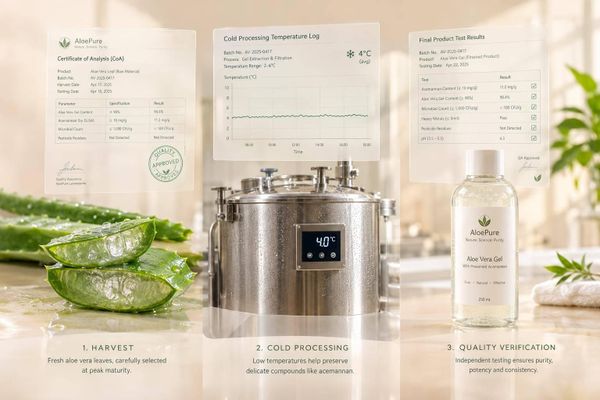
That’s why low-heat or cold-processed products make more sense here. It also helps when manufacturers disclose the finished product’s acetylation level. Without that, you’re left guessing.
So when comparing products, look for:
- Low-heat processing
- Disclosed acetylation levels
- Drying methods that are less harsh, such as freeze-drying
Key Takeaways
| Finding | Detail |
|---|---|
| 140 °F (60 °C) is the safer ceiling | Limits deacetylation to ~14%; preserves bioactivity |
| 176 °F (80 °C) and above can cause real damage | Deacetylation exceeds 46%; dry heat raises cytotoxicity |
| Drying method affects acetylation | Spray-drying can reduce acetylation by up to 70%; freeze-drying is preferable |
| Structure = function | Preserving acemannan's structure helps retain immune and gut bioactivity |
FAQs
How can I tell if acemannan was low-heat processed?
Check its degree of acetylation. Acemannan gets much of its activity from its acetyl groups, so low-heat processing matters.
Once temperatures hit 176 °F (80 °C) or more, acemannan can break down in a big way, often with deacetylation above 46%. At 140 °F (60 °C), deacetylation is usually far lower, at around 14%, which helps keep the quality of supplements used for immune and gut support.
Why do acetyl groups matter for immune and gut support?
Acetyl groups matter because they shape acemannan’s bioactivity and physical traits, which help support immune function and gut health.
When acetylation is higher, acemannan is better able to promote macrophage activation, cytokine production, and phagocytic activity. Put simply, those acetyl groups help the compound do its job.
When acemannan goes through deacetylation and loses those groups, its effects start to weaken. It becomes less effective at stimulating cell proliferation, and its water solubility and structure can shift as well.
Is freeze-dried acemannan better preserved than heat-dried?
Yes. Freeze-dried acemannan is usually preserved better than heat-dried acemannan.
Research shows that processing at 80°C (176°F) or higher can cause major structural changes, especially deacetylation. That matters because acetylation helps maintain acemannan’s bioactivity, immunostimulatory effects, and structural integrity.
So if supplement quality matters, avoiding high heat is a smart move, especially for immune and gut support.