The Best Questions to Ask Before Buying an Aloe Vera Supplement
8 essential questions to verify aloe plant part, acemannan amount, aloin testing, lab COA, research-based dose, safety, and interactions.

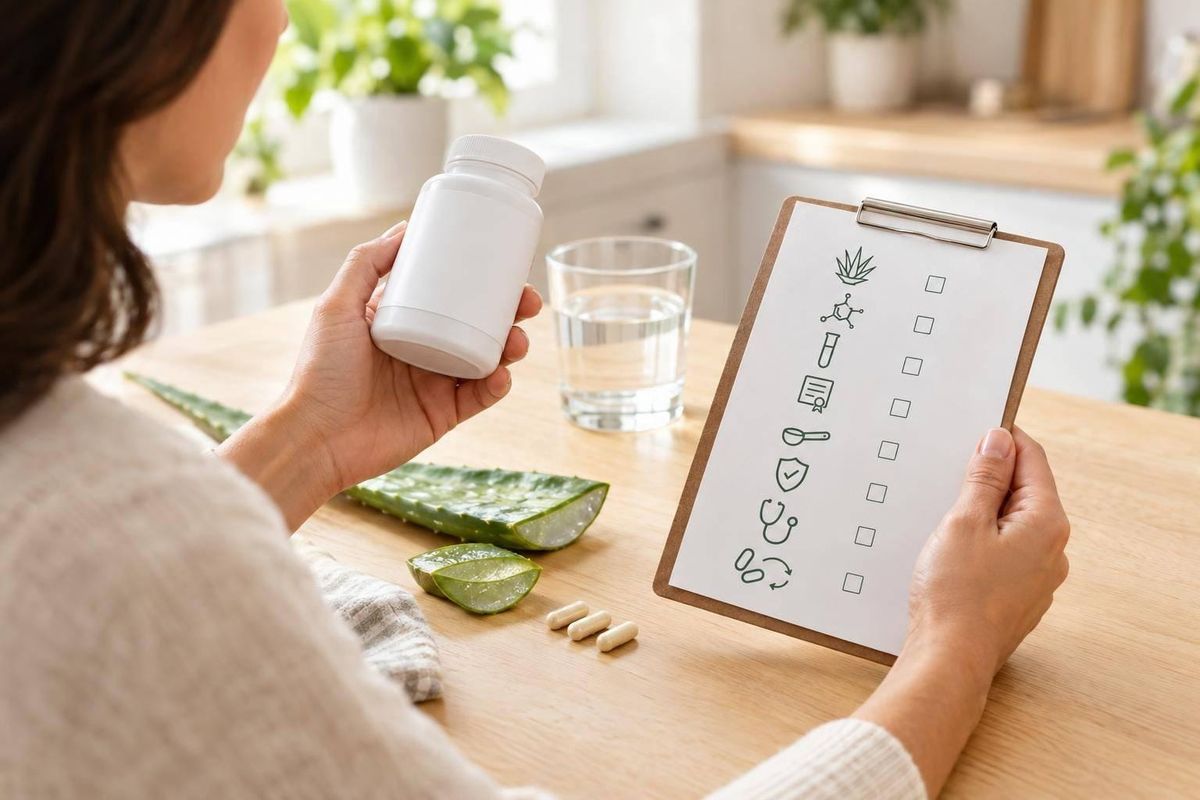
Before I buy an aloe vera supplement, I want proof of what’s in it - not just promises on the bottle. I start with the label and a test report for the bottle’s lot. Supplements aren’t FDA-approved for safety and effectiveness before sale.
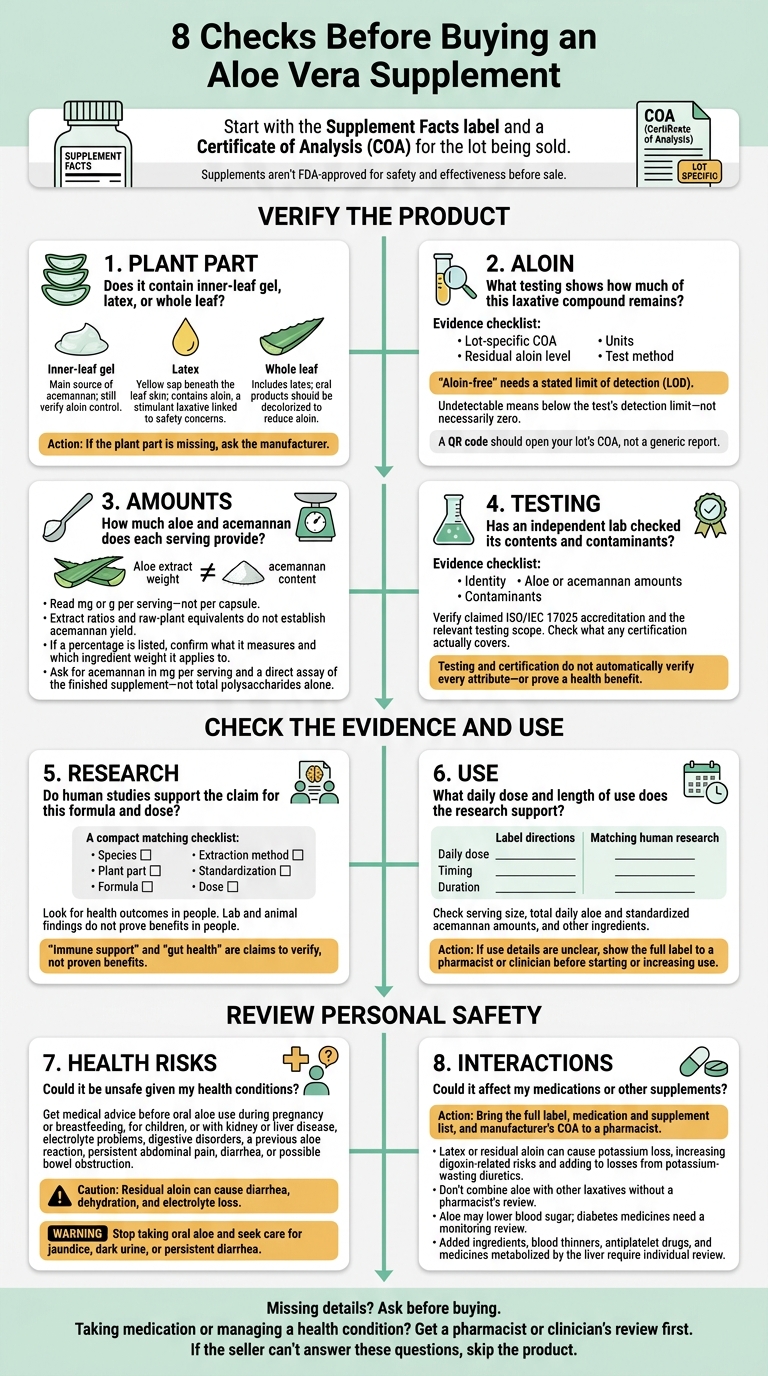
Here are the 8 questions I use to check a product:
- Plant part: Does it contain inner-leaf gel, latex, or whole leaf?
- Aloin: What testing shows how much of this laxative compound remains?
- Amounts: How much aloe and acemannan - the main polysaccharide in inner-leaf gel - does each serving provide? (See acemannan's science-backed health benefits)
- Testing: Has an independent lab checked its contents and contaminants?
- Research: Do human studies support the claim for this formula and dose?
- Use: What daily dose and length of use does the research support?
- Health risks: Could it be unsafe given my health conditions?
- Interactions: Could it affect my medications or other supplements?
My rule: “aloe extract” doesn’t tell me the acemannan amount, and “aloin-free” needs a stated test detection limit. If those details are missing, I ask for them before buying. <u>If I take medication or have a health condition, I get a pharmacist or clinician’s review first.</u>
8 Checks Before Buying an Aloe Vera Supplement
3 People Who Should Avoid Aloe Vera | Is Aloe Vera Safe for Everyone?
sbb-itb-b88dd21
Read the Label Before Comparing Supplements
Start with the Supplement Facts panel. Check the serving size and aloe amount per serving. A serving may be measured in capsules or, for liquids, in fl oz or mL. Read aloe amounts in mg or g per serving - not per capsule.
Next, check the aloe ingredient name, plant part, and product form. The label should specify inner leaf or whole leaf, which helps you judge whether the product is a suitable acemannan source. “Aloe extract” alone does not tell you its acemannan content. Check Other Ingredients for capsule materials, fillers, and flow agents. Hypromellose (HPMC) means the capsule shell is plant-based.
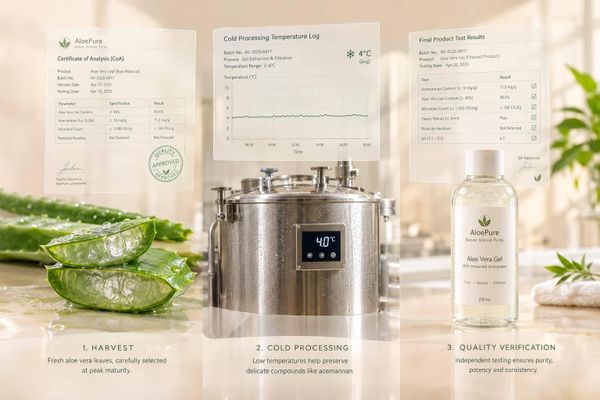
Look for a lot number and expiration date, then ask for a Certificate of Analysis (COA) for the lot being sold. A QR code matters only if it links to that lot’s COA. After checking the label, use the questions below to compare products more closely.
Supplements are not FDA-approved for safety and effectiveness before sale. FDA disclaimers do not prove safety, effectiveness, or benefit claims. That makes the next question important: which part of the aloe plant is in the supplement?
1. Does it contain inner-leaf gel, latex, or whole leaf?
Next, check which part of the plant the label names. Inner-leaf gel is the main source of acemannan and the part most often used in oral aloe supplements.
Aloe latex is the yellow sap beneath the leaf skin. It contains aloin, a stimulant laxative linked to safety concerns in oral supplements.
For whole-leaf products, processing matters. Whole-leaf extract uses the entire leaf, including the latex. Oral products should be decolorized to reduce aloin.
If the label doesn't name the plant part, ask the manufacturer which part it uses and whether it removes the latex. 100% Pure Inner Leaf tells you the source, but you should still ask for proof that aloin is controlled or removed.
2. What testing confirms aloin removal or control?
Once you know which plant part was used, check whether processing controlled aloin. A “purified” claim isn’t enough. Ask how processing reduced aloin and request the measured amount remaining.
Request the certificate of analysis (COA) for your bottle’s lot. It should show the residual aloin level, the units, and the lab’s test method - not just a pass/fail result.
For an “aloin-free” claim, ask for the lab’s limit of detection (LOD). An undetectable result only means the amount was below that limit. The report needs to state the exact detection limit.
If the packaging includes a QR code for test results, check that it opens your lot’s COA rather than a generic report. If the report doesn’t match the batch, treat the QR code as marketing, not proof.
3. What do the aloe and acemannan amounts mean?
Once you’ve checked the plant part and aloin status, look at what the label’s numbers measure. Aloe vera weight is not the same as acemannan content. Acemannan is the main polysaccharide in inner-leaf gel, so check whether the label lists aloe weight or acemannan per serving.
Raw-plant equivalents and extract ratios describe how much plant material went in or how concentrated an extract is. They don’t tell you the acemannan yield.
Look for a stated acemannan amount, not just the total weight of aloe vera extract. If the label lists a percentage, check whether it means acemannan or total polysaccharides - and which ingredient weight that percentage applies to. Percentages, extract ratios, and milligrams aren’t interchangeable.
Ask for the assay method used to measure acemannan. Also confirm that testing covered the finished supplement and measured acemannan directly, rather than total polysaccharides alone. Without that measurement, the amount you’ll take remains unconfirmed - a distinction to check before comparing products or trusting benefit claims.
4. Does independent testing verify purity and label accuracy?
After checking the aloe source, aloin control, and ingredient amounts, look at who tested the product - and what they tested. A useful certificate of analysis (COA) should include identity testing, aloe or acemannan amounts, and contaminant results.
If a lab claims ISO/IEC 17025 accreditation, verify it and check that its accredited testing scope covers the tests in the report. Independent lab reports and certification seals offer different types of assurance.
Manufacturer testing supports internal quality control. Independent labs verify only the tests they perform. Third-party certifications audit facilities and processes, but may not check every ingredient claim. None automatically checks every attribute.
Certifications such as GMP and NSF indicate facility and process standards. Look beyond the logo: verify the certification’s scope and whether it covers acemannan testing.
Testing can support identity, purity, and label accuracy. It does not prove that a supplement will treat or cure a condition. Once those quality checks are covered, examine whether research supports the advertised benefit.
5. What research supports the advertised benefits?
Ask for human clinical trials that test the specific benefit claimed. Lab and animal studies can suggest how an ingredient might work, but they don’t prove it works in people.
Then check whether the research matches the product you’re buying: its species, plant part, extraction method, standardization, formula, and dose. Processing can change acemannan, so the same ingredient name isn’t enough.
Look for health outcomes in people, not just lab activity, in studies of the supplement’s specific form. Findings on gut fermentation, immune cells, or signaling molecules don’t prove better digestion or stronger immunity in people.
Treat “immune support” and “gut health” as claims to verify, not proven benefits.
Ask what the study measured, what dose it used, and how long it lasted. If the research matches the product, ask how much to take and for how long - and check both before buying.
6. How much should I take, and for how long?
Use the research to work out the daily dose and how long to take it. Check both the serving size and the total daily dose. Find out how much aloe extract and standardized acemannan each dose contains, plus what else is included.
Then compare the label’s recommended dose and duration with the research. Do they match?
If the dose, timing, or duration isn’t clear, show the full label to a pharmacist or clinician before starting or increasing use.
7. Could my health conditions make it unsafe?
After checking the dose, review your personal health risks. Don’t use oral aloe without medical advice if you’re pregnant, breastfeeding, giving it to a child, or have kidney or liver disease, electrolyte problems, a digestive disorder, a previous aloe reaction, persistent abdominal pain, diarrhea, or a possible bowel obstruction.
Products that may still contain aloin carry a higher risk. Diarrhea can cause dehydration and electrolyte loss, especially if you already have kidney or electrolyte problems. Choose products with clear aloin control.
Stop taking oral aloe and seek care if you develop jaundice, dark urine, or persistent diarrhea. Next, check for medication and supplement interactions.
8. Could it interact with my medications or supplements?
Even if the product is otherwise right for you, check whether it interacts with anything you already take. Before starting, ask a pharmacist to review the full formula. Bring the Supplement Facts label, your medication and supplement list, and the manufacturer’s COA. Ask them to verify the aloe form and aloin status.
Aloe latex or residual aloin can cause diarrhea and potassium loss. That can increase the risk of digoxin-related problems and add to potassium loss from potassium-wasting diuretics. Don’t combine aloe with other laxatives without a pharmacist’s review.
Aloe may also lower blood sugar. If you take diabetes medicine, ask how often to check your glucose and when to contact your prescriber. Added ingredients, such as berberine or glucomannan, need a separate interaction review. Check these risks before you buy.
Interactions with blood thinners, antiplatelet drugs, and medicines metabolized by the liver need to be checked individually.
Your Checklist Before Buying
Use this checklist to compare products before you buy.
- Check the plant part and aloin test results. The label should say inner-leaf gel or whole leaf - not just “aloe vera.” Ask for a lot-specific test report showing aloin levels.
- Confirm the amount per serving. Look for both the aloe amount and acemannan per serving. If acemannan appears as a percentage, ask for the amount in mg per serving.
- Ask for the lot-specific Certificate of Analysis (COA). Check that an independent party performed the testing.
- Review the evidence, dose, and duration together. Make sure human studies support the claim at the stated dose and duration.
- Read the safety warnings first. Get any missing safety and use details in writing. If you take medications or have a health condition, ask a pharmacist or clinician to review the formula, dose, duration, and interaction risks. If the seller can’t answer these questions, skip the product.